Universität Wien, Fakultät für Chemie, Institut für Biophysikalische Chemie, Althanstraße 14, 1090, Wien, Austria.
Angew Chem Int Ed Engl. 2019 May 27;58(22):7475-7479. doi: 10.1002/anie.201901332. Epub 2019 Apr 17.
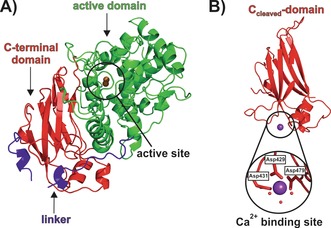
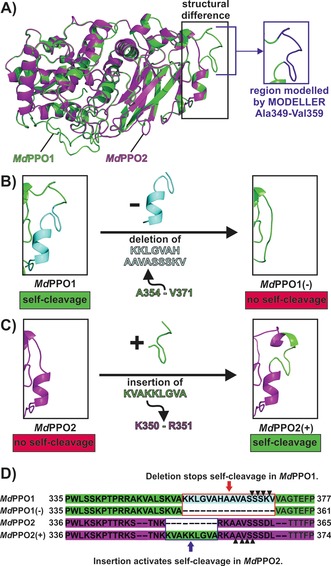
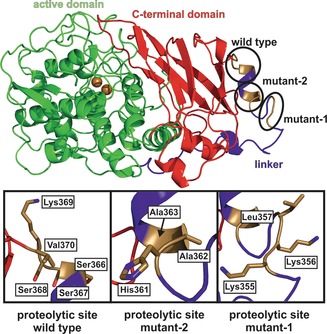
The conversion of inactive pro-polyphenol oxidases (pro-PPOs) into the active enzyme results from the proteolytic cleavage of its C-terminal domain. Herein, a peptide-mediated cleavage process that activates pro-MdPPO1 (Malus domestica) is reported. Mass spectrometry, mutagenesis studies, and X-ray crystal-structure analysis of pro-MdPPO1 (1.35 Å) and two separated C-terminal domains, one obtained upon self-cleavage of pro-MdPPO1 and the other one produced independently, were applied to study the observed self-cleavage. The sequence Lys 355-Val 370 located in the linker between the active and the C-terminal domain is indispensable for the self-cleavage. Partial introduction (Lys 352-Ala 360) of this peptide into the sequence of two other PPOs, MdPPO2 and aurone synthase (CgAUS1), triggered self-cleavage in the resulting mutants. This is the first experimental proof of a self-cleavage-inducing peptide in PPOs, unveiling a new mode of activation for this enzyme class that is independent of any external protease.
无活性的原多酚氧化酶(pro-PPOs)转化为活性酶是通过其 C 端结构域的蛋白水解切割实现的。本文报道了一种肽介导的切割过程,可激活原 MdPPO1(苹果)。采用质谱分析、突变研究以及 pro-MdPPO1(1.35Å)和两个分离的 C 端结构域的 X 射线晶体结构分析,对观察到的自我切割进行了研究。位于活性和 C 端结构域之间连接体上的序列 Lys355-Val370 对自我切割是必不可少的。将该肽的一部分(Lys352-Ala360)引入另外两种 PPO,即 MdPPO2 和查尔酮合酶(CgAUS1)的序列中,导致突变体中的自我切割。这是 PPO 中自我切割诱导肽的首次实验证明,揭示了该酶类的一种新的激活方式,不依赖任何外切蛋白酶。