RAND Corporation, Pittsburgh, PA.
RAND Corporation, Arlington, VA.
J Am Med Dir Assoc. 2019 Apr;20(4):503-508.e1. doi: 10.1016/j.jamda.2019.01.120. Epub 2019 Mar 1.
Trends over time in the United States show success in rebalancing long-term services and supports (LTSS) toward increased home- and community-based services (HCBS) relative to institutionalized care. However, the diffusion and utilization of HCBS may be inequitable across rural and urban residents. We sought to identify potential disparities in rural HCBS access and utilization, and to elucidate factors associated with these disparities.
We used qualitative interviews with key informants to explore and identify potential disparities and their associated supply-side factors.
We interviewed 3 groups of health care stakeholders (Medicaid administrators, service agency managers and staff, and patient advocates) from 14 states (n = 40).
Interviews were conducted using a semistructured interview guide, and data were thematically coded using a standardized codebook.
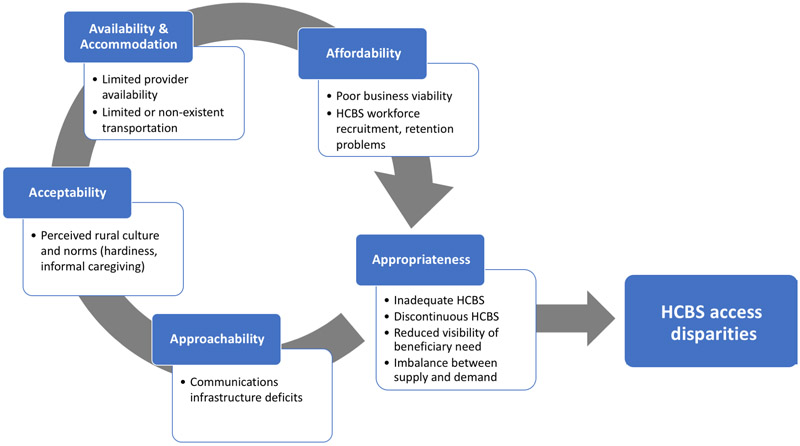
Stakeholders identified supply-side factors inhibiting rural HCBS access, including limited availability of LTSS providers, inadequate transportation services, telecommunications barriers, threats to business viability, and challenges to caregiving workforce recruitment and retention. Stakeholders perceived that rural persons have a greater reliance on informal caregiving supports, either as a cultural preference or as compensation for the dearth of HCBS.
CONCLUSIONS/IMPLICATIONS: LTSS rebalancing efforts that limit the institutional LTSS safety net may have unintended consequences in rural contexts if they do not account for supply-side barriers to HCBS. We identified supply-side factors that (1) inhibit beneficiaries' access to HCBS, (2) affect the adequacy and continuity of HCBS, and (3) potentially impact long-term business viability for HCBS providers. Spatial isolation of beneficiaries may contribute to a perceived lack of demand and reduce chances of funding for new services. Addressing these problems requires stakeholder collaboration and comprehensive policy approaches with attention to rural infrastructure.
美国的时间趋势表明,在长期服务和支持(LTSS)方面取得了成功,相对于机构化护理,更多地转向了家庭和社区为基础的服务(HCBS)。然而,HCBS 的普及和利用可能在农村和城市居民之间存在不平等。我们试图确定农村 HCBS 获得和利用方面的潜在差异,并阐明与这些差异相关的因素。
我们使用与关键信息提供者的定性访谈来探索和确定潜在的差异及其相关的供应方因素。
我们采访了来自 14 个州的 3 组医疗保健利益相关者(医疗补助管理人员、服务机构经理和工作人员以及患者倡导者)(n=40)。
访谈采用半结构化访谈指南进行,数据使用标准化的代码簿进行主题编码。
利益相关者确定了抑制农村 HCBS 获得的供应方因素,包括 LTSS 提供者的有限可用性、交通服务不足、电信障碍、对企业生存能力的威胁以及对护理人员招聘和保留的挑战。利益相关者认为,农村人更多地依赖非正式的护理支持,无论是作为文化偏好还是作为 HCBS 匮乏的补偿。
结论/含义:如果 LTSS 再平衡努力不考虑 HCBS 的供应方障碍,限制机构 LTSS 安全网可能会对农村环境产生意想不到的后果。我们确定了供应方因素,这些因素(1)抑制了受益人获得 HCBS 的机会,(2)影响了 HCBS 的充足性和连续性,(3)可能影响 HCBS 提供者的长期商业可行性。受益人的空间隔离可能导致对需求的感知不足,并减少为新服务提供资金的机会。解决这些问题需要利益相关者的合作和全面的政策方法,关注农村基础设施。