Thrasher James F, Anshari Dien, Lambert-Jessup Victoria, Islam Farahnaz, Mead Erin, Popova Lucy, Salloum Ramzi, Moodie Crawford, Louviere Jordan, Lindblom Eric N
Professor, Department of Health Promotion, Education & Behavior, Arnold School of Public Health, University of South Carolina, Columbia, SC.
Assistant Professor, Faculty of Public Health, University of Indonesia, Depok, Indonesia.
Tob Regul Sci. 2018 Mar;4(2):73-87. doi: 10.18001/TRS.4.2.7.
Our aim was to identify message characteristics for cigarette pack inserts that aim to help smokers quit.
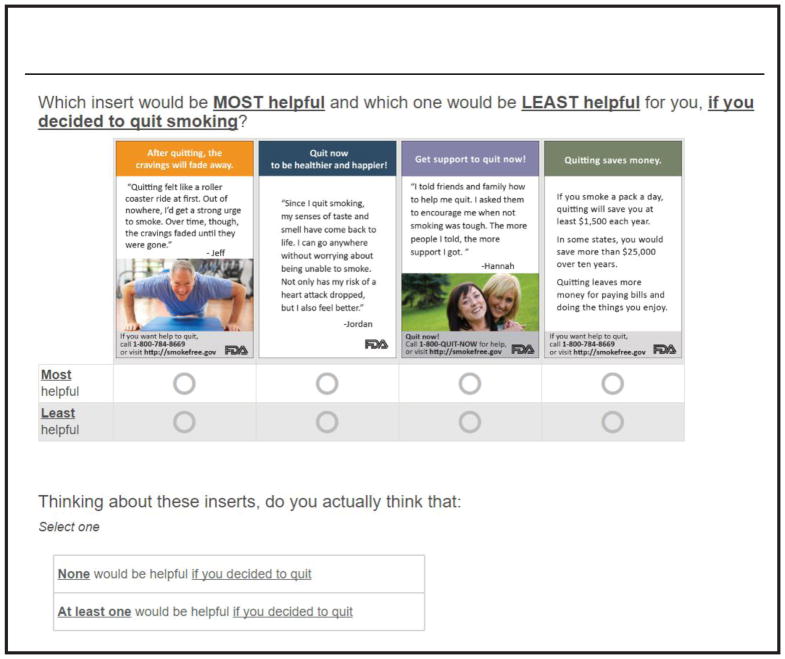
US adult smokers from an online consumer panel (N = 665) participated in a discrete choice experiment with a 2x2x2x2x4 within-subjects balanced incomplete block design, manipulating: image (vs no image), text type (testimonial vs informational), cessation resource information (vs none), call to action (vs none), and message topic (well-being, financial benefit, cravings, social support). Participants evaluated 9 choice sets, each with 4 inserts, selecting: (1) the most and least helpful for quitting; and (2) the most and least motivating to quit. Linear models regressed choices on insert characteristics, controlling for sociodemographics and smoking-related variables. We assessed interactions between insert characteristics and smoker attributes (ie, education, quit intention, self-efficacy).
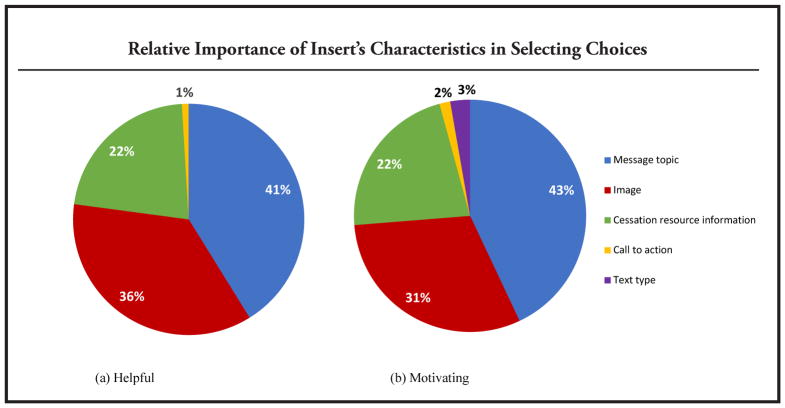
Inserts were most helpful and motivating when they included an image, provided cessation resource information, or referenced well-being and financial benefits. Significant interactions indicated that inserts with cessation resource information were relatively more helpful and motivating among smokers with low self-efficacy, an intention to quit, or lower education.
Cigarette pack inserts with imagery and cessation resource information may be particularly effective in promoting smoking cessation.
我们的目标是确定旨在帮助吸烟者戒烟的烟盒内插页的信息特征。
来自在线消费者小组的美国成年吸烟者(N = 665)参与了一项采用2×2×2×2×4受试者内平衡不完全区组设计的离散选择实验,实验操控因素包括:有无图片、文本类型(推荐型与信息型)、戒烟资源信息(有无)、行动呼吁(有无)以及信息主题(健康、经济利益、烟瘾、社会支持)。参与者评估9组选择集,每组有4个内插页,选择:(1)对戒烟最有帮助和最无帮助的;(2)对戒烟最有激励作用和最无激励作用的。线性模型将选择结果对插页特征进行回归分析,同时控制社会人口统计学和吸烟相关变量。我们评估了插页特征与吸烟者属性(即教育程度、戒烟意愿、自我效能感)之间的相互作用。
当烟盒内插页包含图片、提供戒烟资源信息或提及健康和经济利益时,其帮助性和激励性最大。显著的相互作用表明,对于自我效能感低、有戒烟意愿或教育程度较低的吸烟者,提供戒烟资源信息的插页相对更有帮助和激励作用。
带有图片和戒烟资源信息的烟盒内插页在促进戒烟方面可能特别有效。