UMR1332 Biologie du Fruit et Pathologie, Centre INRA de Nouvelle Aquitaine Bordeaux, INRA, Univ. Bordeaux, av Edouard Bourlaux, 33140, Villenave d'Ornon, France.
Plateforme Métabolome du Centre de Génomique Fonctionnelle Bordeaux, MetaboHUB, IBVM, Centre INRA de Nouvelle Aquitaine Bordeaux, av Edouard Bourlaux, 33140, Villenave d'Ornon, France.
Metabolomics. 2019 Feb 26;15(3):28. doi: 10.1007/s11306-019-1488-3.
Proton nuclear magnetic resonance spectroscopy (H-NMR)-based metabolomic profiling has a range of applications in plant sciences.
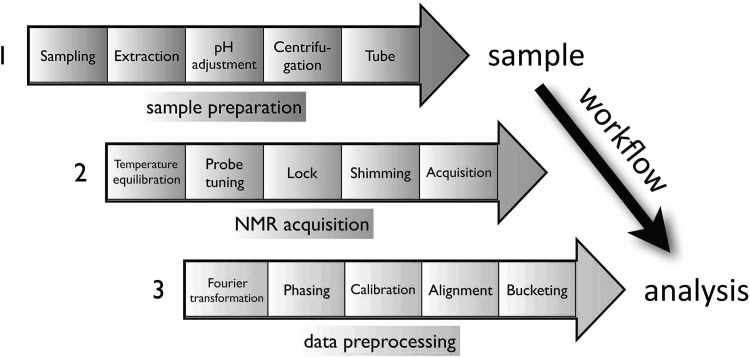
The aim of the present work is to provide advice for minimizing uncontrolled variability in plant sample preparation before and during NMR metabolomic profiling, taking into account sample composition, including its specificity in terms of pH and paramagnetic ion concentrations, and NMR spectrometer performances.
An automation of spectrometer preparation routine standardization before NMR acquisition campaign was implemented and tested on three plant sample sets (extracts of durum wheat spikelet, Arabidopsis leaf and root, and flax leaf, root and stem). We performed H-NMR spectroscopy in three different sites on the wheat sample set utilizing instruments from two manufacturers with different probes and magnetic field strengths. The three collections of spectra were processed separately with the NMRProcFlow web tool using intelligent bucketing, and the resulting buckets were subjected to multivariate analysis.
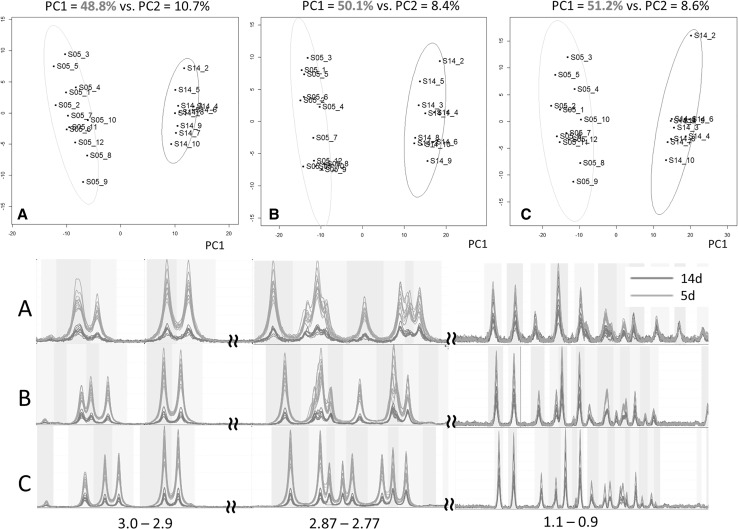
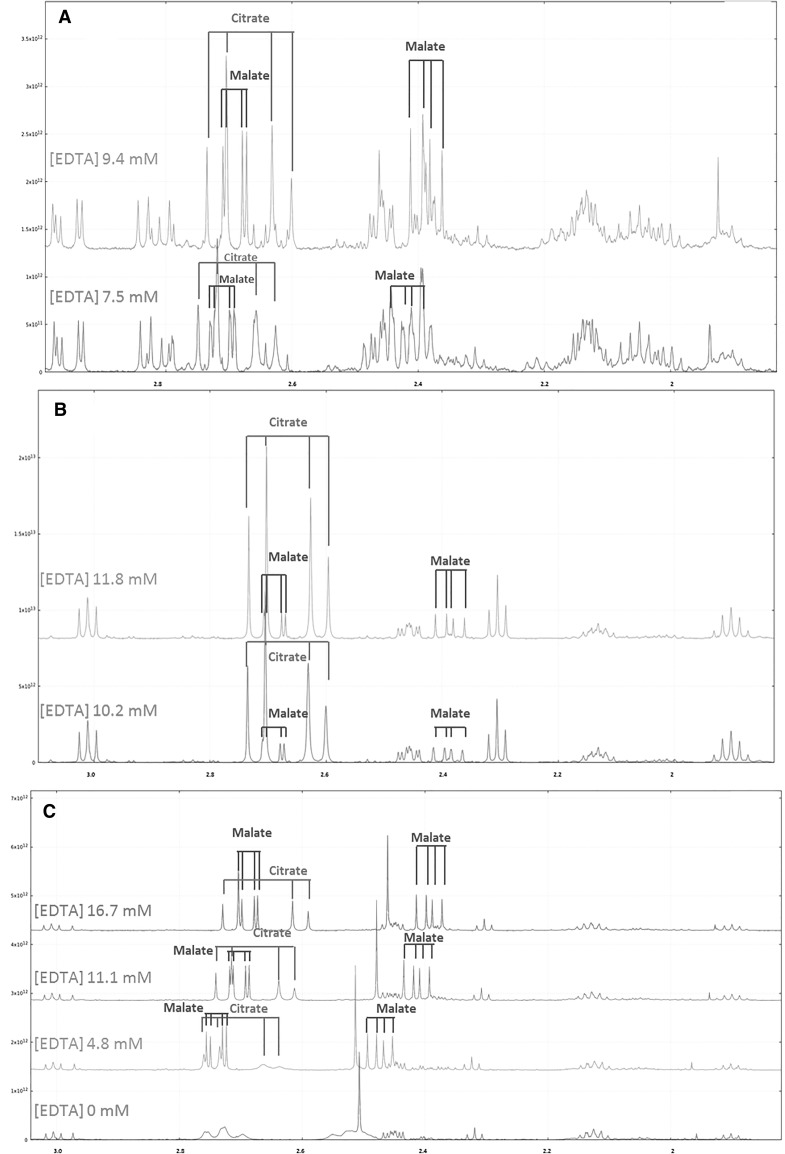
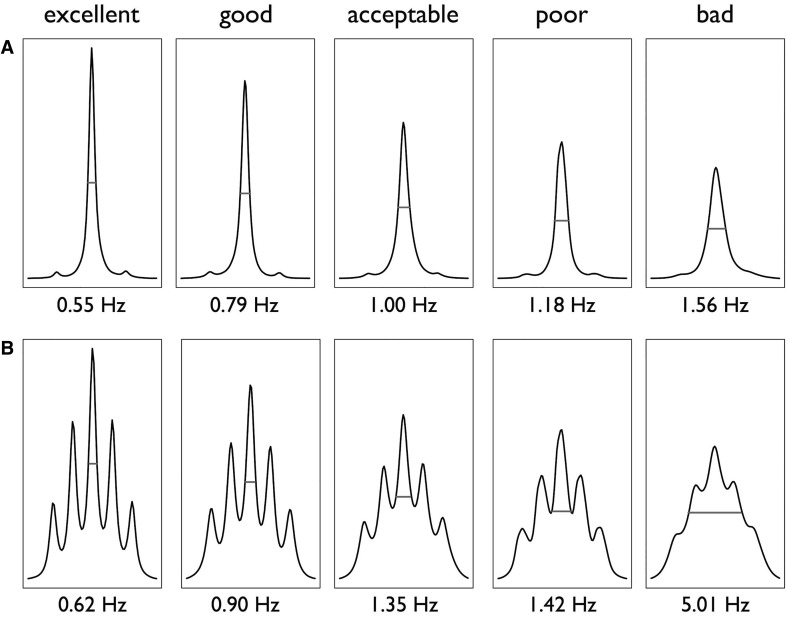
Comparability of large- (Arabidopsis) and medium-size (flax) datasets measured at 600 MHz and from the wheat sample set recorded at the three sites (400, 500 and 600 MHz) was exceptionally good in terms of spectral quality. The coefficient of variation of the full width at half maximum (FWHM) and the signal-to-noise ratio (S/N) of two selected peaks was comprised between 5 and 10% depending on the size of sample set and the spectrometer field. EDTA addition improved citrate and malate resonance patterns for wheat sample sets. A collection of 22 samples of wheat spikelet extracts was used as a proof of concept and showed that the data collected at the three sites on instruments of different field strengths and manufacturers yielded the same discrimination pattern of the biological groups.
Standardization or automation of several steps from extract preparation to data reduction improves data quality for small to large collections of plant samples of different origins.
基于质子核磁共振波谱(H-NMR)的代谢组学分析在植物科学中有广泛的应用。
本研究旨在为最小化植物样品在 NMR 代谢组学分析前后的制备过程中的不可控变异性提供建议,同时考虑到样品的组成,包括其 pH 值和顺磁离子浓度的特异性,以及 NMR 光谱仪的性能。
我们在三个植物样品组(硬粒小麦小穗提取物、拟南芥叶和根、亚麻叶、根和茎)上实现了自动标准化光谱仪准备常规操作,并对其进行了测试。我们利用来自两个制造商的不同探头和磁场强度的仪器,在三个不同的地点对小麦样品进行了 H-NMR 光谱分析。我们使用 NMRProcFlow 网络工具对三个采集的光谱数据集分别进行处理,采用智能分箱处理,将得到的分箱进行多元分析。
从 600 MHz 测量的大(拟南芥)和中(亚麻)数据集以及在三个地点(400、500 和 600 MHz)记录的小麦样品的全宽半最大值(FWHM)和信噪比(S/N)的变化系数,在光谱质量方面非常好。两个选定峰的 FWHM 和 S/N 的变化系数取决于样品集的大小和光谱仪的磁场强度,在 5%至 10%之间。EDTA 的添加改善了小麦样品的柠檬酸盐和苹果酸盐的共振图谱。使用 22 个小麦小穗提取物样本的集合作为概念验证,结果表明,来自不同磁场强度和制造商的仪器在三个地点采集的数据产生了相同的生物群体的区分模式。
从小样本到大样本的不同来源的植物样品的提取制备到数据减少的几个步骤的标准化或自动化,提高了数据质量。