Koh Yong-Gon, Lee Jin-Ah, Kim Yong Sang, Lee Hwa Yong, Kim Hyo Jeong, Kang Kyoung-Tak
Joint Reconstruction Center, Department of Orthopaedic Surgery, Yonsei Sarang Hospital, Seoul, Republic of Korea.
Department of Mechanical Engineering, Yonsei University, Seoul, Republic of Korea.
J Tissue Eng. 2019 Feb 28;10:2041731419832133. doi: 10.1177/2041731419832133. eCollection 2019 Jan-Dec.
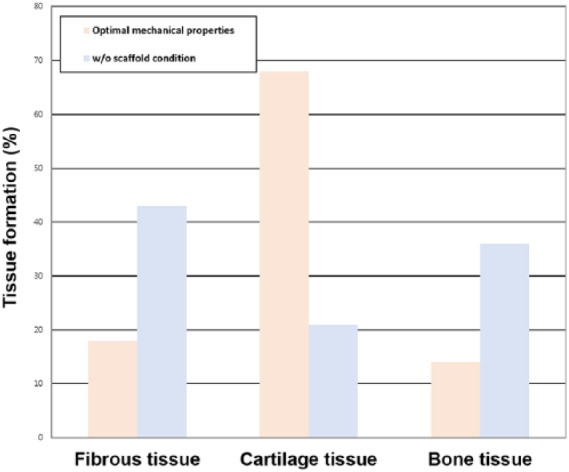
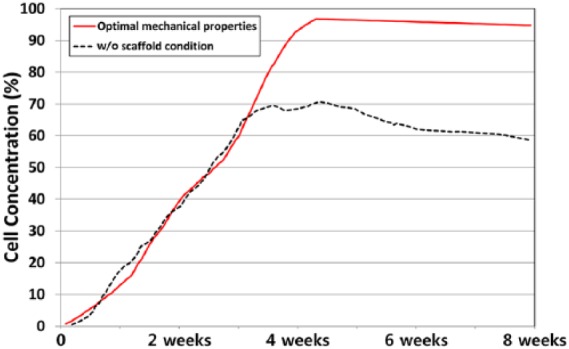
The development of successful scaffolds for bone tissue engineering requires concurrent engineering that combines different research fields. In previous studies, phenomenological computational models predicted the mechanical properties of a scaffold in a simple loading condition using the mechano-regulation theory. Therefore, the aim of this study is to predict the mechanical properties of an optimum scaffold required for cartilage regeneration using three-dimensional knee joint developed from medical imaging and mechano-regulation theory. It was predicted that the scaffold with optimal mechanical properties would result in greater amounts of cartilage tissue formation than without a scaffold. The results demonstrated the ability of the algorithms to design optimized scaffolds with target properties and confirmed the applicability of set techniques for bone tissue engineering. The scaffolds were optimized to suit the site-specific loading requirements, and the results reveal a new approach for computational simulations in tissue engineering.
开发用于骨组织工程的成功支架需要将不同研究领域结合起来的协同工程。在先前的研究中,现象学计算模型使用机械调节理论预测了在简单加载条件下支架的力学性能。因此,本研究的目的是利用从医学成像和机械调节理论开发的三维膝关节来预测软骨再生所需的最佳支架的力学性能。据预测,具有最佳力学性能的支架将比没有支架的情况产生更多的软骨组织形成。结果证明了算法设计具有目标性能的优化支架的能力,并证实了所设定技术在骨组织工程中的适用性。这些支架经过优化以适应特定部位的加载要求,结果揭示了一种用于组织工程计算模拟的新方法。