Di Foggia Giacomo
Università di Milano-Bicocca, Via B, Degli Arcimboldi 8, 20126 Milano, Italy.
Heliyon. 2018 Nov 21;4(11):e00953. doi: 10.1016/j.heliyon.2018.e00953. eCollection 2018 Nov.
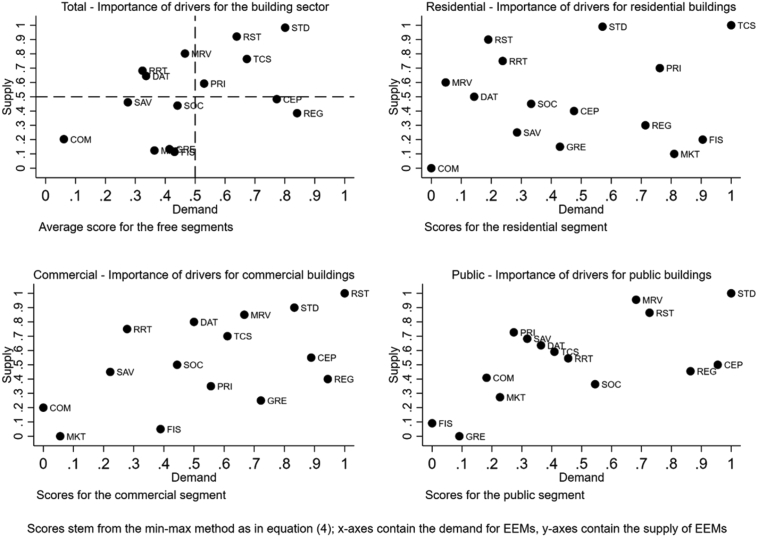
Governments, worldwide, are committed to achieving sustainable development goals (SDGs). In a context where urban agglomerates consume roughly 80% of the global energy, of which buildings account for 40%, energy-efficient buildings can make a significant contribution to meeting SDGs 11 and 13. Currently, the implementation of energy efficiency measures (EEMs) in building is constrained by socioeconomic and technical barriers. Using empirical survey data, the drivers that affect both the supply of and demand for EEMs were identified. These drivers were then categorized within four clusters according to their importance in meeting supply and demand priorities. The following critical drivers were identified: standardization, low transaction costs, energy prices, and stability of the regulatory framework. The findings indicated that an effective energy policy provides consumers with reliable information and project developers with a stable regulatory environment. Investment behavior is rational and responsive to reliable information that prompts a switch toward sustainable building choices.
世界各国政府都致力于实现可持续发展目标(SDGs)。在城市群消耗全球约80%能源(其中建筑物占40%)的背景下,节能建筑可为实现可持续发展目标11和13做出重大贡献。目前,建筑领域能效措施(EEMs)的实施受到社会经济和技术障碍的制约。利用实证调查数据,确定了影响能效措施供需的驱动因素。然后根据这些驱动因素在满足供需优先事项方面的重要性,将其分为四类。确定了以下关键驱动因素:标准化、低交易成本、能源价格和监管框架的稳定性。研究结果表明,有效的能源政策为消费者提供可靠信息,并为项目开发商提供稳定的监管环境。投资行为是理性的,并且对促使转向可持续建筑选择的可靠信息做出反应。