Tritch William, Allen Linda J S
Department of Mathematics and Statistics, Texas Tech University, Lubbock, TX 79409-1042, USA.
Infect Dis Model. 2018 Mar 22;3:60-73. doi: 10.1016/j.idm.2018.03.002. eCollection 2018.
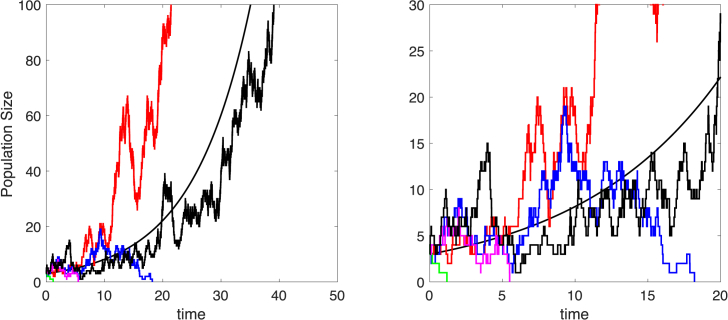
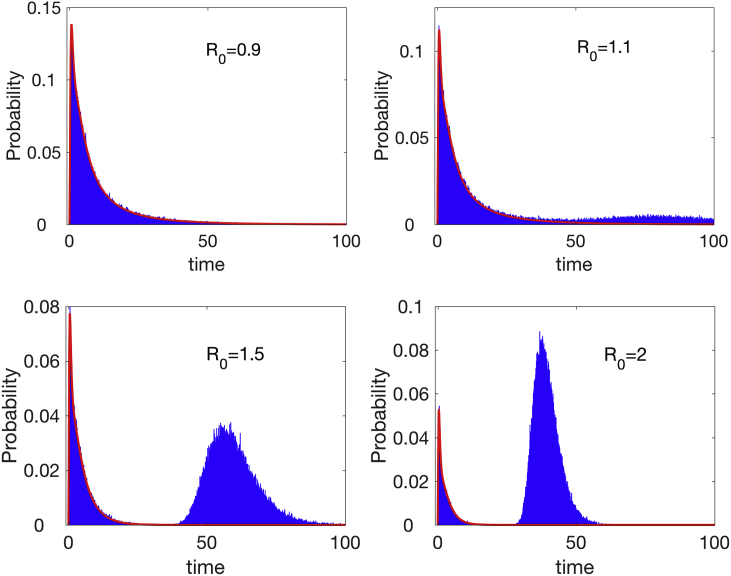
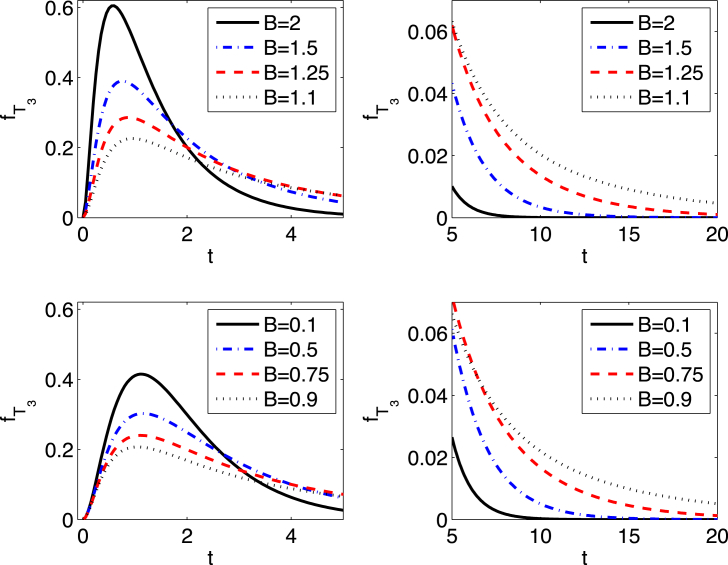
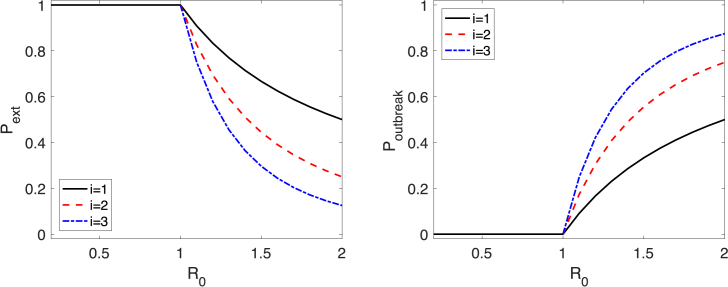
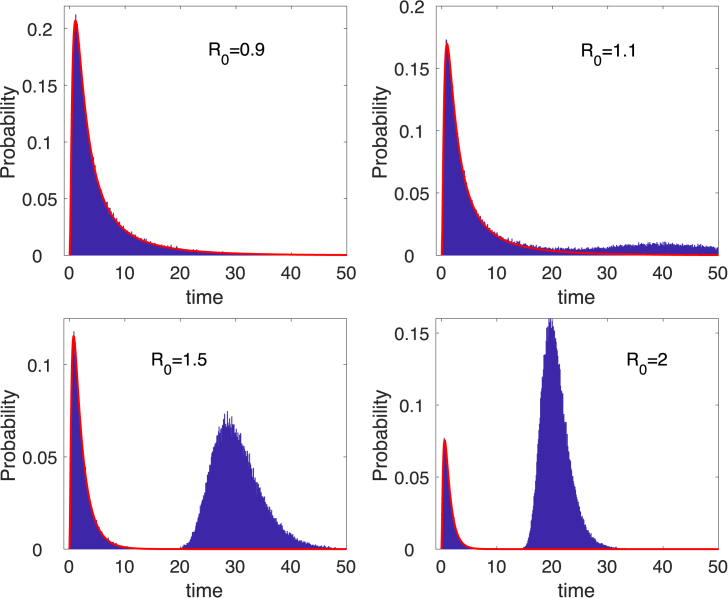
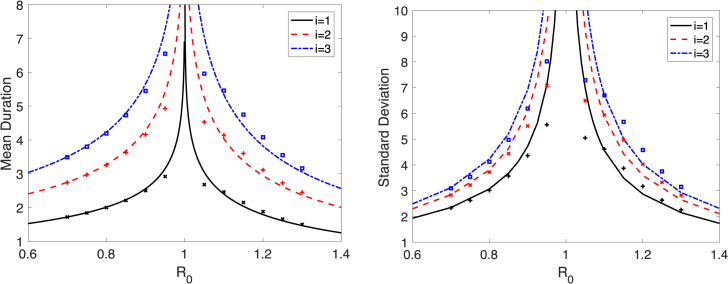
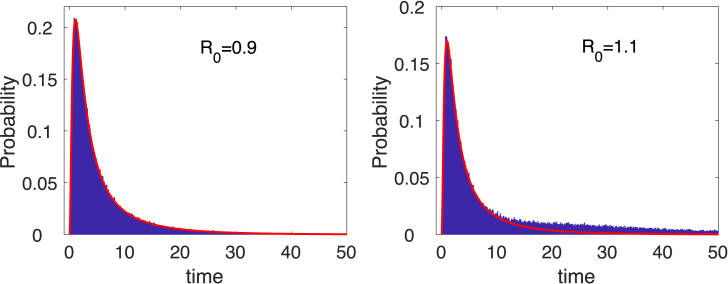
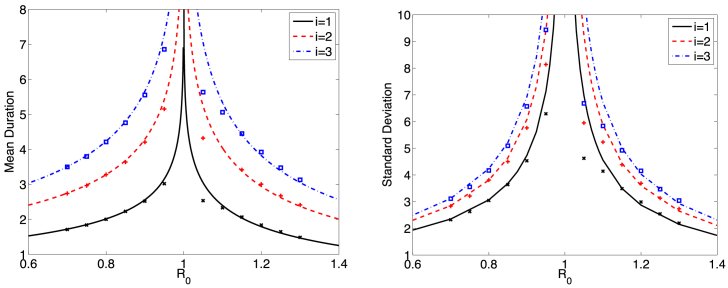
Disease outbreaks in stochastic SIR epidemic models are characterized as either minor or major. When , all epidemics are minor, whereas if , they can be minor or major. In 1955, Whittle derived formulas for the probability of a minor or a major epidemic. A minor epidemic is distinguished from a major one in that a minor epidemic is generally of shorter duration and has substantially fewer cases than a major epidemic. In this investigation, analytical formulas are derived that approximate the probability density, the mean, and the higher-order moments for the duration of a minor epidemic. These analytical results are applicable to minor epidemics in stochastic SIR, SIS, and SIRS models with a single infected class. The probability density for minor epidemics in more complex epidemic models can be computed numerically applying multitype branching processes and the backward Kolmogorov differential equations. When is close to one, minor epidemics are more common than major epidemics and their duration is significantly longer than when or .
随机SIR传染病模型中的疾病爆发被分为小规模或大规模。当 时,所有疫情都是小规模的,而如果 ,则可能是小规模或大规模的。1955年,惠特尔推导出了小规模或大规模疫情概率的公式。小规模疫情与大规模疫情的区别在于,小规模疫情的持续时间通常较短,病例数也比大规模疫情少得多。在本研究中,推导出了近似小规模疫情持续时间的概率密度、均值和高阶矩的解析公式。这些解析结果适用于具有单个感染类别的随机SIR、SIS和SIRS模型中的小规模疫情。更复杂传染病模型中小规模疫情的概率密度可以通过应用多类型分支过程和反向柯尔莫哥洛夫微分方程进行数值计算。当 接近1时,小规模疫情比大规模疫情更常见,并且其持续时间明显长于 或 时的情况。