Fred Hutchinson Cancer Research Center, Seattle, Washington.
Yale School of Public Health, New Haven, Connecticut.
Cancer. 2019 Jul 1;125(13):2262-2271. doi: 10.1002/cncr.32051. Epub 2019 Mar 6.
The objective of this study was to evaluate the role of a 12-month exercise intervention on endocrine-related quality of life (QOL) and overall QOL among breast cancer survivors with aromatase inhibitor (AI)-induced arthralgia in the Hormones and Physical Exercise (HOPE) Study.
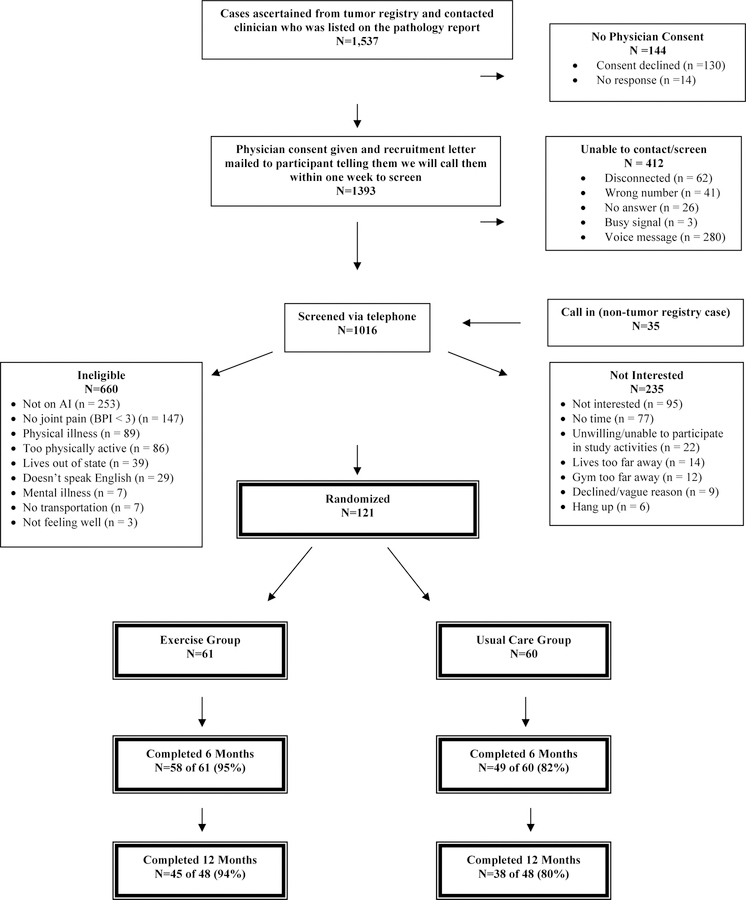
This was a randomized controlled trial of 121 breast cancer survivors who were currently receiving AIs and experiencing at least mild arthralgia. QOL was assessed using the Functional Assessment of Cancer Therapy (FACT) questionnaires and the 36-Item Short Form Survey (SF-36) at baseline, 6 months, and 12 months. Participants were randomized to either a 1-year gym-based, supervised exercise intervention group (150 minutes of aerobic exercise and 2 strength-training sessions each week) or a usual care group. Effects of the intervention on QOL were assessed using mixed-model, repeated-measures analysis.
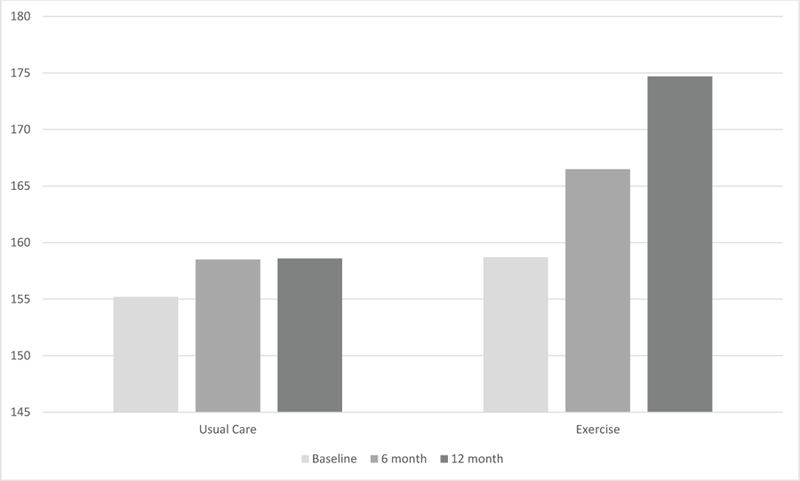
At 12 months, the exercise group had greater improvement in the overall QOL measures as well as the breast cancer-specific (scores, 2.2 vs 0.7; P = .02), endocrine-specific (scores, 5.6 vs 1.6; P < .001), and fatigue-specific (score, 5.8 vs 0.5; P < .001) subscales compared with the usual care group. The results indicated a stronger effect at 12 months versus 6 months after the intervention.
Combined aerobic and resistance exercise, such as treadmill walking and strength training, improved endocrine-related and overall QOL among breast cancer survivors who were experiencing adverse side effects from AIs. Because adverse side effects associated with AI use are quite common and this is the main reason for treatment discontinuation, this nonpharmacologic intervention could benefit many breast cancer survivors and increase successful adherence to AIs in breast cancer treatment.
本研究旨在评估为期 12 个月的运动干预对接受芳香化酶抑制剂(AI)治疗且伴有 AI 诱导性关节痛的乳腺癌幸存者的内分泌相关生活质量(QOL)和整体 QOL 的影响,该研究纳入了来自 Hormones and Physical Exercise(HOPE)研究的 121 名乳腺癌幸存者。
这是一项随机对照试验,纳入了 121 名正在接受 AI 治疗且至少有轻度关节痛的乳腺癌幸存者。在基线、6 个月和 12 个月时,使用癌症治疗功能评估(FACT)问卷和 36 项简短健康调查(SF-36)评估 QOL。参与者被随机分为为期 1 年的健身房监督运动干预组(每周进行 150 分钟的有氧运动和 2 次力量训练)或常规护理组。采用混合模型重复测量分析评估干预对 QOL 的影响。
在 12 个月时,运动组在整体 QOL 评分以及乳腺癌特异性(评分,2.2 比 0.7;P =.02)、内分泌特异性(评分,5.6 比 1.6;P <.001)和疲劳特异性(评分,5.8 比 0.5;P <.001)亚量表的评分上均有更大的改善,与常规护理组相比。结果表明,干预后 12 个月的效果强于 6 个月。
结合有氧运动和抗阻运动,如跑步机步行和力量训练,可改善正在接受 AI 治疗且出现不良反应的乳腺癌幸存者的内分泌相关和整体 QOL。由于 AI 应用相关的不良反应相当常见,且这是治疗中断的主要原因,因此这种非药物干预可能使许多乳腺癌幸存者受益,并提高 AI 在乳腺癌治疗中的应用率。