From the Departments of Clinical Neurosciences (C.J.L., I.T.S.C.-G., P.V.R., A.W., E.W., J.B.R.) and Psychology (T.W.R.), and Behavioral and Clinical Neuroscience Institute (T.W.R., J.B.R.), University of Cambridge, UK; University Medical Centre Hamburg-Eppendorf (E.W.), University of Hamburg, Germany; and MRC Cognition and Brain Sciences Unit (J.B.R.), Cambridge, UK.
Neurology. 2019 Apr 2;92(14):e1547-e1557. doi: 10.1212/WNL.0000000000007249. Epub 2019 Mar 6.
To determine the influence of apathy, impulsivity, and behavioral change on survival in patients with frontotemporal dementia, progressive supranuclear palsy, and corticobasal syndrome.
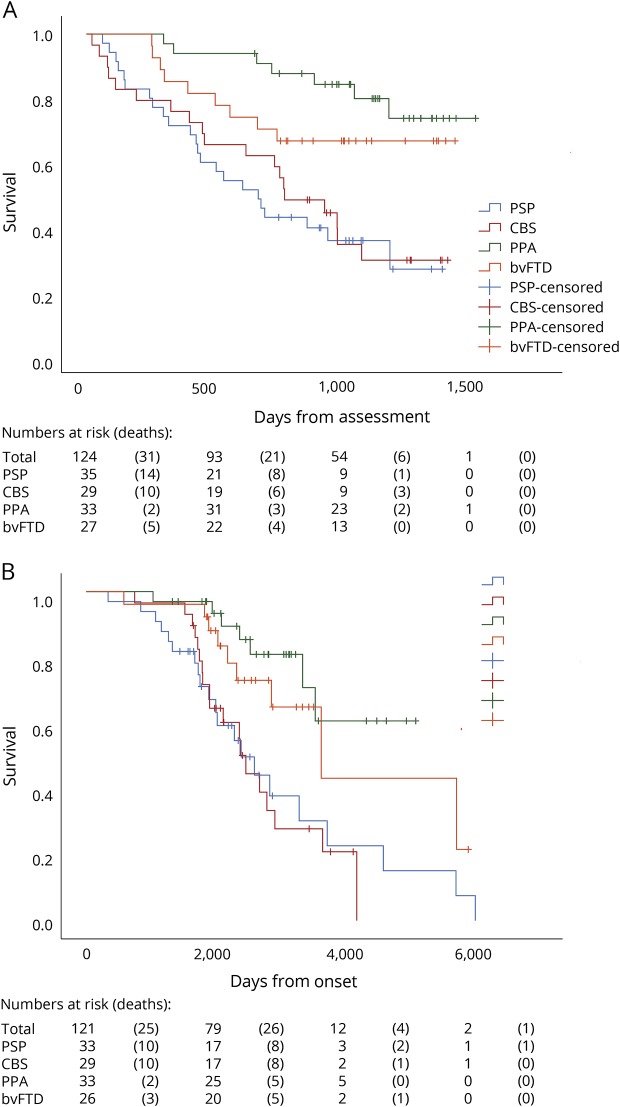
We assessed 124 patients from the epidemiologic PiPPIN (Pick's Disease and Progressive Supranuclear Palsy, Prevalence and Incidence) study. Patients underwent detailed baseline cognitive and behavioral assessment focusing on apathy, impulsivity, and behavioral change. Logistic regression identified predictors of death within 2.5 years from assessment, including age, sex, diagnosis, cognition, and 8 neurobehavioral profiles derived from a principal component analysis of neuropsychological and behavioral measures.
An apathetic neurobehavioral profile predicted death (Wald statistic = 8.119, = 0.004, Exp(B) = 2.912, confidence interval = >1 [1.396-6.075]) and was elevated in all patient groups. This profile represented apathy, weighted strongly to carer reports from the Apathy Evaluation Scale, Neuropsychiatric Inventory, and Cambridge Behavioral Inventory. Age at assessment, sex, and global cognitive impairment were not significant predictors. Differences in mortality risk across diagnostic groups were accounted for by their neuropsychiatric and behavioral features.
The relationship between apathy and survival highlights the need to develop more effective and targeted measurement tools to improve its recognition and facilitate treatment. The prognostic importance of apathy suggests that neurobehavioral features might be useful to predict survival and stratify patients for interventional trials. Effective symptomatic interventions targeting the neurobiology of apathy might ultimately also improve prognosis.
确定淡漠、冲动和行为改变对额颞叶痴呆、进行性核上性麻痹和皮质基底节综合征患者生存的影响。
我们评估了来自流行病学 PiPPIN(Pick 病和进行性核上性麻痹,患病率和发病率)研究的 124 名患者。患者接受了详细的基线认知和行为评估,重点关注淡漠、冲动和行为改变。逻辑回归确定了 2.5 年内评估死亡的预测因素,包括年龄、性别、诊断、认知和从神经心理学和行为测量的主成分分析中得出的 8 个神经行为特征。
淡漠的神经行为特征预测死亡(Wald 统计量=8.119,=0.004,Exp(B)=2.912,置信区间>1[1.396-6.075]),并且在所有患者组中都升高。该特征代表了淡漠,强烈加权于照顾者从淡漠评估量表、神经精神病学量表和剑桥行为量表的报告。评估时的年龄、性别和整体认知障碍不是显著的预测因素。诊断组之间的死亡率差异由其神经精神和行为特征解释。
淡漠与生存之间的关系突出表明需要开发更有效和有针对性的测量工具,以提高对其的认识并促进治疗。淡漠的预后重要性表明,神经行为特征可能有助于预测生存并为干预试验分层患者。针对淡漠的神经生物学的有效对症干预措施最终也可能改善预后。