Mergel Olga, Schneider Sabine, Tiwari Rahul, Kühn Philipp T, Keskin Damla, Stuart Marc C A, Schöttner Sebastian, de Kanter Martinus, Noyong Michael, Caumanns Tobias, Mayer Joachim, Janzen Christoph, Simon Ulrich, Gallei Markus, Wöll Dominik, van Rijn Patrick, Plamper Felix A
Institute of Physical Chemistry , RWTH Aachen University , Landoltweg 2 , 52056 Aachen , Germany.
Department of Biomedical Engineering-FB40 , University of Groningen , University Medical Center Groningen , A. Deusinglaan 1 , Groningen , 9713 AV , The Netherlands.
Chem Sci. 2018 Dec 13;10(6):1844-1856. doi: 10.1039/c8sc04369h. eCollection 2019 Feb 14.
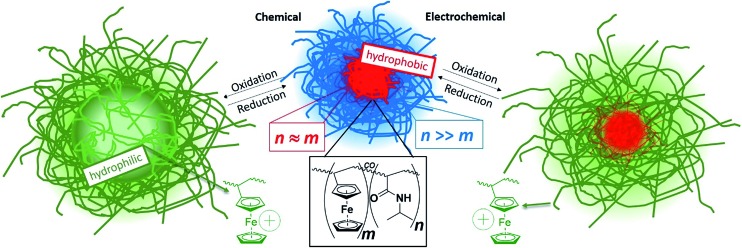
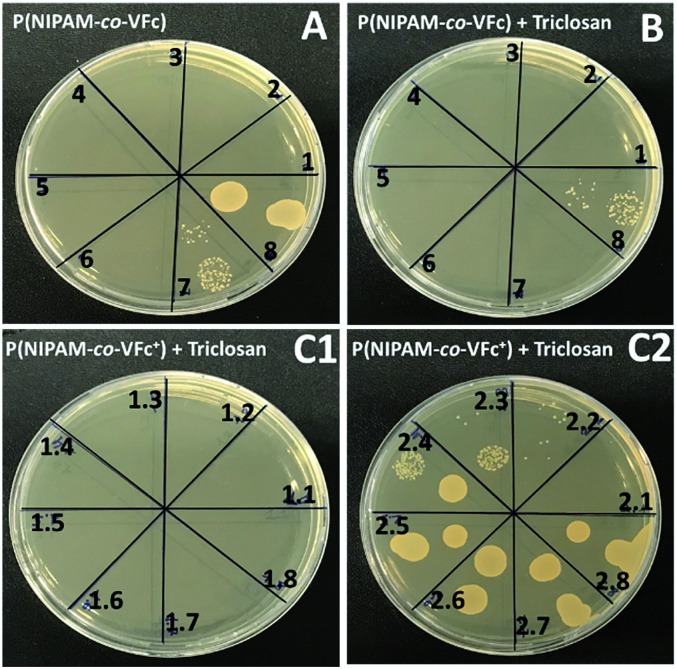
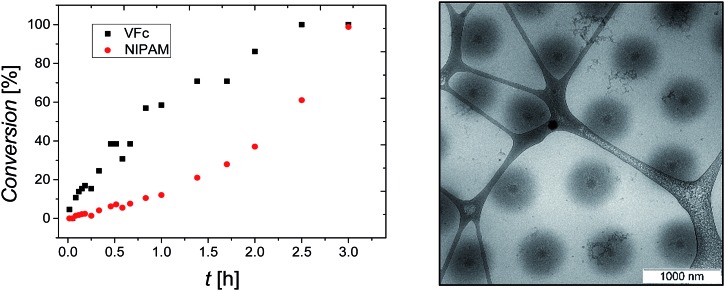
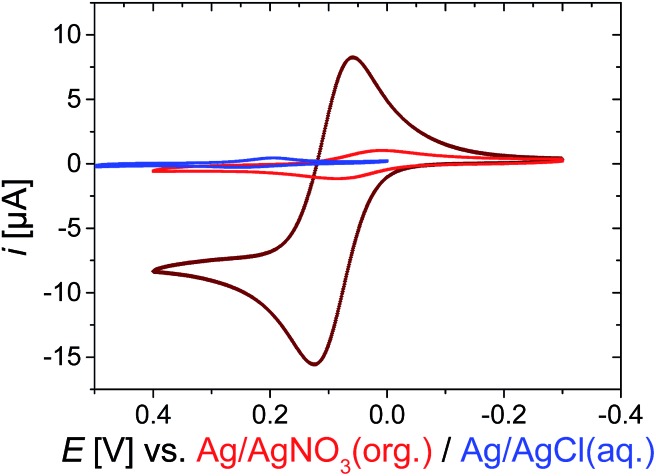
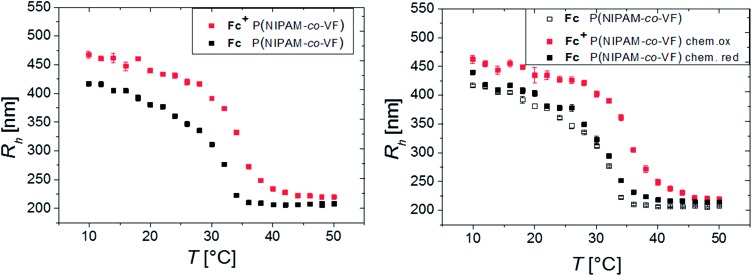
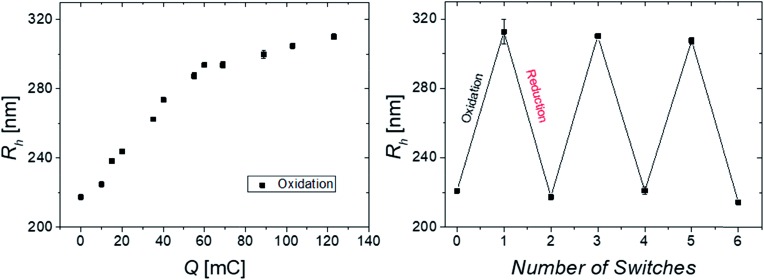
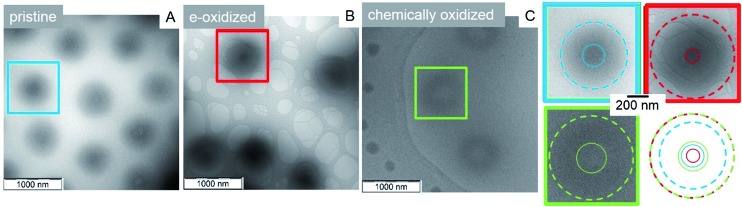
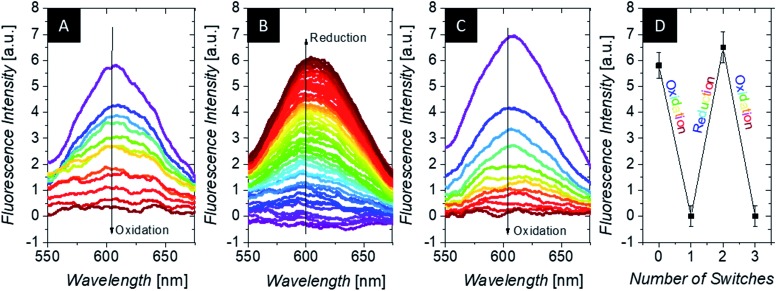
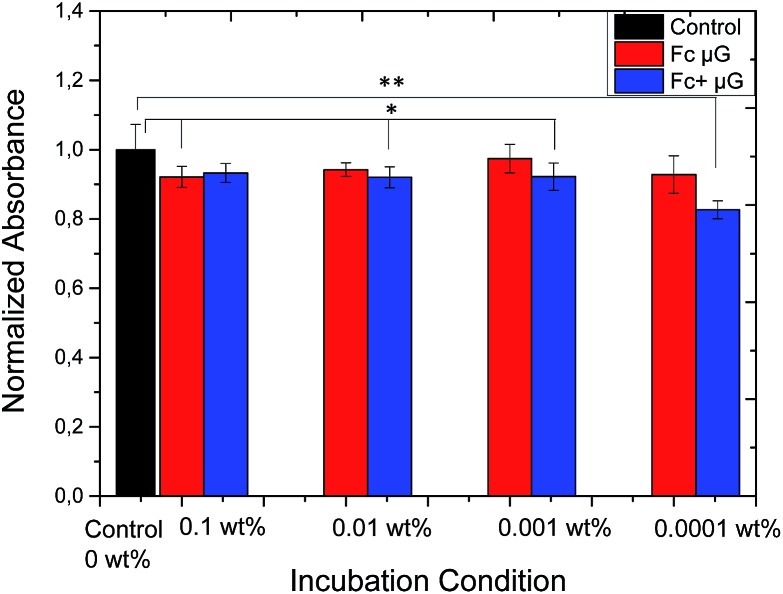
Controlling and understanding the electrochemical properties of electroactive polymeric colloids is a highly topical but still a rather unexplored field of research. This is especially true when considering more complex particle architectures like stimuli-responsive microgels, which would entail different kinetic constraints for charge transport within one particle. We synthesize and electrochemically address dual stimuli responsive core-shell microgels, where the temperature-responsiveness modulates not only the internal structure, but also the microgel electroactivity both on an internal and on a global scale. In detail, a facile one-step precipitation polymerization results in architecturally advanced poly(-isopropylacrylamide--vinylferrocene) P(NIPAM--VFc) microgels with a ferrocene (Fc)-enriched (collapsed/hard) core and a NIPAM-rich shell. While the remaining Fc units in the shell are electrochemically accessible, the electrochemical activity of Fc in the core is limited due to the restricted mobility of redox active sites and therefore restricted electron transfer in the compact core domain. Still, prolonged electrochemical action and/or chemical oxidation enable a reversible adjustment of the internal microgel structure from core-shell microgels with a dense core to completely oxidized microgels with a highly swollen core and a denser corona. The combination of thermo-sensitive and redox-responsive units being part of the network allows for efficient amplification of the redox response on the overall microgel dimension, which is mainly governed by the shell. Further, it allows for an electrochemical switching of polarity (hydrophilicity/hydrophobicity) of the microgel, enabling an electrochemically triggered uptake and release of active guest molecules. Hence, bactericidal drugs can be released to effectively kill bacteria. In addition, good biocompatibility of the microgels in cell tests suggests suitability of the new microgel system for future biomedical applications.
控制和理解电活性聚合物胶体的电化学性质是一个热门但仍未充分探索的研究领域。当考虑更复杂的粒子结构,如刺激响应性微凝胶时,情况尤其如此,因为这会对单个粒子内的电荷传输带来不同的动力学限制。我们合成并对双刺激响应性核壳微凝胶进行电化学研究,其中温度响应性不仅调节内部结构,还在内部和整体尺度上调节微凝胶的电活性。具体而言,一种简便的一步沉淀聚合反应产生了结构先进的聚(N-异丙基丙烯酰胺-乙烯基二茂铁)P(NIPAM-VFc)微凝胶,其具有富含二茂铁(Fc)的(塌陷/坚硬)核和富含NIPAM的壳。虽然壳中剩余的Fc单元在电化学上是可及的,但由于氧化还原活性位点的迁移受限,因此致密核域中的电子转移受限,核中Fc的电化学活性受到限制。尽管如此,长时间的电化学作用和/或化学氧化能够使内部微凝胶结构从具有致密核的核壳微凝胶可逆地调整为具有高度溶胀核和更致密冠层的完全氧化微凝胶。作为网络一部分的热敏和氧化还原响应单元的组合允许在主要由壳控制的整体微凝胶尺寸上有效放大氧化还原响应。此外,它允许微凝胶的极性(亲水性/疏水性)进行电化学切换,从而实现电化学触发的活性客体分子的摄取和释放。因此,可以释放杀菌药物以有效杀死细菌。此外,微凝胶在细胞测试中的良好生物相容性表明新的微凝胶系统适用于未来的生物医学应用。