Keskin Damla, Zu Guangyue, Forson Abigail M, Tromp Lisa, Sjollema Jelmer, van Rijn Patrick
University of Groningen, University Medical Center Groningen, Department of Biomedical Engineering, W. J. Kolff Institute, Antonius Deusinglaan 1, 9713 AV, Groningen, the Netherlands.
Bioact Mater. 2021 Apr 3;6(10):3634-3657. doi: 10.1016/j.bioactmat.2021.03.004. eCollection 2021 Oct.
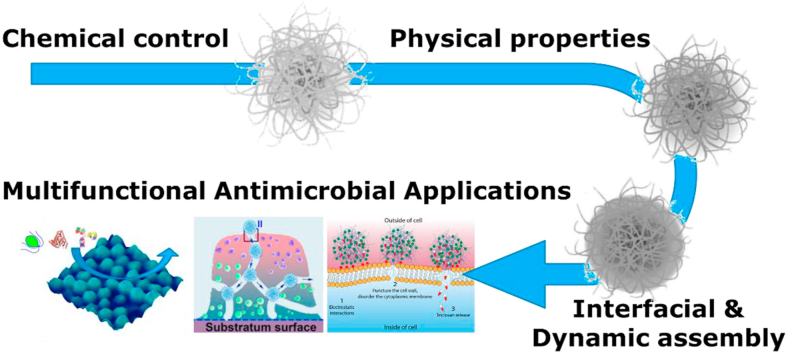
The implementation of nanotechnology to develop efficient antimicrobial systems has a significant impact on the prospects of the biomedical field. Nanogels are soft polymeric particles with an internally cross-linked structure, which behave as hydrogels and can be reversibly hydrated/dehydrated (swollen/shrunken) by the dispersing solvent and external stimuli. Their excellent properties, such as biocompatibility, colloidal stability, high water content, desirable mechanical properties, tunable chemical functionalities, and interior gel-like network for the incorporation of biomolecules, make them fascinating in the field of biological/biomedical applications. In this review, various approaches will be discussed and compared to the newly developed nanogel technology in terms of efficiency and applicability for determining their potential role in combating infections in the biomedical area including implant-associated infections.
实施纳米技术以开发高效抗菌系统对生物医学领域的前景具有重大影响。纳米凝胶是具有内部交联结构的软质聚合物颗粒,其表现为水凝胶,并且可以通过分散溶剂和外部刺激可逆地水合/脱水(溶胀/收缩)。它们具有优异的性能,如生物相容性、胶体稳定性、高含水量、理想的机械性能、可调节的化学功能以及用于掺入生物分子的内部凝胶状网络,使其在生物/生物医学应用领域极具吸引力。在本综述中,将讨论各种方法,并与新开发的纳米凝胶技术在效率和适用性方面进行比较,以确定它们在对抗包括植入相关感染在内的生物医学领域感染中的潜在作用。