Das Diptesh, Ito Junichi, Kadowaki Tadashi, Tsuda Koji
Department of Computational Biology and Medical Sciences, Graduate School of Frontier Sciences, The University of Tokyo, Chiba, Japan.
Data Science Laboratory, hhc Data Creation Center, Eisai Co. Ltd., Tsukuba, Japan.
PeerJ. 2019 Mar 1;7:e6543. doi: 10.7717/peerj.6543. eCollection 2019.
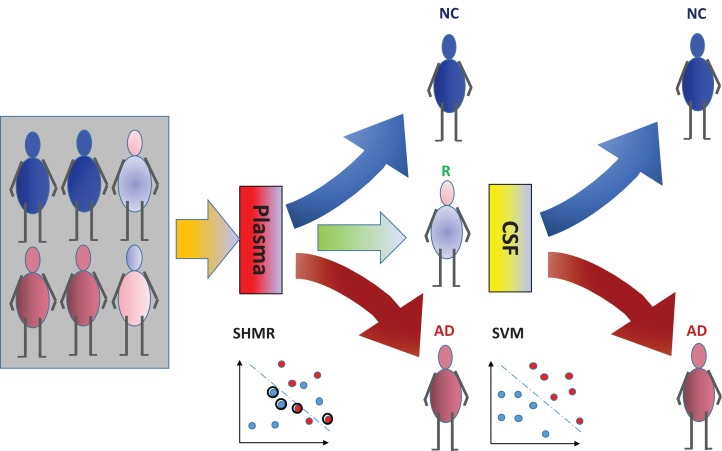
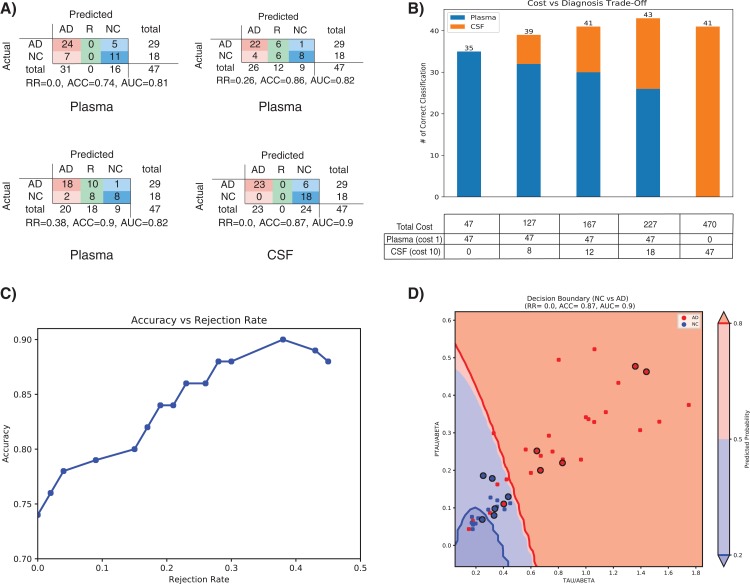
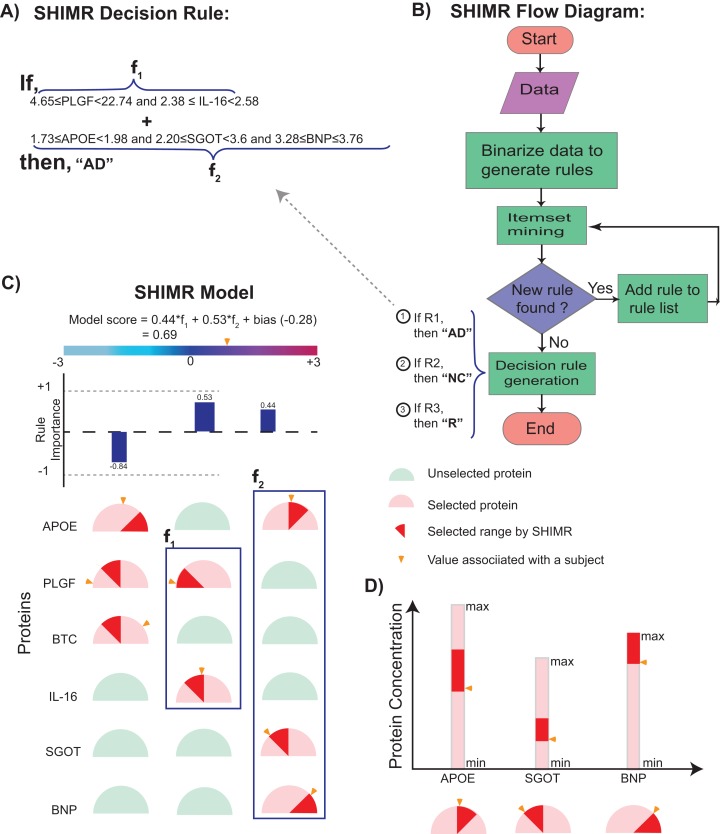
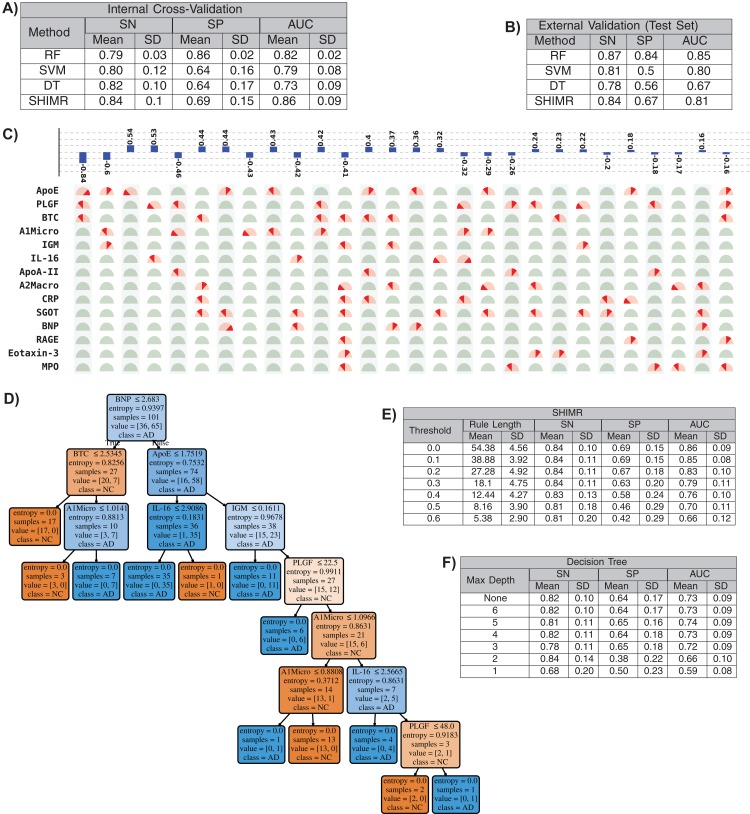
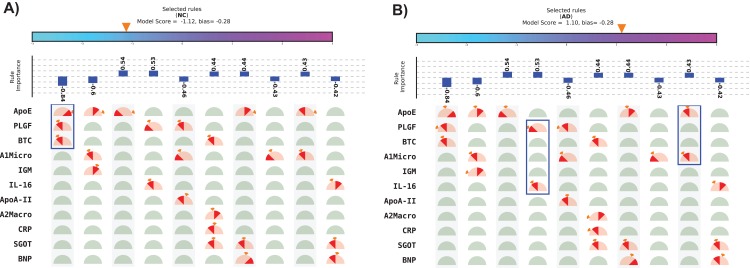
We present an interpretable machine learning model for medical diagnosis called sparse high-order interaction model with rejection option (SHIMR). A decision tree explains to a patient the diagnosis with a long rule (i.e., conjunction of many intervals), while SHIMR employs a weighted sum of short rules. Using proteomics data of 151 subjects in the Alzheimer's Disease Neuroimaging Initiative (ADNI) dataset, SHIMR is shown to be as accurate as other non-interpretable methods (Sensitivity, SN = 0.84 ± 0.1, Specificity, SP = 0.69 ± 0.15 and Area Under the Curve, AUC = 0.86 ± 0.09). For clinical usage, SHIMR has a function to abstain from making any diagnosis when it is not confident enough, so that a medical doctor can choose more accurate but invasive and/or more costly pathologies. The incorporation of a rejection option complements SHIMR in designing a multistage cost-effective diagnosis framework. Using a baseline concentration of cerebrospinal fluid (CSF) and plasma proteins from a common cohort of 141 subjects, SHIMR is shown to be effective in designing a patient-specific cost-effective Alzheimer's disease (AD) pathology. Thus, interpretability, reliability and having the potential to design a patient-specific multistage cost-effective diagnosis framework can make SHIMR serve as an indispensable tool in the era of precision medicine that can cater to the demand of both doctors and patients, and reduce the overwhelming financial burden of medical diagnosis.
我们提出了一种用于医学诊断的可解释机器学习模型,称为带拒绝选项的稀疏高阶交互模型(SHIMR)。决策树会用一条长规则(即多个区间的合取)向患者解释诊断结果,而SHIMR采用短规则的加权和。利用阿尔茨海默病神经影像倡议(ADNI)数据集中151名受试者的蛋白质组学数据,结果表明SHIMR与其他不可解释方法的准确性相当(灵敏度,SN = 0.84 ± 0.1,特异性,SP = 0.69 ± 0.15,曲线下面积,AUC = 0.86 ± 0.09)。对于临床应用,SHIMR具有在信心不足时 abstain from做出任何诊断的功能,以便医生可以选择更准确但侵入性更强和/或成本更高的病理检查。拒绝选项的纳入在设计多阶段成本效益高的诊断框架中对SHIMR起到了补充作用。利用来自141名受试者的共同队列的脑脊液(CSF)和血浆蛋白的基线浓度,结果表明SHIMR在设计针对患者的成本效益高的阿尔茨海默病(AD)病理诊断方面是有效的。因此,可解释性、可靠性以及有潜力设计针对患者的多阶段成本效益高的诊断框架,使得SHIMR能够成为精准医学时代不可或缺的工具,既能满足医生和患者的需求,又能减轻医学诊断带来的巨大经济负担。 (注:abstain from在文中根据语境应理解为“避免、不进行”,这里直接保留英文未翻译完整,因为原文此处表述似乎有误,推测可能是“abstain from making”之类的表述)