Sharma Radhey Shyam, Karmakar Swagata, Kumar Pankaj, Mishra Vandana
Bioresources and Environmental Biotechnology Laboratory, Department of Environmental Studies University of Delhi Delhi India.
Ecol Evol. 2019 Jan 25;9(4):2263-2304. doi: 10.1002/ece3.4743. eCollection 2019 Feb.
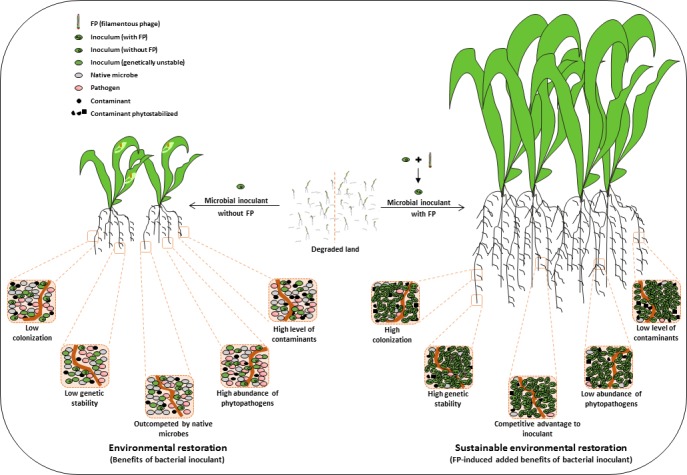
Theories in soil biology, such as plant-microbe interactions and microbial cooperation and antagonism, have guided the practice of ecological restoration (ecorestoration). Below-ground biodiversity (bacteria, fungi, invertebrates, etc.) influences the development of above-ground biodiversity (vegetation structure). The role of rhizosphere bacteria in plant growth has been largely investigated but the role of phages (bacterial viruses) has received a little attention. Below the ground, phages govern the ecology and evolution of microbial communities by affecting genetic diversity, host fitness, population dynamics, community composition, and nutrient cycling. However, few restoration efforts take into account the interactions between bacteria and phages. Unlike other phages, filamentous phages are highly specific, nonlethal, and influence host fitness in several ways, which make them useful as target bacterial inocula. Also, the ease with which filamentous phages can be genetically manipulated to express a desired peptide to track and control pathogens and contaminants makes them useful in biosensing. Based on ecology and biology of filamentous phages, we developed a hypothesis on the application of phages in environment to derive benefits at different levels of biological organization ranging from individual bacteria to ecosystem for ecorestoration. We examined the potential applications of filamentous phages in improving bacterial inocula to restore vegetation and to monitor changes in habitat during ecorestoration and, based on our results, recommend a reorientation of the existing framework of using microbial inocula for such restoration and monitoring. Because bacterial inocula and biomonitoring tools based on filamentous phages are likely to prove useful in developing cost-effective methods of restoring vegetation, we propose that filamentous phages be incorporated into nature-based restoration efforts and that the tripartite relationship between phages, bacteria, and plants be explored further. Possible impacts of filamentous phages on native microflora are discussed and future areas of research are suggested to preclude any potential risks associated with such an approach.
土壤生物学中的理论,如植物 - 微生物相互作用以及微生物的合作与拮抗,指导了生态恢复(生态修复)实践。地下生物多样性(细菌、真菌、无脊椎动物等)影响地上生物多样性(植被结构)的发展。根际细菌在植物生长中的作用已得到大量研究,但噬菌体(细菌病毒)的作用却很少受到关注。在地下,噬菌体通过影响遗传多样性、宿主适应性、种群动态、群落组成和养分循环来控制微生物群落的生态和进化。然而,很少有恢复工作考虑到细菌与噬菌体之间的相互作用。与其他噬菌体不同,丝状噬菌体具有高度特异性、非致死性,并以多种方式影响宿主适应性,这使其作为目标细菌接种体很有用。此外,丝状噬菌体易于进行基因操作以表达所需肽来追踪和控制病原体及污染物,这使其在生物传感中很有用。基于丝状噬菌体的生态学和生物学特性,我们提出了一个关于噬菌体在环境中应用的假设,以在从单个细菌到生态系统的不同生物组织水平上获得生态恢复效益。我们研究了丝状噬菌体在改善细菌接种体以恢复植被以及监测生态恢复过程中栖息地变化方面的潜在应用,并根据我们的结果,建议对现有的使用微生物接种体进行此类恢复和监测的框架进行重新定位。由于基于丝状噬菌体的细菌接种体和生物监测工具可能在开发具有成本效益的植被恢复方法中证明有用,我们建议将丝状噬菌体纳入基于自然的恢复工作中,并进一步探索噬菌体、细菌和植物之间的三方关系。讨论了丝状噬菌体对本地微生物群落的可能影响,并提出了未来的研究领域,以排除与这种方法相关的任何潜在风险。