Silveira Cynthia B, Rohwer Forest L
Department of Biology, San Diego State University, San Diego, California, USA.
NPJ Biofilms Microbiomes. 2016 Jul 6;2:16010. doi: 10.1038/npjbiofilms.2016.10. eCollection 2016.
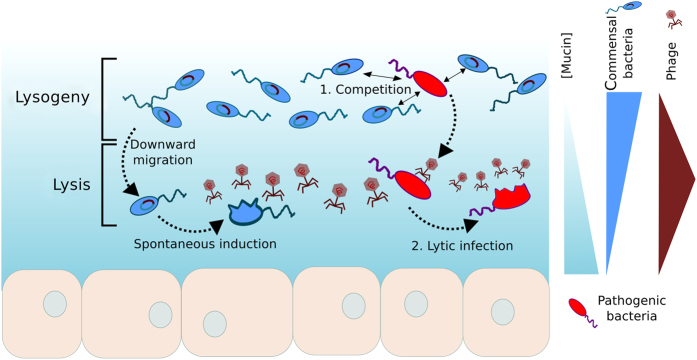
Phages can exploit their bacterial hosts by lytic infection, when many viral particles are released at cell lysis, or by lysogeny, when phages integrate into the host's genome. We recently proposed a new dynamic model of bacteria-phage interactions in which lysogeny predominates at high microbial abundance and growth rates. This model, named Piggyback-the-Winner (PtW), contrasts to current accepted models on the frequency of lysis and lysogeny and predicts that phages integrate into their hosts' genomes as prophages when microbial abundances and growth rates are high. According to PtW, switching to the temperate life cycle reduces phage predation control on bacterial abundance and confers superinfection exclusion, preventing that a closely-related phage infects the same bacterial cell. Here we examine how PtW is important for metazoans. Specifically, we postulate that PtW and the recently described bacteriophage adherence to mucus (BAM) model are strongly interrelated and have an important role in the development of the microbiome. In BAM, phage produced by the microbiome attach to mucins and protect underlying epithelial cells from invading bacteria. Spatial structuring of the mucus creates a gradient of phage replication strategies consistent with PtW. We predict that lysogeny is favored at the top mucosal layer and lytic predation predominates in the bacteria-sparse intermediary layers. The lysogeny confers competitive advantage to commensals against niche invasion and the lytic infection eliminates potential pathogens from deeper mucus layers.
噬菌体可以通过裂解感染来利用其细菌宿主,即当许多病毒颗粒在细胞裂解时释放出来;或者通过溶原性,即噬菌体整合到宿主基因组中。我们最近提出了一种新的细菌 - 噬菌体相互作用动态模型,其中溶原性在高微生物丰度和生长速率下占主导地位。这个名为“搭乘赢家”(PtW)的模型,与目前关于裂解和溶原频率的公认模型形成对比,并预测当微生物丰度和生长速率较高时,噬菌体作为原噬菌体整合到宿主基因组中。根据PtW模型,切换到温和生命周期可减少噬菌体对细菌丰度的捕食控制,并赋予超感染排除能力,防止密切相关的噬菌体感染同一细菌细胞。在这里,我们研究PtW模型对后生动物的重要性。具体而言,我们假设PtW模型与最近描述的噬菌体附着于黏液(BAM)模型密切相关,并且在微生物组的发育中起重要作用。在BAM模型中,微生物组产生的噬菌体附着于黏蛋白,保护下层上皮细胞免受入侵细菌的侵害。黏液的空间结构形成了与PtW模型一致的噬菌体复制策略梯度。我们预测溶原性在黏膜顶层更受青睐,而裂解捕食在细菌稀少的中间层占主导地位。溶原性赋予共生菌对抗生态位入侵的竞争优势,而裂解感染则从更深的黏液层消除潜在病原体。