Department of Periodontology and Conservative Dentistry, Muenster University Hospital, Muenster, Germany.
Department of Periodontology, University Hospital Wuerzburg, Wuerzburg, Germany.
J Periodontal Res. 2019 Aug;54(4):435-443. doi: 10.1111/jre.12645. Epub 2019 Mar 9.
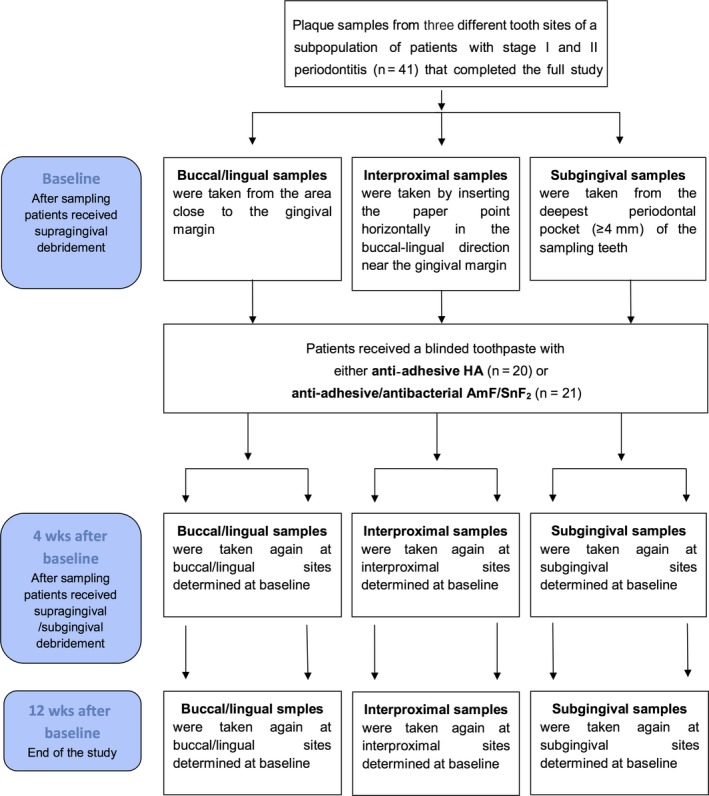
This subgroup analysis of a 12-week randomized, double-blind, and two-center trial aimed to evaluate whether two different toothpaste formulations can differentially modulate the dental microbiome.
Forty one mild to moderate periodontitis patients used as an adjunct to periodontal treatment either a toothpaste with anti-adhesive zinc-substituted carbonated hydroxyapatite (HA) or with antimicrobial and anti-adhesive amine fluoride/stannous fluoride (AmF/SnF ) during a 12-week period. Plaque samples from buccal/lingual, interproximal, and subgingival sites were taken at baseline, 4 weeks after oral hygiene phase, and 8 weeks after periodontal therapy. Samples were analyzed with paired-end Illumina Miseq 16S rDNA sequencing. The differences and changes on community level (alpha and beta diversity) and on the level of single agglomerated ribosomal sequence variants (aRSV) were calculated with analysis of covariance (ANCOVA) and likelihood ratio test (LRT).
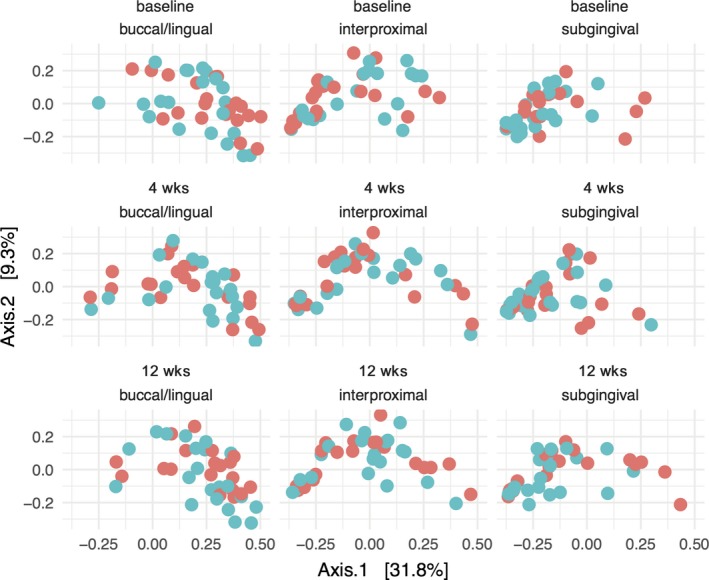
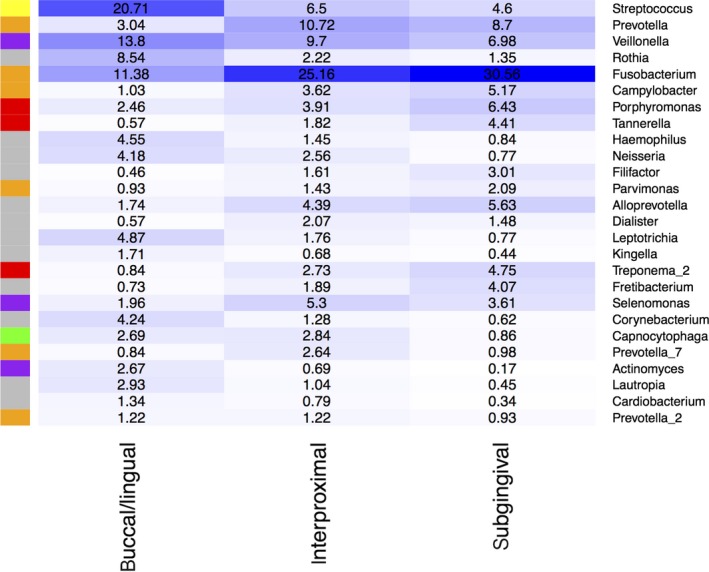
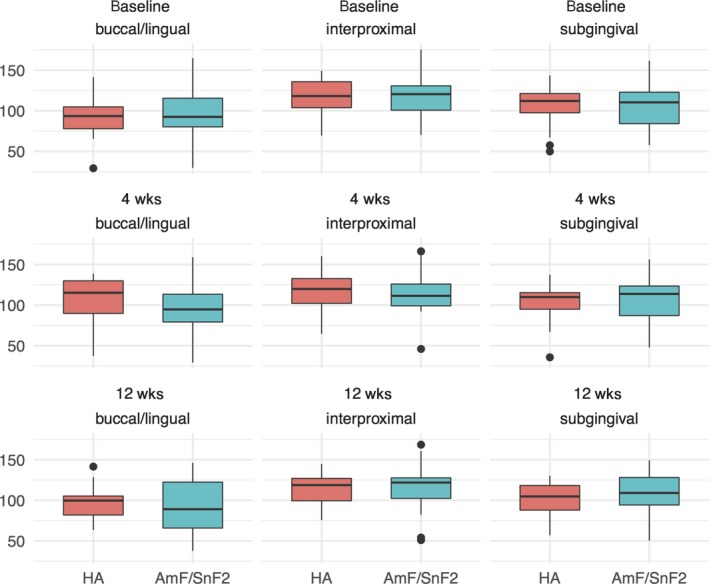
Interproximal and subgingival sites harbored predominately Fusobacterium and Prevotella species associated with periodontitis, whereas buccal/lingual sites harbored mainly Streptococcus and Veillonella species associated with periodontal health. Alpha and beta diversity did not change noticeably differently between both toothpaste groups (P > 0.05, ANCOVA). Furthermore, none of the aRSVs showed a noticeably different change between the tested toothpastes during periodontal therapy (P > 0.05, LRT).
The use of a toothpaste containing anti-adhesive HA did not induce statistically noticeably different changes on microbial composition compared to an antimicrobial and anti-adhesive AmF/SnF formulation.
本亚组分析是一项为期 12 周的随机、双盲、两中心试验的一部分,旨在评估两种不同的牙膏配方是否能不同程度地调节口腔微生物组。
41 名轻度至中度牙周炎患者在牙周治疗的辅助下,使用一种含有抗黏附锌取代碳酸羟基磷灰石(HA)的牙膏或含有抗菌和抗黏附胺氟化物/锡氟化物(AmF/SnF)的牙膏,在 12 周内使用。在基线、口腔卫生阶段后 4 周和牙周治疗后 8 周,从颊/舌、邻间和龈下部位采集菌斑样本。使用 Illumina Miseq 16S rDNA 测序对样本进行分析。采用协方差分析(ANCOVA)和似然比检验(LRT)计算群落水平(alpha 和 beta 多样性)和单个聚集核糖体序列变异体(aRSV)水平的差异和变化。
邻间和龈下部位主要携带与牙周炎相关的 Fusobacterium 和 Prevotella 物种,而颊/舌部位主要携带与牙周健康相关的 Streptococcus 和 Veillonella 物种。两种牙膏组之间的 alpha 和 beta 多样性变化不明显(P>0.05,ANCOVA)。此外,在牙周治疗期间,两种牙膏之间没有一个 aRSV 显示出明显不同的变化(P>0.05,LRT)。
与含有抗菌和抗黏附 AmF/SnF 配方的牙膏相比,使用含有抗黏附 HA 的牙膏不会在微生物组成上引起统计学上明显不同的变化。