Faculty of Pharmacy, Tehran University of Medical Sciences, Tehran, Iran.
PhytoPharmacology Interest Group (PPIG), Universal Scientific Education and Research Network (USERN), Tehran, Iran.
Daru. 2019 Jun;27(1):389-406. doi: 10.1007/s40199-019-00255-6. Epub 2019 Mar 9.
Chemotherapy, as one of the main approaches of cancer treatment, is accompanied with several adverse effects, including chemotherapy-induced peripheral neuropathy (CIPN). Since current methods to control the condition are not completely effective, new treatment options should be introduced. Medicinal plants can be suitable candidates to be assessed regarding their effects in CIPN. Current paper reviews the available preclinical and clinical studies on the efficacy of herbal medicines in CIPN.
Electronic databases including PubMed, Scopus, and Cochrane library were searched with the keywords "neuropathy" in the title/abstract and "plant", "extract", or "herb" in the whole text. Data were collected from inception until April 2018.
Plants such as chamomile (Matricaria chamomilla L.), sage (Salvia officinalis L.), cinnamon (Cinnamomum cassia (L.) D. Don), and sweet flag (Acorus calamus L.) as well as phytochemicals like matrine, curcumin, and thioctic acid have demonstrated beneficial effects in animal models of CIPN via prevention of axonal degeneration, decrease in total calcium level, improvement of endogenous antioxidant defense mechanisms such as superoxide dismutase and reduced glutathione, and regulation of neural cell apoptosis, nuclear factor-ĸB, cyclooxygenase-2, and nitric oxide signaling. Also, five clinical trials have evaluated the effect of herbal products in patients with CIPN.
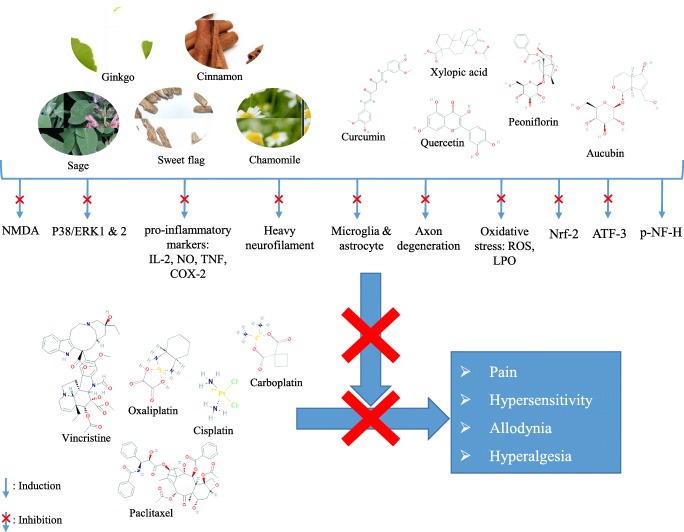
There are currently limited clinical evidence on medicinal plants for CIPN which shows the necessity of future mechanistic studies, as well as well-designed clinical trial for further confirmation of the safety and efficacy of herbal medicines in CIPN. Graphical abstract Schematic mechanisms of medicinal plants to prevent chemotherapy-induced neuropathy: NO: nitric oxide, TNF: tumor necrosis factor, PG: prostaglandin, NF-ĸB: nuclear factor kappa B, LPO: lipid peroxidation, ROS: reactive oxygen species, COX: cyclooxygenase, IL: interleukin, ERK: extracellular signal-related kinase, X: inhibition, ↓: induction.
化疗作为癌症治疗的主要方法之一,伴随着多种不良反应,包括化疗引起的周围神经病变(CIPN)。由于目前控制这种疾病的方法并非完全有效,因此应引入新的治疗选择。药用植物可以作为评估其在 CIPN 中作用的合适候选物。本文综述了草药治疗 CIPN 的现有临床前和临床研究。
使用标题/摘要中包含“神经病变”和全文中包含“植物”、“提取物”或“草药”的关键词,在 PubMed、Scopus 和 Cochrane 图书馆等电子数据库中进行搜索。数据收集从建库开始到 2018 年 4 月。
一些植物,如甘菊(Matricaria chamomilla L.)、鼠尾草(Salvia officinalis L.)、肉桂(Cinnamomum cassia (L.) D. Don)和菖蒲(Acorus calamus L.)以及一些植物化学物质,如苦参碱、姜黄素和硫辛酸,已通过预防轴突变性、降低总钙水平、改善超氧化物歧化酶和还原型谷胱甘肽等内源性抗氧化防御机制、调节神经细胞凋亡、核因子-κB、环氧合酶-2 和一氧化氮信号通路,在 CIPN 的动物模型中显示出有益作用。此外,有五项临床试验评估了草药产品在 CIPN 患者中的疗效。
目前,药用植物治疗 CIPN 的临床证据有限,这表明有必要进行进一步的机制研究以及设计良好的临床试验,以进一步证实草药治疗 CIPN 的安全性和疗效。