Trak-Fellermeier María A, Campos Maribel, Meléndez Marytere, Pomeroy Jeremy, Palacios Cristina, Rivera-Viñas Juana, Méndez Keimari, Febo Irma, Willett Walter, Gillman Mathew W, Franks Paul W, Joshipura Kaumudi
Center for Clinical Research and Health Promotion, School of Dental Medicine, Medical Sciences Campus, University of Puerto Rico, San Juan, PR, USA,
Clinical Research Center, Marshfield Clinic Research Institute, Marshfield Clinic Health System, Marshfield, WI, USA.
Diabetes Metab Syndr Obes. 2019 Feb 18;12:225-238. doi: 10.2147/DMSO.S179009. eCollection 2019.
Inappropriate gestational weight gain (GWG) has been associated with adverse perinatal events. High rates of GWG have been reported among Hispanic women. Observational studies indicate that dietary and physical activity interventions during the prenatal period may improve maternal and infant health, but very few randomized trials have been conducted among high-risk overweight/obese Hispanic women. Accordingly, we conducted a lifestyle intervention among high-risk pregnant women and evaluated its impact on achieving appropriate GWG and on improving birthweight.
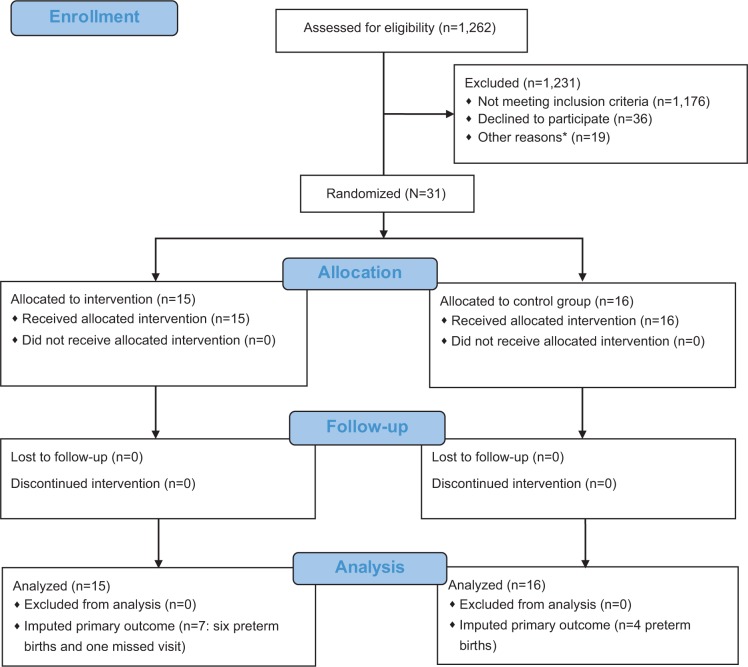
Eligible overweight/obese women presenting at the University Hospital in Puerto Rico with a singleton pregnancy before 16 gestational weeks were recruited and randomized to lifestyle intervention (n=15) or control group (n=16). The lifestyle intervention focused on improving physical activity and diet quality and optimizing caloric intake. We evaluated the impact of the lifestyle intervention on achieving appropriate GWG and on infant birthweight. Poisson and linear regression analyses were performed.
The primary intent to treat analysis showed no significant effect on achievement of appropriate GWG/week through 36 weeks in the intervention group (4/15 women) when compared with the control group (3/16 women) (adjusted incidence rate ratio =1.14; 95% CI: 0.20, 6.67). Although not statistically significant, women in the intervention group (6/15) were 1.7 times more likely to achieve appropriate weekly GWG until delivery when compared with controls (4/16 women) (adjusted incidence rate ratio = 1.67; 95% CI: 0.40, 6.94). We observed lower adjusted birthweight-for-length z-scores in the intervention compared with the control group among male newborns with -score difference -1.74 (-3.04, -0.43), but not among females -0.83 (-3.85, 2.19). These analyses were adjusted for age and baseline body mass index.
Although larger studies are required to determine whether women with obesity may benefit from prenatal lifestyle interventions targeting GWG, our results are suggestive of the intervention improving adherence to established Institute of Medicine guidelines.
孕期体重增加不当(GWG)与不良围产期事件相关。据报道,西班牙裔女性的GWG发生率较高。观察性研究表明,孕期的饮食和体育活动干预可能改善母婴健康,但针对高危超重/肥胖西班牙裔女性进行的随机试验却很少。因此,我们对高危孕妇进行了生活方式干预,并评估了其对实现适当GWG及改善出生体重的影响。
招募在波多黎各大学医院就诊、孕16周前单胎妊娠的符合条件的超重/肥胖女性,并随机分为生活方式干预组(n = 15)或对照组(n = 16)。生活方式干预的重点是改善体育活动和饮食质量,并优化热量摄入。我们评估了生活方式干预对实现适当GWG及婴儿出生体重的影响。进行了泊松回归和线性回归分析。
主要意向性分析显示,与对照组(3/16名女性)相比,干预组(4/15名女性)在孕36周时每周实现适当GWG方面无显著效果(调整后的发病率比 = 1.14;95%可信区间:0.20,6.67)。尽管无统计学意义,但与对照组(4/16名女性)相比,干预组女性(6/15)在分娩前每周实现适当GWG的可能性高1.7倍(调整后的发病率比 = 1.67;95%可信区间:0.40,6.94)。我们观察到,干预组男性新生儿的调整后的身长别体重z评分低于对照组,评分差异为-1.74(-3.04,-0.43),但女性中无差异,为-0.83(-3.85,2.19)。这些分析对年龄和基线体重指数进行了调整。
虽然需要更大规模的研究来确定肥胖女性是否能从针对GWG的孕期生活方式干预中获益,但我们的结果提示该干预可提高对美国医学研究所既定指南的依从性。