DAHFMO-Unit of Histology and Medical Embryology, Sapienza University of Rome, Laboratory Affiliated to Istituto Pasteur Italia-Fondazione Cenci Bolognetti, Via A. Scarpa, 14, 00161 Rome, Italy.
Istituto di Istologia ed Embriologia, Università Cattolica del Sacro Cuore, Fondazione Policlinico Universitario A. Gemelli IRCCS, 00168 Rome, Italy.
Cells. 2019 Mar 11;8(3):232. doi: 10.3390/cells8030232.
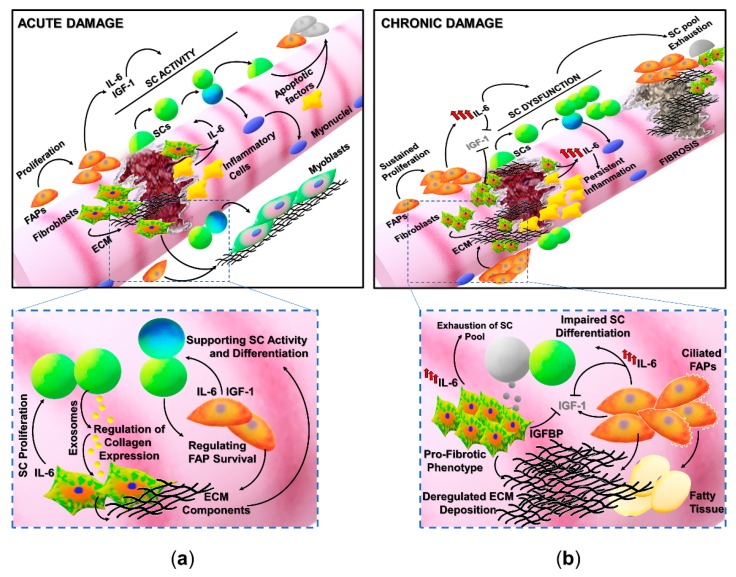
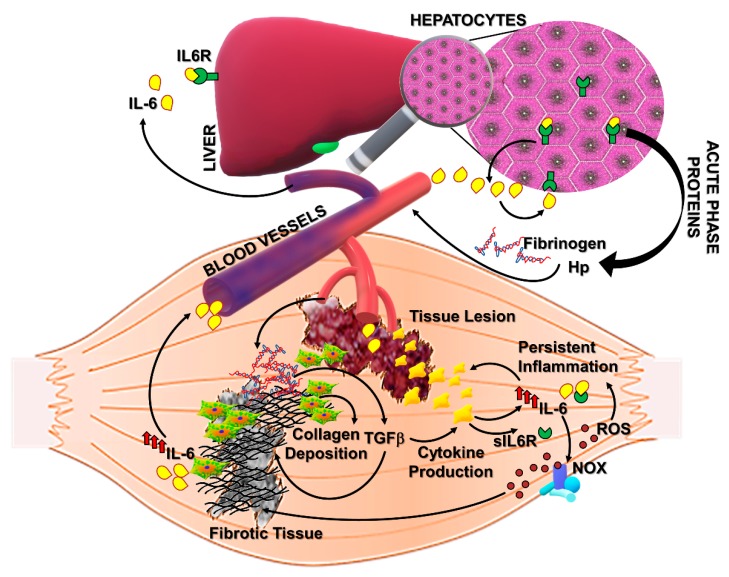
Muscle regeneration, characterized by the activation and proliferation of satellite cells and other precursors, is accompanied by an inflammatory response and the remodeling of the extracellular matrix (ECM), necessary to remove cellular debris and to mechanically support newly generated myofibers and activated satellite cells. Muscle repair can be considered concluded when the tissue architecture, vascularization, and innervation have been restored. Alterations in these connected mechanisms can impair muscle regeneration, leading to the replacement of functional muscle tissue with a fibrotic scar. In the present review, we will discuss the cellular mediators of fibrosis and how the altered expression and secretion of soluble mediators, such as IL-6 and IGF-1, can modulate regulatory networks involved in the altered regeneration and fibrosis during aging and diseases.
肌肉再生的特征是卫星细胞和其他前体细胞的激活和增殖,伴随着炎症反应和细胞外基质 (ECM) 的重塑,这对于清除细胞碎片以及机械支持新生成的肌纤维和激活的卫星细胞是必要的。当组织结构、血管生成和神经支配得到恢复时,可以认为肌肉修复已经完成。这些相关机制的改变会损害肌肉再生,导致功能性肌肉组织被纤维化瘢痕所取代。在本综述中,我们将讨论纤维化的细胞介质,以及可溶性介质(如 IL-6 和 IGF-1)表达和分泌的改变如何调节与衰老和疾病过程中改变的再生和纤维化相关的调控网络。