Li Chengsi, Zeng Haiyan, Zhang Jumei, He Wenjing, Ling Na, Chen Moutong, Wu Shi, Lei Tao, Wu Haoming, Ye Yingwang, Ding Yu, Wang Juan, Wei Xianhu, Zhang Youxiong, Wu Qingping
State Key Laboratory of Applied Microbiology South China, Guangdong Provincial Key Laboratory of Microbiology Culture Collection and Application, Guangdong Open Laboratory of Applied Microbiology, Guangdong Institute of Microbiology, Guangzhou, China.
Department of Food Science and Technology, Jinan University, Guangzhou, China.
Front Microbiol. 2019 Feb 26;10:283. doi: 10.3389/fmicb.2019.00283. eCollection 2019.
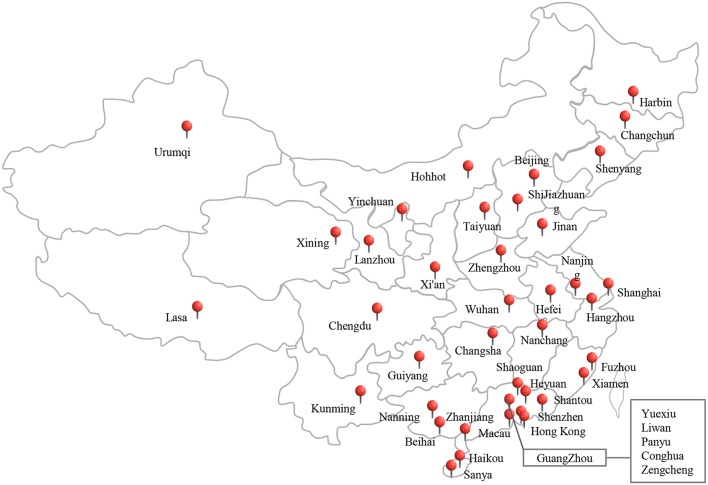
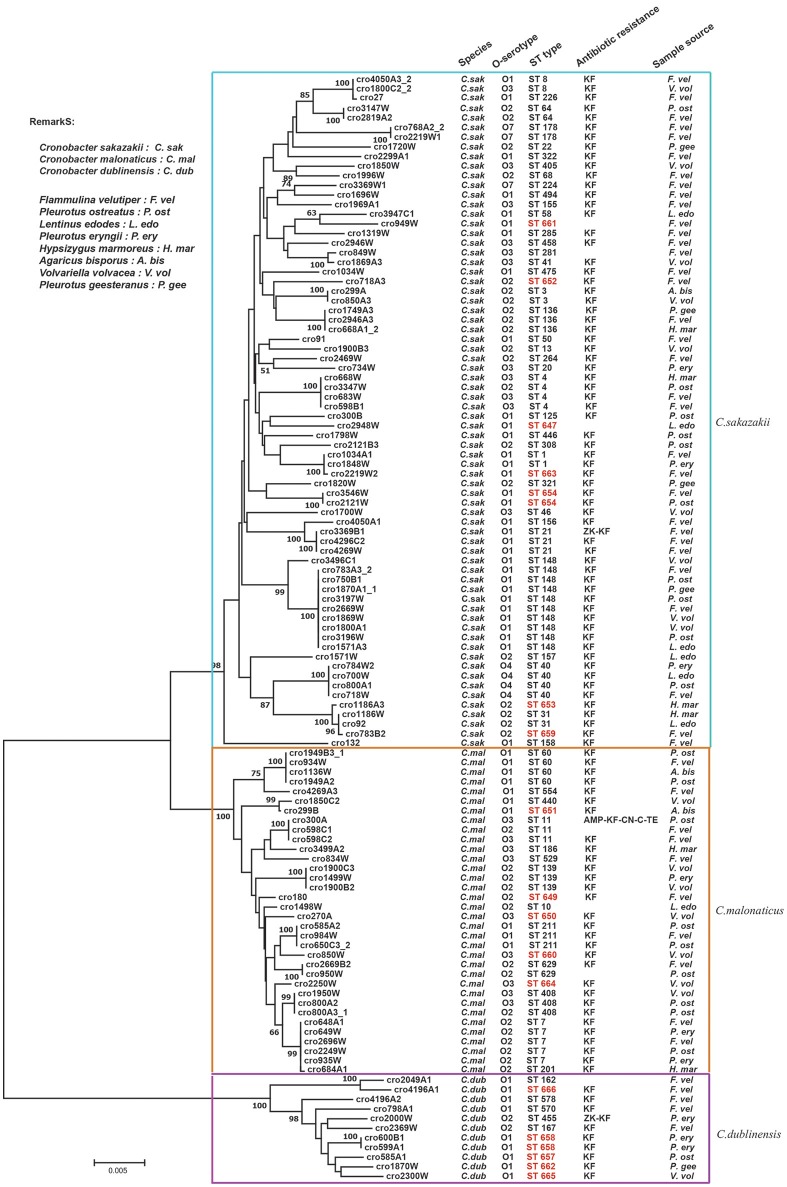
spp. are foodborne pathogens that can infect and cause life-threatening diseases in all age groups, particularly in infants and immunocompromised elderly. This study aimed to investigate the prevalence, antibiotic susceptibility, and molecular characteristics of spp. isolates in edible mushrooms collected from 44 cities in China. In total, 668 edible mushrooms were collected from traditional retail markets and supermarkets and were analyzed by quantitative methods, PCR-based serotyping, multilocus sequence typing (MLST), and antibiotic susceptibility testing. Among the 668 samples tested, 89 (13.32%) were positive for spp., and the contamination levels exceeded the 110 most probable number (MPN)/g in 13.48% (12/89) of the samples. samples had the highest contamination rate of 17.54% (37/211), whereas samples had the lowest contamination rate of 3.28% (2/61). Ten serotypes were identified among 115 isolates, of which the serogroup O1 ( = 32) was the primary serotype. MLST indicated that there was quite high genetic diversity in spp. and 72 sequence types were identified, 17 of which were new. Notably, ST148 ( = 10) was the most prevalent, followed by ST7 ( = 5). Antibiotic susceptibility testing revealed that the majority of spp. strains were susceptible to the 16 antibiotics tested. However, a portion of isolates exhibited relatively high resistance to cephalothin, with resistance and intermediate rates of 93.91 and 6.09%, respectively. One isolate (cro300A) was multidrug-resistant, with resistance to five antibiotics. Overall, this large-scale study revealed the relatively high prevalence and high genetic diversity of spp. on edible mushrooms in China, indicating a potential public health concern. To our knowledge, this is the first large-scale and systematic study on the prevalence of spp. on edible mushrooms in China, and the findings can provide valuable information that can guide the establishment of effective measures for the control and precaution of spp on edible mushrooms during production processes.
[具体菌名]属是食源性病原体,可感染所有年龄组并导致危及生命的疾病,尤其是在婴儿和免疫功能低下的老年人中。本研究旨在调查从中国44个城市采集的食用菌中[具体菌名]属分离株的流行情况、抗生素敏感性和分子特征。总共从传统零售市场和超市收集了668份食用菌,并通过定量方法、基于PCR的血清分型、多位点序列分型(MLST)和抗生素敏感性测试进行分析。在测试的668个样本中,89个(13.32%)[具体菌名]属呈阳性,13.48%(12/89)的样本污染水平超过110最可能数(MPN)/克。[具体菌名]样本的污染率最高,为17.54%(37/211),而[具体菌名]样本的污染率最低,为3.28%(2/61)。在115株分离株中鉴定出10种血清型,其中O1血清群(=32)是主要血清型。MLST表明[具体菌名]属存在相当高的遗传多样性,鉴定出72种序列类型,其中17种是新的。值得注意的是,ST148(=10)最为普遍,其次是ST7(=5)。抗生素敏感性测试表明,大多数[具体菌名]属菌株对测试的16种抗生素敏感。然而,一部分分离株对头孢噻吩表现出相对较高的耐药性,耐药率和中介率分别为93.91%和6.09%。一株分离株(cro300A)具有多重耐药性,对五种抗生素耐药。总体而言,这项大规模研究揭示了中国食用菌上[具体菌名]属的相对高流行率和高遗传多样性,表明存在潜在的公共卫生问题。据我们所知,这是中国首次关于食用菌上[具体菌名]属流行情况的大规模系统性研究,研究结果可为制定食用菌生产过程中[具体菌名]属的有效控制和预防措施提供有价值的信息。