Lu Yan, Liu Peng, Li Changguo, Sha Miao, Fang Jingquan, Gao Jingwen, Xu Xiaoxi, Matthews Karl R
College of Food Science, Northeast Agricultural University, Harbin, China.
Green Food Research Institute of Heilongjiang (National Research Center of Dairy Engineering and Technology), Northeast Agricultural University, Harbin, China.
Front Microbiol. 2019 Aug 21;10:1938. doi: 10.3389/fmicb.2019.01938. eCollection 2019.
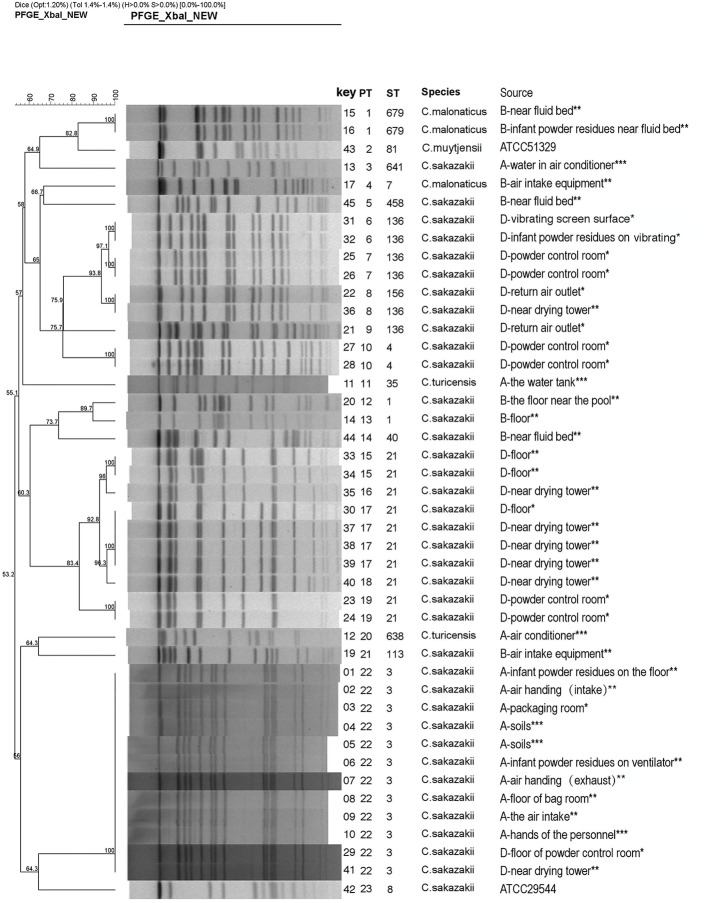
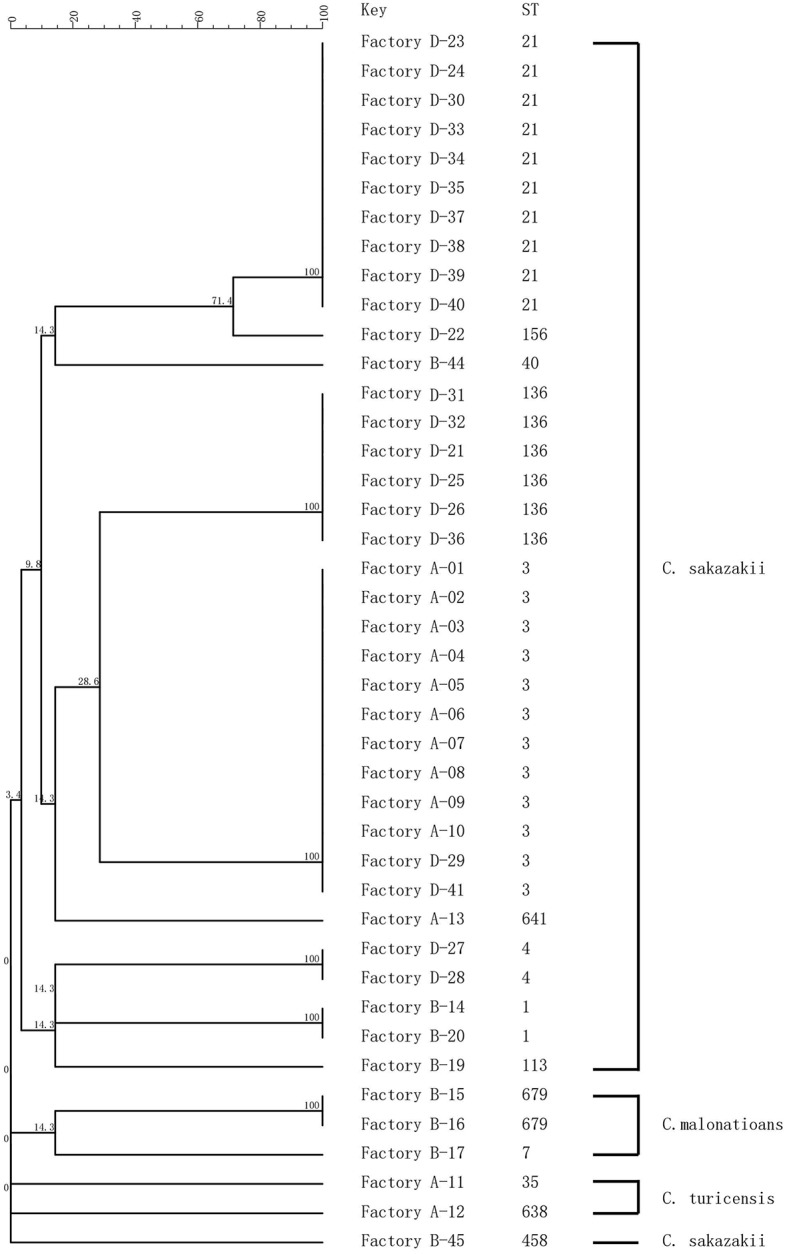
The aim of this study was to investigate the prevalence and genotypic characteristics of isolated from powdered infant formula (PIF) manufacturing facilities and to identify a potential source of contamination. A total of 42 isolates (5%) were detected in 835 environmental samples collected during the surveillance study. These isolates included . ( = 37), . ( = 3), and ( = 2). The isolates were divided into 14 sequence types (STs) by multi-locus sequence typing (MLST) and 21 pulsotypes (PTs) using pulsed-field gel electrophoresis (PFGE). The dominant sequence types were ST3 ( = 12) and ST21 ( = 10), followed by ST136 ( = 6). The major PTs were PT22 ( = 12) and PT17 ( = 4) based on 100% similarity. Strains isolated from samples collected at the same production facility showed closer phylogenetic relation than those collected from distinct facilities. The result of extensive traceback sampling showed that PIF residues (PIF dust in production areas), fluid beds, drying areas, floors, and soil samples collected adjacent to the production facilities were the primary positive areas for . The present study outlines an effective approach to determine prevalence and genetic diversity of isolates associated with contamination of PIF.
本研究的目的是调查从婴儿配方奶粉(PIF)生产设施中分离出的[具体细菌名称未给出]的流行情况和基因型特征,并确定潜在的污染源。在监测研究期间收集的835份环境样本中,共检测到42株分离株(占5%)。这些分离株包括[具体细菌名称未给出](n = 37)、[具体细菌名称未给出](n = 3)和[具体细菌名称未给出](n = 2)。通过多位点序列分型(MLST)将分离株分为14个序列类型(STs),并使用脉冲场凝胶电泳(PFGE)分为21个脉冲型(PTs)。主要的序列类型是ST3(n = 12)和ST21(n = 10),其次是ST136(n = 6)。基于100%的相似性,主要的脉冲型是PT22(n = 12)和PT17(n = 4)。从同一生产设施采集的样本中分离出的菌株显示出比从不同设施采集的菌株更密切的系统发育关系。广泛的追溯采样结果表明,PIF残留物(生产区域的PIF粉尘)、流化床、干燥区域、地板以及生产设施附近采集的土壤样本是[具体细菌名称未给出]的主要阳性区域。本研究概述了一种有效的方法来确定与PIF污染相关的[具体细菌名称未给出]分离株的流行情况和遗传多样性。