Huang Lin-Ting, Wu Shi-Lan, Liao Xin, Ma Shu-Juan, Tan Hong-Zhuan
Department of Epidemiology and Health Statistics, Xiangya School of Public Health, Central South University, Changsha 410083, Hunan Province, China.
World J Clin Cases. 2019 Mar 6;7(5):572-584. doi: 10.12998/wjcc.v7.i5.572.
Adiponectin (ADIPOQ) is an important factor involved in the regulation of both carbohydrate and lipid metabolism. Polymorphisms in the gene are known to influence an individual's predisposition to metabolic syndrome and type 2 diabetes. Moreover, women with gestational diabetes mellitus (GDM) are at an increased risk of developing type 2 diabetes. Several studies have been conducted previously to assess the association between polymorphisms and GDM; however, the results of the association are inconclusive.
To quantitatively evaluate the association between , , and polymorphisms and the risk of GDM.
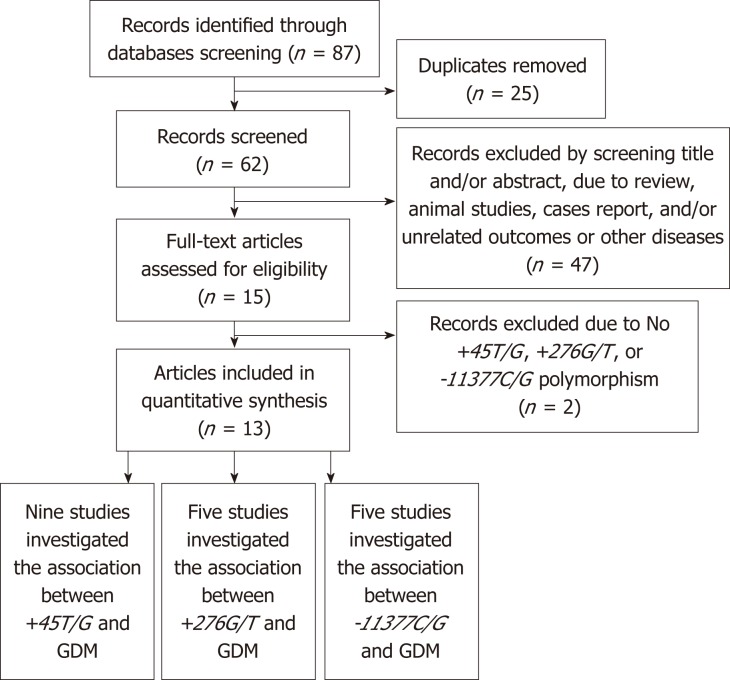
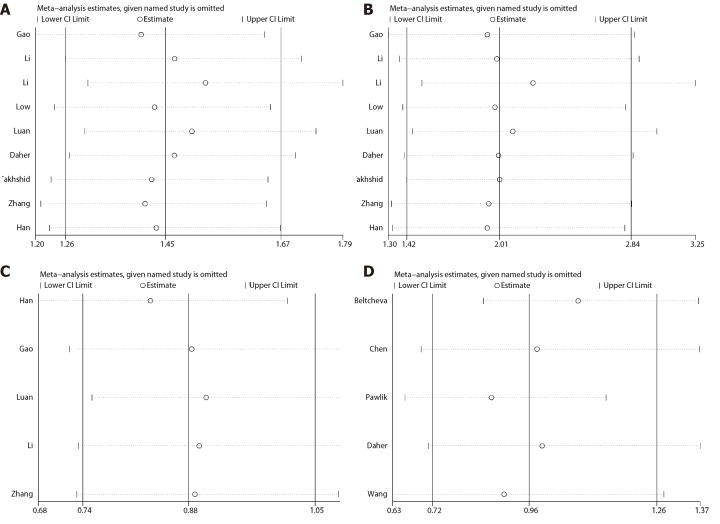
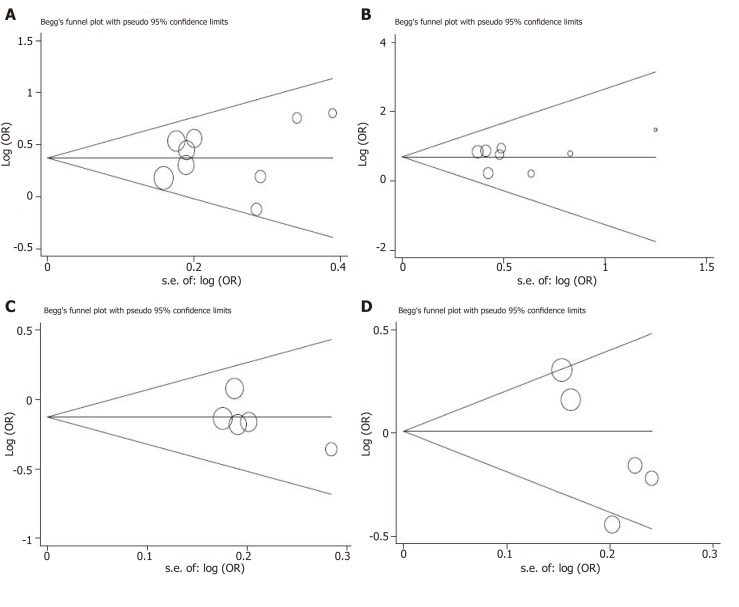
A systematic search of EMBASE, PubMed, CNKI, Web of Science, and WANFANG DATA was conducted up to October 20, 2018. We calculated merged odds ratios (ORs) with 95% confidence intervals (CIs) using a fixed-effects or random-effects model depending on the between-study heterogeneity to evaluate the association between , , and polymorphisms and the risk of GDM. Subgroup analysis was performed by ethnicity. Publication and sensitivity bias analyses were performed to test the robustness of the association. All statistical analyses were conducted using Stata12.0.
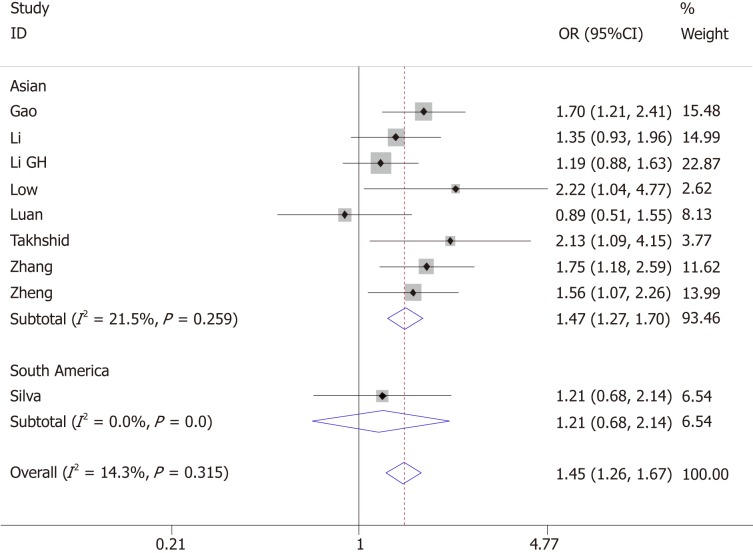
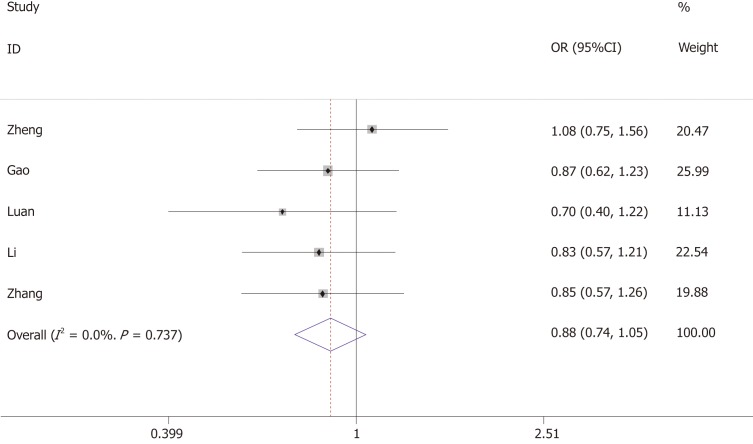
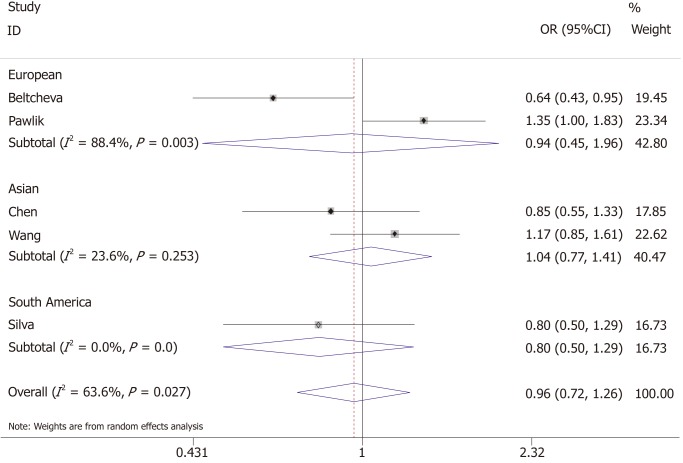
Nine studies of included 1024 GDM cases and 1059 controls, five studies of included 590 GDM cases and 595 controls, and five studies of included 722 GDM cases and 791 controls. Pooled ORs indicated that increased GDM risk in Asians (allelic model: OR = 1.47, 95%CI: 1.27-1.70, = 0.000; dominant model: OR = 1.54, 95%CI: 1.27-1.85, = 0.000; recessive model: OR=2.00, 95%CI: 1.43-2.85, = 0.000), not in South Americans (allelic model: OR = 1.21, 95%CI: 0.68-2.41, = 0.510; dominant model: OR = 1.13, 95%CI: 0.59-2.15, = 0.710; recessive model: OR = 2.18, 95%CI: 0.43-11.07, = 0.350). There were no significant associations between (allelic model: OR = 0.88, 95%CI: 0.74-1.05, = 0.158; dominant model: OR = 0.91, 95%CI: 0.65-1.26, = 0.561; recessive model: OR = 0.82, 95%CI: 0.64-1.05, = 0.118) or (allelic model: OR = 0.96, 95%CI: 0.72-1.26, = 0.750; dominant model: OR = 1.00, 95%CI: 0.73-1.37, = 0.980; recessive model: OR = 0.90, 95%CI: 0.61-1.32, = 0.570) and the risk of GDM.
Our meta-analysis shows the critical role of the polymorphism in GDM, especially in Asians. Studies focused on delineating ethnicity-specific factors with larger sample sizes are needed.
脂联素(ADIPOQ)是参与碳水化合物和脂质代谢调节的重要因素。已知该基因的多态性会影响个体患代谢综合征和2型糖尿病的易感性。此外,患有妊娠期糖尿病(GDM)的女性患2型糖尿病的风险增加。此前已经进行了多项研究来评估该基因多态性与GDM之间的关联;然而,关联结果尚无定论。
定量评估该基因多态性与GDM风险之间的关联。
截至2018年10月20日,对EMBASE、PubMed、中国知网、Web of Science和万方数据进行了系统检索。根据研究间的异质性,使用固定效应或随机效应模型计算合并比值比(OR)及其95%置信区间(CI),以评估该基因多态性与GDM风险之间的关联。按种族进行亚组分析。进行发表偏倚和敏感性分析以检验关联的稳健性。所有统计分析均使用Stata12.0进行。
关于该基因的9项研究纳入了1024例GDM病例和1059例对照,关于该基因的5项研究纳入了590例GDM病例和595例对照,关于该基因的5项研究纳入了722例GDM病例和791例对照。合并OR表明,该基因多态性在亚洲人中增加了GDM风险(等位基因模型:OR = 1.47,95%CI:1.27 - 1.70,P = 0.000;显性模型:OR = 1.54,95%CI:1.27 - 1.85,P = 0.000;隐性模型:OR = 2.00,95%CI:1.43 - 2.85,P = 0.000),而在南美洲人中则无此关联(等位基因模型:OR = 1.21,95%CI:0.68 - 2.41,P = 0.510;显性模型:OR = 1.13,95%CI:0.59 - 2.15,P = 0.710;隐性模型:OR = 2.18,95%CI:0.43 - 11.07,P = 0.350)。该基因多态性(等位基因模型:OR = 0.88,95%CI:0.74 - 1.05,P = 0.158;显性模型:OR = 0.91,95%CI:0.65 - 1.26,P = 0.561;隐性模型:OR = 0.82,95%CI:0.64 - 1.05,P = 0.118)或该基因多态性(等位基因模型:OR = 0.96,95%CI:0.72 - 1.26,P = 0.750;显性模型:OR = 1.00,95%CI:0.73 - 1.37,P = 0.980;隐性模型:OR = 0.90,95%CI:0.61 - 1.32,P = 0.570)与GDM风险之间均无显著关联。
我们的荟萃分析显示该基因多态性在GDM中起关键作用,尤其是在亚洲人中。需要开展样本量更大、专注于阐明种族特异性因素的研究。