Centre of Studies in Geography and Spatial Planning, University of Coimbra, 3004-530 Coimbra, Portugal.
Department of Geography and Tourism, University of Coimbra, 3004-530 Coimbra, Portugal.
Int J Environ Res Public Health. 2019 Mar 7;16(5):836. doi: 10.3390/ijerph16050836.
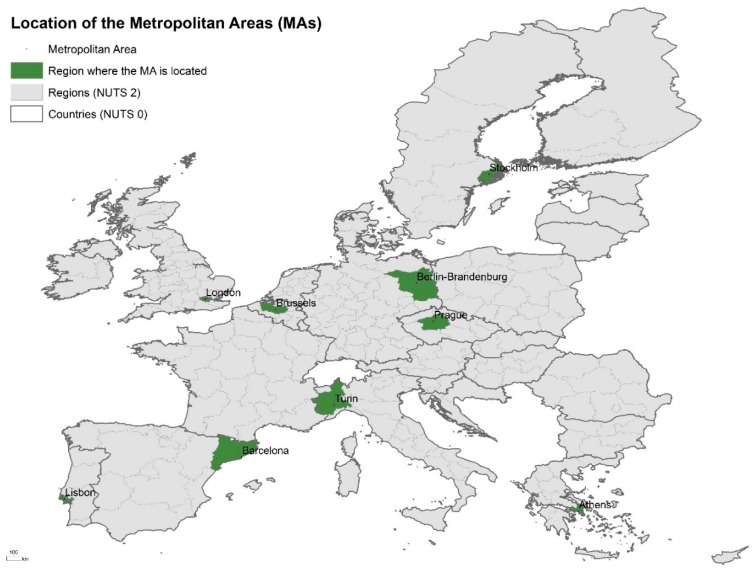
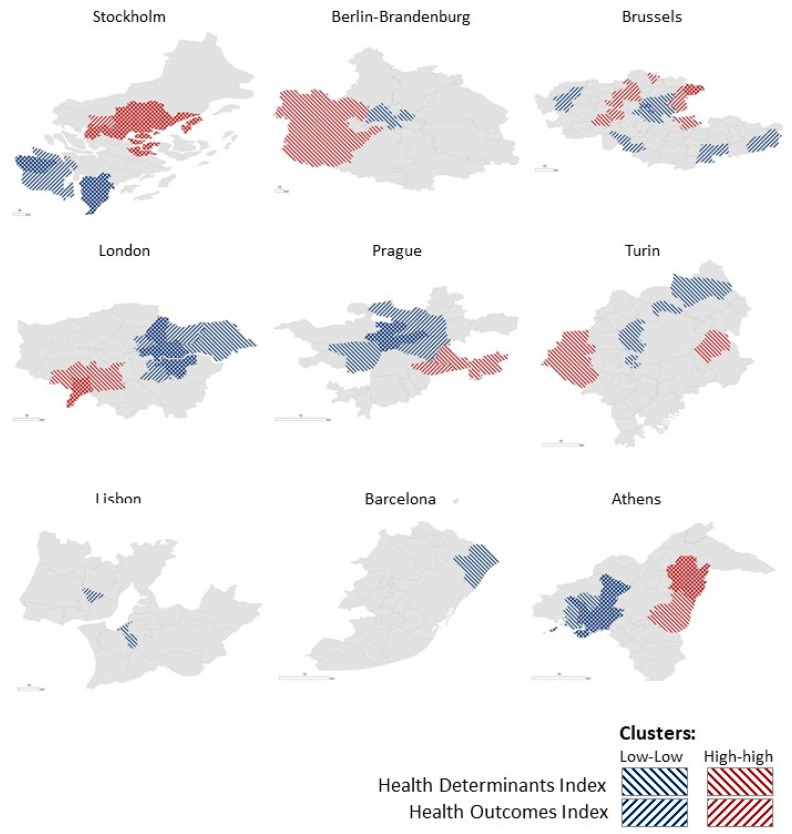
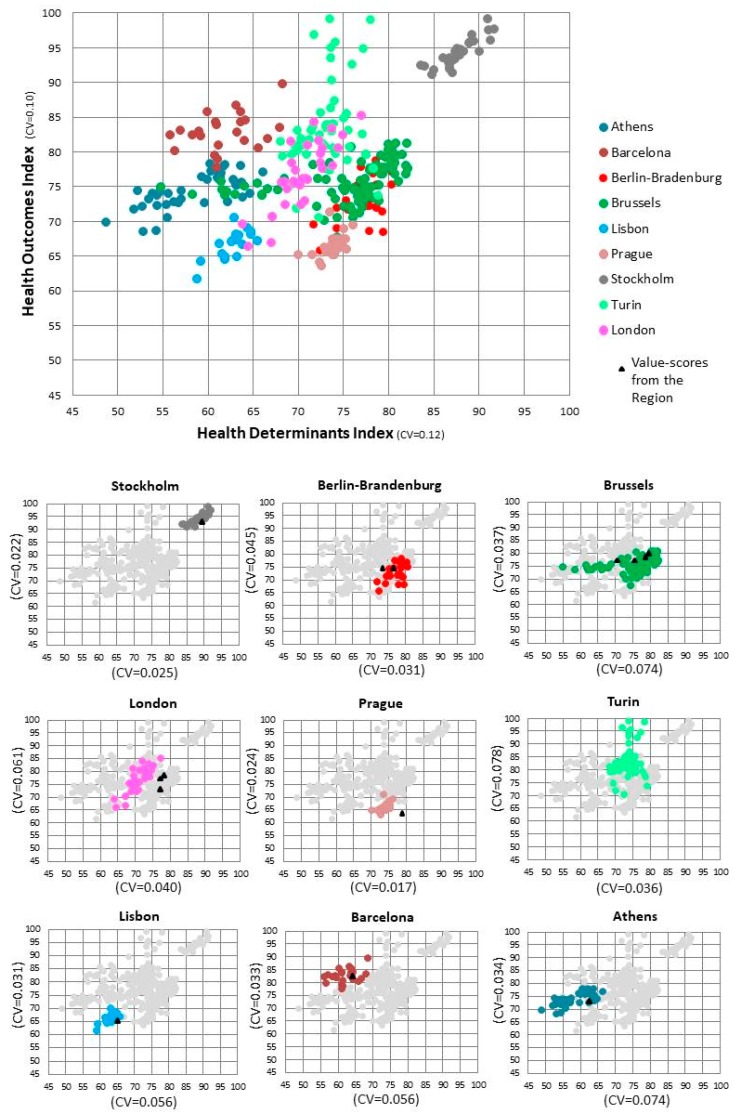
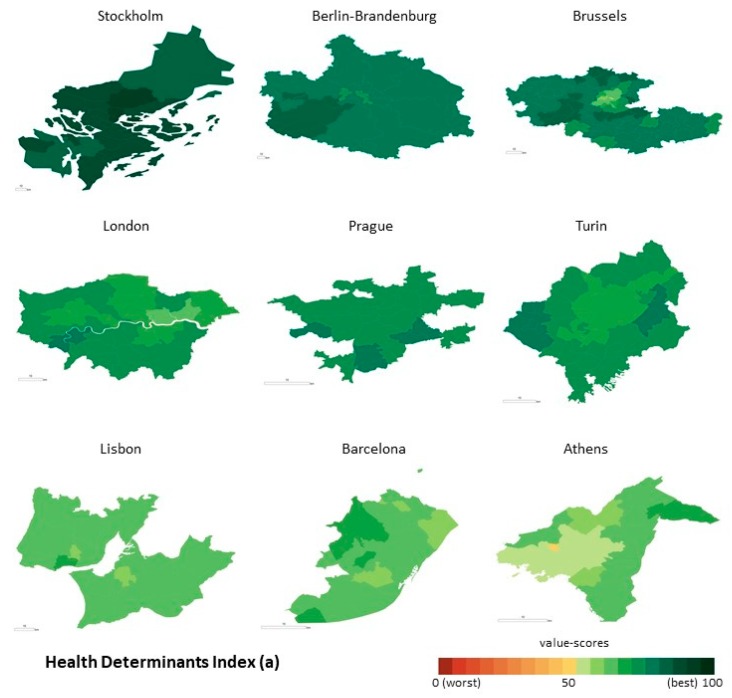
The different geographical contexts seen in European metropolitan areas are reflected in the uneven distribution of health risk factors for the population. Accumulating evidence on multiple health determinants point to the importance of individual, social, economic, physical and built environment features, which can be shaped by the local authorities. The complexity of measuring health, which at the same time underscores the level of intra-urban inequalities, calls for integrated and multidimensional approaches. The aim of this study is to analyse inequalities in health determinants and health outcomes across and within nine metropolitan areas: Athens, Barcelona, Berlin-Brandenburg, Brussels, Lisbon, London, Prague, Stockholm and Turin. We use the EURO-HEALTHY Population Health Index (PHI), a tool that measures health in two components: Health Determinants and Health Outcomes. The application of this tool revealed important inequalities between metropolitan areas: Better scores were found in Northern cities when compared with their Southern and Eastern counterparts in both components. The analysis of geographical patterns within metropolitan areas showed that there are intra-urban inequalities, and, in most cities, they appear to form spatial clusters. Identifying which urban areas are measurably worse off, in either Health Determinants or Health Outcomes, or both, provides a basis for redirecting local action and for ongoing comparisons with other metropolitan areas.
欧洲大都市地区的不同地理背景反映在人口健康风险因素的分布不均上。越来越多的关于多种健康决定因素的证据表明,个人、社会、经济、物质和建筑环境特征非常重要,而这些特征可以由地方当局来塑造。衡量健康的复杂性同时也突显了城市内部不平等的程度,这需要采取综合和多维度的方法。本研究旨在分析九个大都市地区(雅典、巴塞罗那、柏林-勃兰登堡、布鲁塞尔、里斯本、伦敦、布拉格、斯德哥尔摩和都灵)之间和内部的健康决定因素和健康结果的不平等。我们使用了 EURO-HEALTHY 人口健康指数(PHI),这是一种衡量健康的两个组成部分的工具:健康决定因素和健康结果。该工具的应用揭示了大都市地区之间的重要不平等:在两个组成部分中,北方城市的得分都高于其南方和东方城市。对大都市地区内部的地理模式进行分析表明,存在城市内部的不平等,而且在大多数城市中,这些不平等似乎形成了空间集群。确定哪些城市地区在健康决定因素或健康结果方面(或两者兼而有之)明显较差,为重新调整地方行动和与其他大都市地区进行持续比较提供了基础。