Hofmann Mathias, Hodžić Adnan, Pouliou Niki, Joachim Anja
Institute of Parasitology, Department of Pathobiology, University of Veterinary Medicine Vienna, Veterinaerplatz 1, 1210, Vienna, Austria.
Animal Medical Center, Kýprou 61, 722 00, Ierapetra, Greece.
Parasitol Res. 2019 May;118(5):1661-1666. doi: 10.1007/s00436-019-06284-z. Epub 2019 Mar 13.
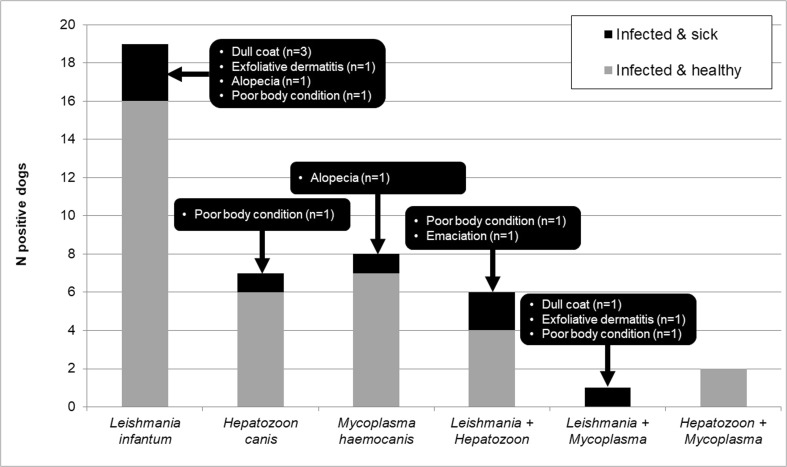
Canine pathogens transmitted by blood-sucking arthropods are of significant importance for veterinary and, in some cases, human health. However, they are still underestimated and rarely investigated in many parts of the Mediterranean region, mostly due to financial reasons. Therefore, in the present paper, we investigated the occurrence of blood-associated pathogens affecting dogs in Crete, Greece. For this purpose, blood samples from 103 shelter dogs were screened for the pathogens by PCR and serological tests. Overall, samples from 43 dogs scored positive for at least one pathogen (41.8%). In particular, antibodies to Leishmania infantum were detected in 26 dogs (25.2%), and 15 and 11 animals were positive for Hepatozoon canis (14.6%) and Mycoplasma haemocanis (10.7%) by PCR, respectively. Co-infections were recorded in nine animals. Clinical signs indicative of infection (alterations of skin or coat or reduced body condition) were detected in 10 animals, four of which were infected with one pathogen, three with two pathogens. Based on the results obtained, dogs from Crete appear to be frequently exposed to several blood-borne pathogens, including agents of zoonotic concern. Given that some of the pathogens were reported for the first time in this area, results presented in our study should improve the awareness of the local veterinarians and of dog rescue organisations in order to reduce disease burden on stray and owned dogs and to control the spread of canine vector-borne diseases from Greece to non-endemic areas by travelling or exported infected dogs.
由吸血节肢动物传播的犬类病原体对兽医领域以及在某些情况下对人类健康都具有重要意义。然而,在地中海地区的许多地方,它们仍然被低估且很少被研究,主要是由于经济原因。因此,在本论文中,我们调查了希腊克里特岛影响犬类的血液相关病原体的发生情况。为此,通过聚合酶链反应(PCR)和血清学检测对103只收容所犬的血液样本进行了病原体筛查。总体而言,43只犬的样本至少对一种病原体检测呈阳性(41.8%)。具体来说,26只犬(25.2%)检测到抗婴儿利什曼原虫抗体,通过PCR分别有15只(14.6%)和11只(10.7%)动物对犬肝簇虫和犬血支原体呈阳性。在9只动物中记录到了混合感染。在10只动物中检测到了表明感染的临床症状(皮肤或被毛改变或身体状况下降),其中4只感染了一种病原体,3只感染了两种病原体。根据获得的结果,克里特岛的犬类似乎经常接触几种血源性病原体,包括一些具有人畜共患风险的病原体。鉴于该地区首次报告了其中一些病原体,我们研究中的结果应提高当地兽医和犬类救援组织的认识,以减轻流浪犬和家养犬的疾病负担,并通过旅行或出口受感染犬只来控制犬媒传播疾病从希腊向非流行地区的传播。