Zechmeister-Koss Ingrid, Stanak Michal, Wolf Sarah
Ludwig Boltzmann Institute for Health Technology Assessment, Garnisongasse 7/20, 1090, Vienna, Austria.
Department of Philosophy, University of Vienna, Vienna, Austria.
Wien Med Wochenschr. 2019 Sep;169(11-12):271-283. doi: 10.1007/s10354-019-0689-8. Epub 2019 Mar 12.
Given limited resources compared to the demand for them, spending resources efficiently is important. Key methods applied for supporting efficient resource allocation are health economic evaluations.
Based on secondary literature, we analyze international challenges for using two types of economic evaluations-cost-effectiveness analysis and cost-utility analysis-in reimbursement decisions and reflect on them for the Austrian case.
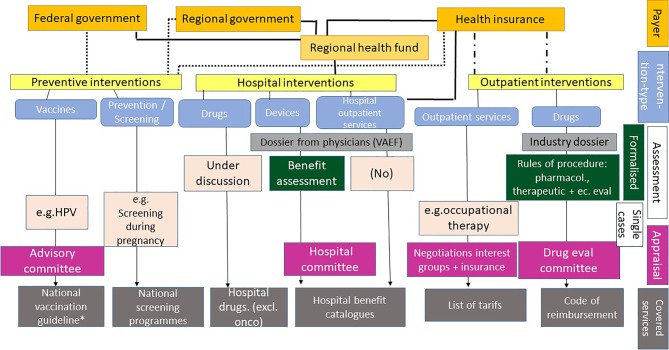
The main challenges with the application of economic evaluations are related to the methods, the decision-making culture, and the respective system. The challenges also apply to the Austrian Bismarck system, where almost no formal requirements for using economic evaluations exist, except on a case-by-case basis. Resource allocation in Austria hence occurs, for the most part, implicitly.
One way forward towards more explicit efficiency considerations may be to consider more descriptive study types and foster capacity building, standardization of methods and presentation of results, and a mandatory detailed guideline.
鉴于资源有限而需求无限,有效利用资源至关重要。用于支持高效资源分配的关键方法是卫生经济评估。
基于二手文献,我们分析了在报销决策中使用两种经济评估方法(成本效益分析和成本效用分析)所面临的国际挑战,并针对奥地利的情况进行了思考。
经济评估应用的主要挑战与方法、决策文化和各自的体系有关。这些挑战也适用于奥地利的俾斯麦体系,在该体系中,除了个别情况外,几乎没有使用经济评估的正式要求。因此,奥地利的资源分配在很大程度上是隐性的。
朝着更明确的效率考量方向前进的一种方法可能是考虑更多描述性研究类型,并促进能力建设、方法标准化和结果呈现,以及制定强制性的详细指南。