Department of Biomedical Sciences for Health,University of Milan,Milan,Italy.
Department of Biomedical and Clinical Sciences 'Luigi Sacco',University of Milan,Milan,Italy.
Epidemiol Infect. 2019 Jan;147:e80. doi: 10.1017/S0950268818003606.
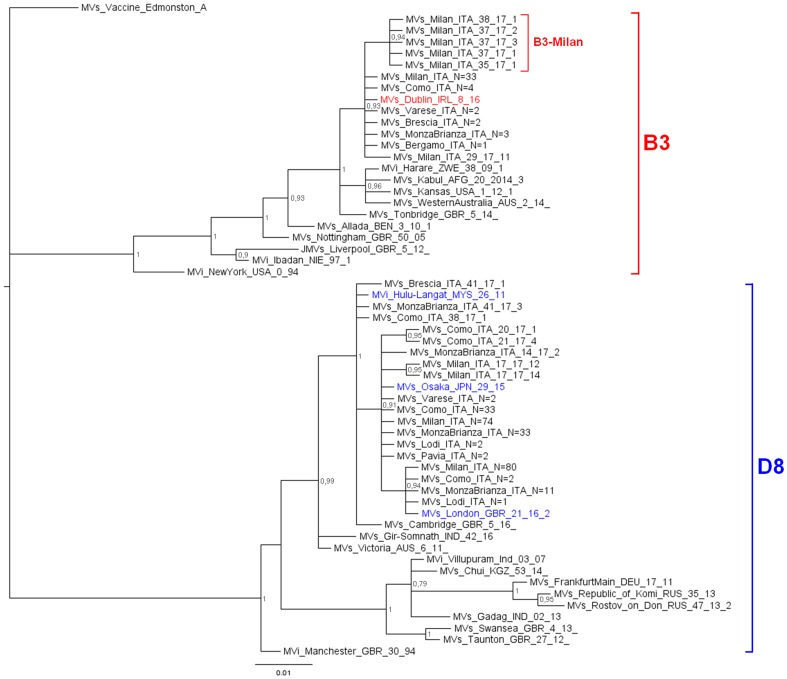
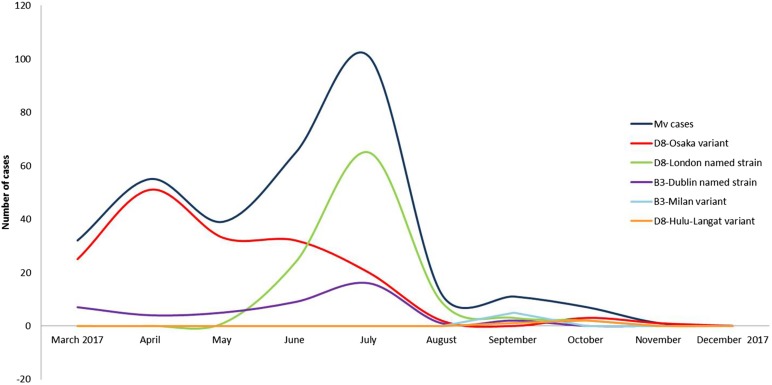
In 2017, Italy experienced a large measles epidemic with 5408 cases and four deaths. As Subnational Reference Laboratory of the Measles and Rubella surveillance NETwork (MoRoNET), the EpiSoMI (Epidemiology and Molecular Surveillance of Infections) Laboratory (University of Milan) set up rapid and active surveillance for the complete characterisation of the Measles virus (Mv) responsible for the large measles outbreak in Milan and surrounding areas (Lombardy, Northern Italy). The aims of this study were to describe the genetic profile of circulating viruses and to track the pathway of measles transmission. Molecular analysis was performed by sequencing the highly variable 450 nucleotides region of the N gene (N-450) of Mv genome. Two-hundred and ninety-nine strains of Mv were analysed. The phylogenetic analysis showed five different variants, two not previously described in the studied area, belonging to D8 and B3 genotypes. Three events of continuous transmission of autochthonous variants (D8-Osaka, D8-London and B3-Milan variants) and two events of continuous transmission of imported variants (B3-Dublin and D8-Hulu Langat) tracked five different transmission pathways. These pathways outlined two epidemic peaks: the first in April and the second in July 2017. The correlation between Mv variant and the epidemiological data may enable us to identify the sources of virus importation and recognise long-lasting virus transmission pathways.
2017 年,意大利爆发了大规模麻疹疫情,共有 5408 例病例和 4 人死亡。作为麻疹和风疹监测网络(MoRoNET)的国家级参考实验室,米兰大学的 EpiSoMI(感染的流行病学和分子监测)实验室针对导致米兰及周边地区(伦巴第大区,意大利北部)大规模麻疹爆发的麻疹病毒(Mv)开展了快速而积极的监测。本研究旨在描述流行病毒的遗传特征,并追踪麻疹传播途径。分子分析通过对 Mv 基因组的 N 基因(N-450)的高度可变 450 个核苷酸区域进行测序完成。共分析了 299 株 Mv 病毒。系统进化分析显示有五种不同的变异株,其中两种在研究区域之前未被描述,属于 D8 和 B3 基因型。五个不同的传播途径追踪到了五个连续传播的本地变异株(D8-Osaka、D8-London 和 B3-Milan 变异株)和两个连续传播的输入变异株(B3-Dublin 和 D8-Hulu Langat)事件。这些途径勾勒出两个流行高峰:第一次是在 2017 年 4 月,第二次是在 7 月。Mv 变异株与流行病学数据之间的相关性使我们能够识别病毒输入的来源,并识别出长期存在的病毒传播途径。