George Goldy C, Iwuanyanwu Eucharia C, Buford Adrianna S, Piha-Paul Sarina A, Subbiah Vivek, Fu Siqing, Karp Daniel D, Pant Shubham, Hinojosa Christina O, Hess Kenneth R, Cleeland Charles S, Bernstam Elmer V, Meric-Bernstam Funda, Hong David S
Department of Investigational Cancer Therapeutics, The University of Texas MD Anderson Cancer Center, Houston, TX, United States.
Department of Biostatistics, The University of Texas MD Anderson Cancer Center, Houston, TX, United States.
J Med Internet Res. 2019 Mar 14;21(3):e10348. doi: 10.2196/10348.
The role of cancer-related internet use on the patient-physician relationship has not been adequately explored among patients who are cancer-related internet users (CIUs) in early-phase clinical trial clinics.
We examined the association between cancer-related internet use and the patient-physician relationship and decision making among CIUs in an early drug development clinic.
Of 291 Phase I clinic patients who completed a questionnaire on internet use, 179 were CIUs. Generations were defined by the year of patient's birth: "millennials" (after 1990) and "Generation X/Y" (1965-1990) grouped as "Millennials or Generation X/Y"; "Baby Boomers" (1946-1964); and "Greatest or Silent Generation" (1945 and earlier). Statistical analyses included the Wilcoxon matched-pairs signed-rank test and the Mann-Whitney U test.
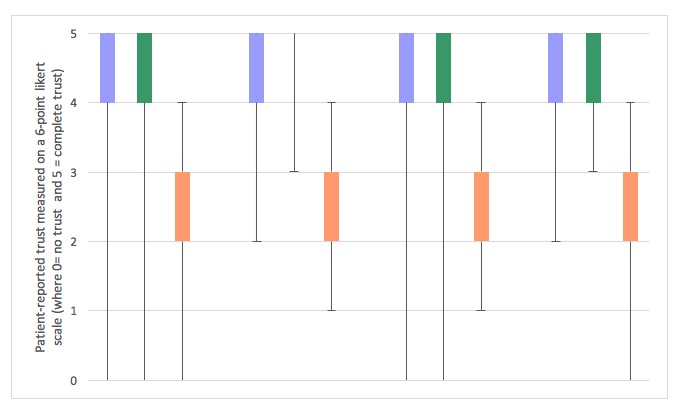
CIUs were 52% (94/179) female, 44% (78/179) were older than 60 years, and 60% (108/179) had household incomes exceeding US $60,000. The sources of information on cancer and clinical trials included physicians (171/179, 96%), the internet (159/179, 89%), and other clinical trial personnel (121/179, 68%). For the overall sample and each generation, the median values for trust in referring and Phase I clinical trial physicians among early drug development clinic CIUs were 5 on a 0-5 scale, with 5 indicating "complete trust." CIUs' trust in their referring (5) and phase 1 (5) physicians was higher than CIUs' trust in Web-based cancer-related information (3; P<.001 for both). CIUs who reported visiting the National Cancer Institute (NCI) website, NCI.org, to learn about cancer reported higher levels of trust in Web-based cancer-related information than CIUs who did not use the NCI website (P=.02). Approximately half of CIUs discussed internet information with their doctor. Only 14% (23/165) of CIUs had asked their physician to recommend cancer-related websites, and 24% (35/144) of CIUs reported at least occasional conflict between their physician's advice and Web-based information.
Despite the plethora of websites related to cancer and cancer clinical trials, patients in early-phase clinical trial settings trust their physicians more than Web-based information. Cancer-related organizations should provide regularly updated links to trustworthy websites with cancer and clinical trial information for patients and providers and educate providers on reliable cancer websites so that they can better direct their patients to appropriate internet content.
在早期临床试验诊所中,癌症相关互联网使用对医患关系的影响在癌症相关互联网使用者(CIUs)中尚未得到充分研究。
我们在一家早期药物研发诊所中,研究了癌症相关互联网使用与CIUs的医患关系及决策之间的关联。
在291名完成互联网使用问卷调查的I期诊所患者中,179名是CIUs。根据患者出生年份定义代际:“千禧一代”(1990年以后)和“X/Y一代”(1965 - 1990年)归为“千禧一代或X/Y一代”;“婴儿潮一代”(1946 - 1964年);以及“最伟大一代或沉默一代”(1945年及更早)。统计分析包括Wilcoxon配对符号秩检验和Mann - Whitney U检验。
CIUs中52%(94/179)为女性,44%(78/179)年龄超过60岁,60%(108/179)家庭收入超过6万美元。癌症和临床试验的信息来源包括医生(171/179,96%)、互联网(159/179,89%)和其他临床试验人员(121/179,68%)。对于总体样本和每一代,早期药物研发诊所CIUs中对转诊医生和I期临床试验医生的信任度中位数在0 - 5分制中为5分,5分表示“完全信任”。CIUs对转诊医生(5分)和I期医生(5分)的信任高于对基于网络的癌症相关信息的信任(3分;两者P <.001)。报告访问美国国立癌症研究所(NCI)网站NCI.org了解癌症的CIUs,对基于网络的癌症相关信息的信任度高于未使用NCI网站的CIUs(P = 0.02)。约一半的CIUs会与医生讨论互联网信息。只有