Jooss Andreas, Haberbosch Linus, Köhn Arvid, Rönnefarth Maria, Bathe-Peters Rouven, Kozarzewski Leonard, Fleischmann Robert, Scholz Michael, Schmidt Sein, Brandt Stephan A
Department of Neurology, Charité - Universitätsmedizin Berlin, Berlin, Germany.
Department of Neurology, Universitätsmedizin Greifswald, Greifswald, Germany.
Front Neurosci. 2019 Feb 27;13:161. doi: 10.3389/fnins.2019.00161. eCollection 2019.
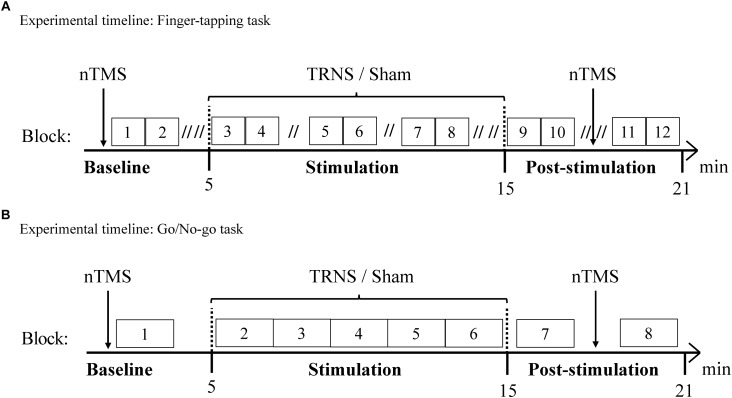
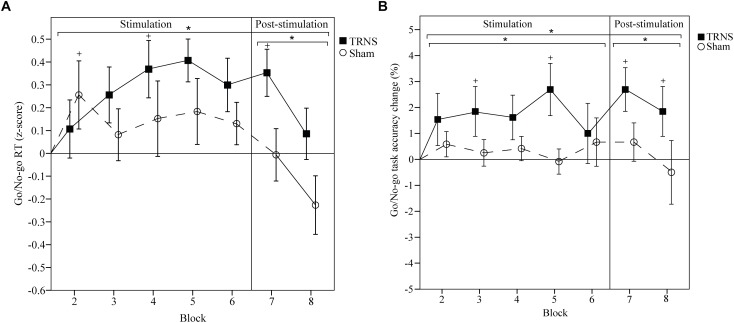
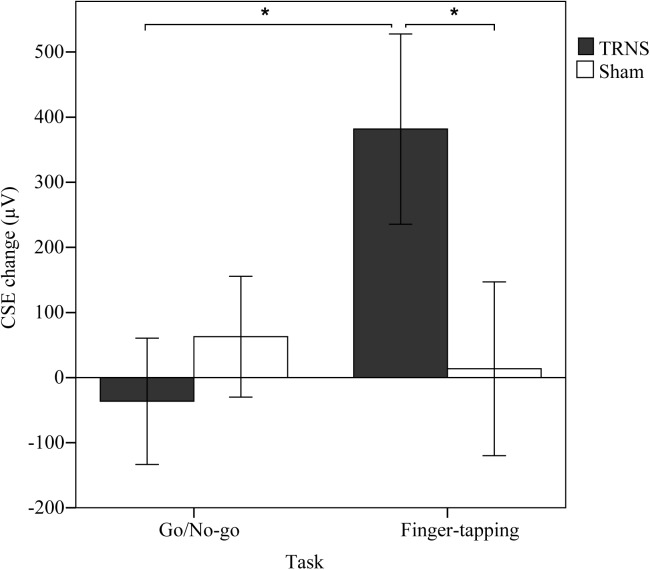
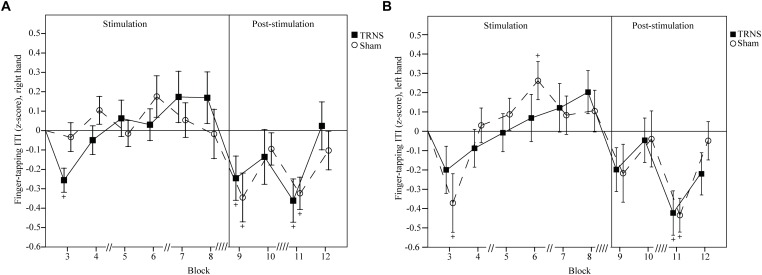
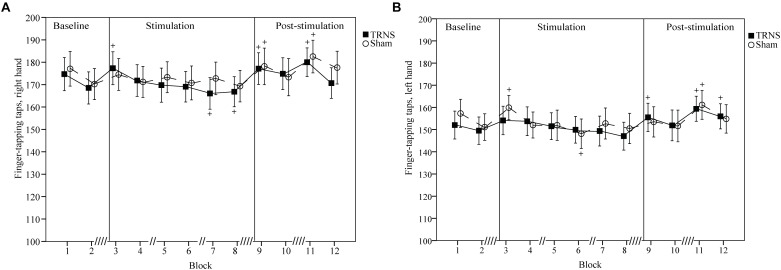
Transcranial random noise stimulation (tRNS) is an emerging non-invasive brain stimulation technique to modulate brain function, with previous studies highlighting its considerable benefits in therapeutic stimulation of the motor system. However, high variability of results and bidirectional task-dependent effects limit more widespread clinical application. Task dependency largely results from a lack of understanding of the interaction between externally applied tRNS and the endogenous state of neural activity during stimulation. Hence, the aim of this study was to investigate the task dependency of tRNS-induced neuromodulation in the motor system using a finger-tapping task (FT) versus a go/no-go task (GNG). We hypothesized that the tasks would modulate tRNS' effects on corticospinal excitability (CSE) and task performance in opposite directions. Thirty healthy subjects received 10 min of tRNS of the dominant primary motor cortex in a double-blind, sham-controlled study design. tRNS was applied during two well-established tasks tied to diverging brain states. Accordingly, participants were randomly assigned to two equally-sized groups: the first group performed a simple motor training task (FT task), known primarily to increase CSE, while the second group performed an inhibitory control task (go/no-go task) associated with inhibition of CSE. To establish task-dependent effects of tRNS, CSE was evaluated prior to- and after stimulation with navigated transcranial magnetic stimulation. In an 'activating' motor task, tRNS during FT significantly facilitated CSE. FT task performance improvements, shown by training-related reductions in intertap intervals and increased number of finger taps, were similar for both tRNS and sham stimulation. In an 'inhibitory' motor task, tRNS during GNG left CSE unchanged while inhibitory control was enhanced as shown by slowed reaction times and enhanced task accuracy during and after stimulation. We provide evidence that tRNS-induced neuromodulatory effects are task-dependent and that resulting enhancements are specific to the underlying task-dependent brain state. While mechanisms underlying this effect require further investigation, these findings highlight the potential of tRNS in enhancing task-dependent brain states to modulate human behavior.
经颅随机噪声刺激(tRNS)是一种新兴的非侵入性脑刺激技术,用于调节脑功能,先前的研究强调了其在运动系统治疗性刺激方面的显著益处。然而,结果的高度变异性和双向任务依赖效应限制了其更广泛的临床应用。任务依赖性很大程度上源于对外部施加的tRNS与刺激期间神经活动的内源性状态之间相互作用的理解不足。因此,本研究的目的是使用手指敲击任务(FT)与Go/No-Go任务(GNG)来研究tRNS在运动系统中诱导的神经调节的任务依赖性。我们假设这些任务会以相反的方向调节tRNS对皮质脊髓兴奋性(CSE)和任务表现的影响。在一项双盲、假对照研究设计中,30名健康受试者接受了10分钟对优势初级运动皮层的tRNS。tRNS在与不同脑状态相关的两项成熟任务期间施加。相应地,参与者被随机分为两个同等规模的组:第一组执行一项简单的运动训练任务(FT任务),主要已知该任务会增加CSE,而第二组执行与CSE抑制相关的抑制控制任务(Go/No-Go任务)。为了确定tRNS的任务依赖效应,在用导航经颅磁刺激刺激之前和之后评估CSE。在一项“激活”运动任务中,FT期间的tRNS显著促进了CSE。FT任务表现的改善,表现为与训练相关的敲击间隔缩短和手指敲击次数增加,tRNS和假刺激相似。在一项“抑制”运动任务中,GNG期间的tRNS使CSE保持不变,而抑制控制得到增强,表现为刺激期间和之后反应时间减慢和任务准确性提高。我们提供的证据表明,tRNS诱导的神经调节效应是任务依赖性的,并且产生的增强作用特定于潜在的任务依赖脑状态。虽然这种效应的潜在机制需要进一步研究,但这些发现突出了tRNS在增强任务依赖脑状态以调节人类行为方面的潜力。