Douzi Wafa, Dupuy Olivier, Theurot Dimitri, Boucard Geoffroy, Dugué Benoit
Laboratoire Mobilité Vieillissement Exercice (MOVE)-EA6314, Faculty of Sport Sciences, University of Poitiers, 8 allée Jean Monnet, 86000, Poitiers, France.
Centre de Recherches sur la Cognition et l'Apprentissage (UMR7295), Université de Poitiers and Université François-Rabelais de Tours, Poitiers, France.
BMC Res Notes. 2019 Mar 15;12(1):141. doi: 10.1186/s13104-019-4172-9.
The aim of the present investigation was to determine whether using cryostimulation (partial-body cryostimulation) impacts sleep quality in professional soccer players. Different exposure durations at - 180 °C were tested randomly after standardized training sessions in nine professional soccer players (no cryostimulation, 180-s exposure, two 90-s exposures separated by a 5-min rest at room temperature, and 90-s exposure), and the effects on sleep quality using 3-dimensional accelerometers worn during sleep were assessed.
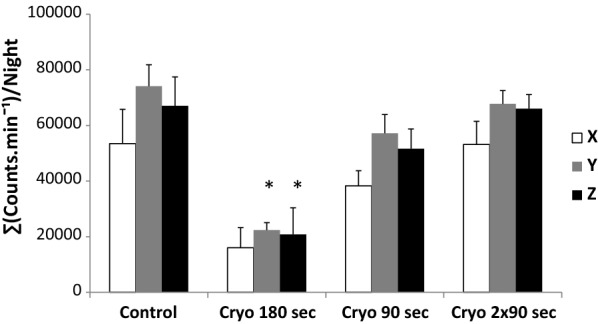
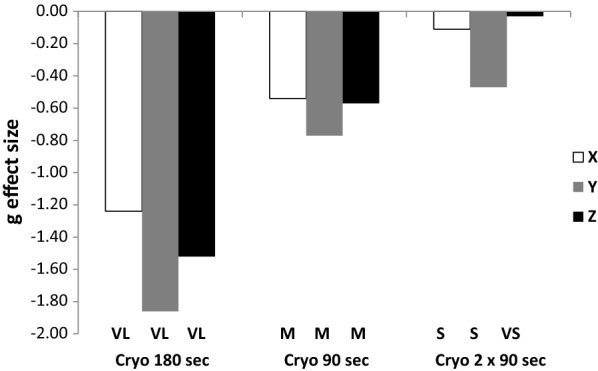
The number of movements during the night after partial-body cryostimulation was significantly reduced only in the 180-s exposure condition (p < 0.05, very large effect size) compared with the control condition. Partial-body cryostimulation seems to induce a positive impact on sleep quality that may be dose-dependent. Trial registration Australia and New Zealand Clinical Trials Registry (ANZCTR), ACTRN12619000330145, date of registration: 4/03/2019. Retrospectively registered.
本研究旨在确定使用冷冻刺激(局部身体冷冻刺激)是否会影响职业足球运动员的睡眠质量。在九名职业足球运动员进行标准化训练后,随机测试了在-180°C下不同的暴露持续时间(无冷冻刺激、180秒暴露、两次90秒暴露,中间在室温下休息5分钟,以及90秒暴露),并使用睡眠期间佩戴的三维加速度计评估了对睡眠质量的影响。
与对照条件相比,仅在180秒暴露条件下,局部身体冷冻刺激后夜间的运动次数显著减少(p<0.05,效应量非常大)。局部身体冷冻刺激似乎对睡眠质量有积极影响,且可能存在剂量依赖性。试验注册澳大利亚和新西兰临床试验注册中心(ANZCTR),ACTRN12619000330145,注册日期:2019年3月4日。回顾性注册。