Rattel Julina A, Grünberger Lisa M, Reichenberger Julia, Liedlgruber Michael, Miedl Stephan F, Blechert Jens, Wilhelm Frank H
Department of Psychology, Division for Clinical Psychology, Psychotherapy and Health Psychology, University of Salzburg, Salzburg, Austria.
Centre for Cognitive Neuroscience, University of Salzburg, Salzburg, Austria.
Cognit Ther Res. 2019 Feb;43(1):174-184. doi: 10.1007/s10608-018-9941-6. Epub 2018 Jun 10.
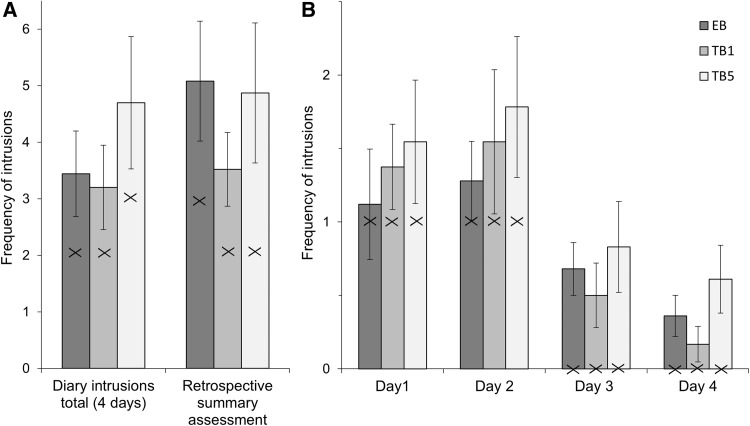
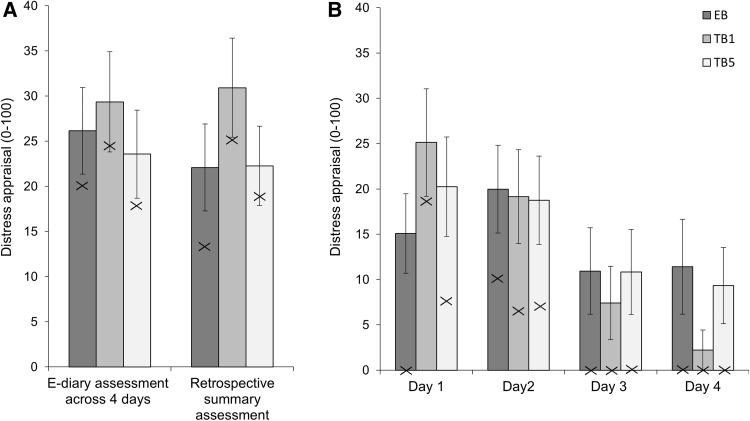
Intrusive thoughts, images, and their appraisal remain difficult to study despite their clinical relevance. Clinical studies typically used time-based (frequency and distress per observation period), while analogue studies mainly used event-based (report upon occurrence) assessment. A comparison of intrusion frequency, distress appraisal, compliance, and reactivity across different assessments is mostly lacking, particularly with regard to analogue research. Here, intrusions were induced via aversive films and assessed by a smart phone application for 4 days. Three sampling modes were compared by randomizing participants to one of three conditions: either one, or five time-based daily prompts, or event-based assessment. At the end of the study, all participants reported intrusions once again in a retrospective summary assessment. Results indicate that intrusions and their distress decayed over a few days. The three assessments did not differ in intrusion frequency, distress appraisal, compliance (generally high), reactivity (generally low), or retrospective summary assessment. Across groups, the more aversive and arousing participants rated the film clips and the more reactivity to the electronic-diary assessment they reported, the more intrusive memories they had; assessment modes did not differ on this. Thus, no general differences were found between electronic-diary assessment modes for analogue intrusions, giving researchers flexibility for tailoring ecological momentary assessment to specific study aims.
尽管侵入性思维、意象及其评估具有临床相关性,但仍难以进行研究。临床研究通常采用基于时间的(每个观察期的频率和痛苦程度)评估方法,而模拟研究主要采用基于事件的(事件发生时报告)评估方法。不同评估方法在侵入频率、痛苦评估、依从性和反应性方面的比较大多缺失,尤其是在模拟研究方面。在此,通过观看厌恶影片诱发侵入性思维,并通过智能手机应用程序进行为期4天的评估。通过将参与者随机分配到三种条件之一来比较三种抽样模式:每天一次或五次基于时间的提示,或基于事件的评估。在研究结束时,所有参与者在回顾性总结评估中再次报告了侵入性思维。结果表明,侵入性思维及其痛苦程度在几天内逐渐减轻。三种评估方法在侵入频率、痛苦评估、依从性(总体较高)、反应性(总体较低)或回顾性总结评估方面没有差异。在所有组中,参与者对影片片段的评价越厌恶和唤起情绪,他们报告的对电子日记评估的反应性越高,他们拥有的侵入性记忆就越多;评估模式在这方面没有差异。因此,在模拟侵入性思维的电子日记评估模式之间未发现总体差异,这为研究人员根据特定研究目标定制生态瞬时评估提供了灵活性。