Department of Psychology, Uppsala University, Uppsala, Sweden.
Swedish Collegium for Advanced Study, Uppsala, Sweden.
Int J Methods Psychiatr Res. 2023 Mar;32(1):e1936. doi: 10.1002/mpr.1936. Epub 2022 Aug 17.
Intrusive memories are a core feature of posttraumatic stress disorder and have transdiagnostic relevance across mental disorders. Establishing flexible methods to monitor intrusions, including patterns and characteristics, is a key challenge. A daily diary has been developed in experimental settings to provide symptom count data, without the need for retrospective self-report over extended time periods (e.g., 1 week, 1 month). We conducted an exploratory, pre-registered data synthesis investigating convergence between the diary and questionnaire measures of intrusive symptoms long used in clinical practice (Impact of Event Scale, IES, and revised version, IES-R, Intrusion subscale).
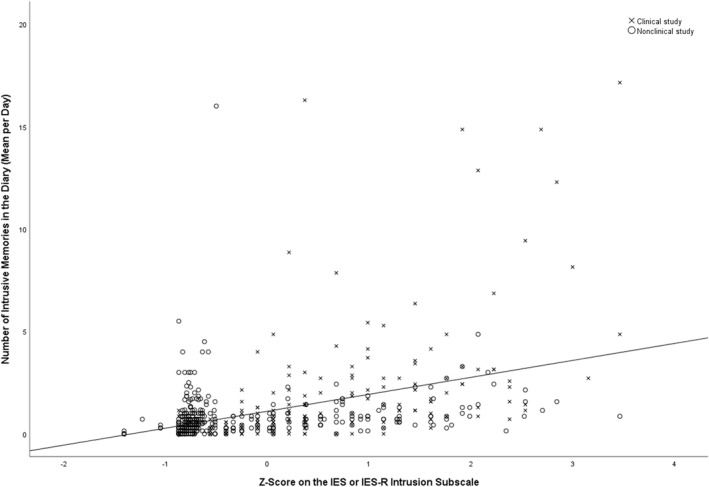
Utilising datasets using the daily diary from 11 studies (4 real-world trauma studies, seven analogue trauma studies; total N = 578), we found significant positive associations between the diary and IES/IES-R Intrusion subscale. Exploratory analyses indicated that the magnitude of this association was stronger for the IES (vs. the IES-R), and in individuals with real-world (vs. analogue) trauma.
This study provides first evidence of convergent validity of a daily diary for monitoring intrusions with a widely used questionnaire. A diary may be a more flexible methodology to obtain information about intrusions (frequency, characteristics, triggers, content), relative to questionnaires which rely on retrospective reporting of symptoms over extended timeframes. We discuss potential benefits of daily monitoring of intrusions in clinical and research contexts.
侵入性记忆是创伤后应激障碍的核心特征,与精神障碍的跨诊断相关。建立灵活的方法来监测侵入性记忆,包括模式和特征,是一个关键挑战。在实验环境中已经开发出一种日常日记,用于提供症状计数数据,而无需在延长的时间段内进行回顾性自我报告(例如,1 周,1 个月)。我们进行了一项探索性的、预先注册的数据综合研究,调查了在临床实践中长期使用的侵入性症状的日记和问卷测量之间的收敛性(事件影响量表,IES 和修订版,IES-R,侵入子量表)。
利用 11 项研究(4 项真实创伤研究,7 项模拟创伤研究;总 N=578)中使用日常日记的数据集,我们发现日记与 IES/IES-R 侵入子量表之间存在显著的正相关。探索性分析表明,这种关联在 IES(与 IES-R 相比)和真实世界(与模拟相比)创伤个体中更强。
这项研究首次提供了日常日记监测侵入性记忆与广泛使用的问卷之间的收敛效度的证据。与依赖于延长时间框架的回顾性症状报告的问卷相比,日记可能是一种更灵活的方法来获取关于侵入性记忆的信息(频率、特征、触发因素、内容)。我们讨论了在临床和研究背景下日常监测侵入性记忆的潜在益处。