Chair for Cognitive Systems, Department of Electrical and Computer Engineering, Technische Universität München (TUM), Munich, Germany.
Institute of High Performance Computing, Social and Cognitive Computing Department, Agency for Science, Technology and Research (A*STAR), Singapore, Singapore.
PLoS One. 2019 Mar 18;14(3):e0213516. doi: 10.1371/journal.pone.0213516. eCollection 2019.
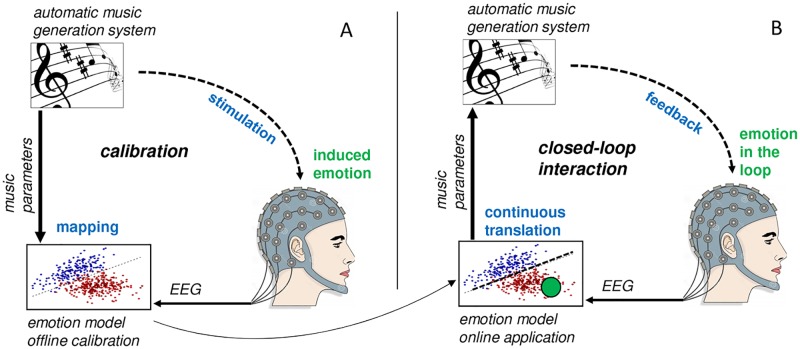
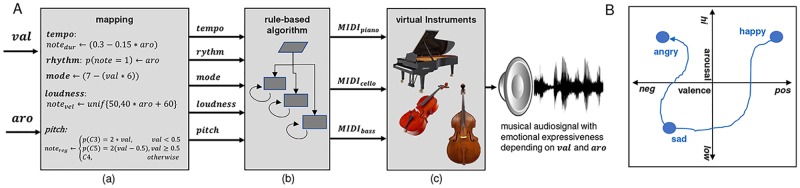
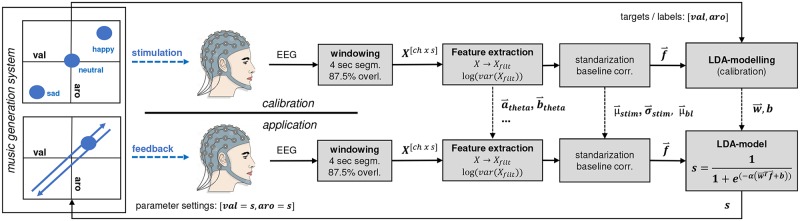
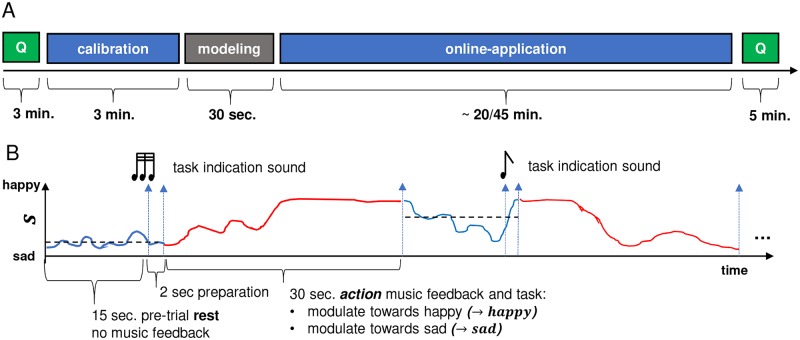
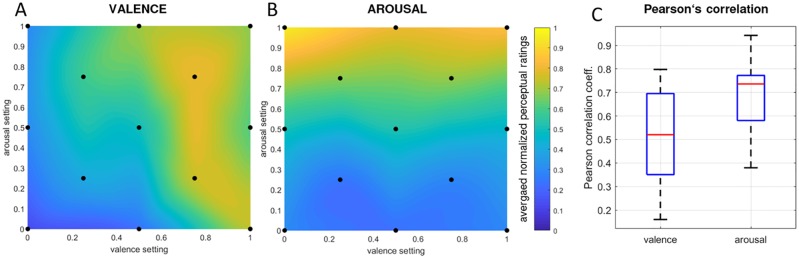
Emotions play a critical role in rational and intelligent behavior; a better fundamental knowledge of them is indispensable for understanding higher order brain function. We propose a non-invasive brain-computer interface (BCI) system to feedback a person's affective state such that a closed-loop interaction between the participant's brain responses and the musical stimuli is established. We realized this concept technically in a functional prototype of an algorithm that generates continuous and controllable patterns of synthesized affective music in real-time, which is embedded within a BCI architecture. We evaluated our concept in two separate studies. In the first study, we tested the efficacy of our music algorithm by measuring subjective affective responses from 11 participants. In a second pilot study, the algorithm was embedded in a real-time BCI architecture to investigate affective closed-loop interactions in 5 participants. Preliminary results suggested that participants were able to intentionally modulate the musical feedback by self-inducing emotions (e.g., by recalling memories), suggesting that the system was able not only to capture the listener's current affective state in real-time, but also potentially provide a tool for listeners to mediate their own emotions by interacting with music. The proposed concept offers a tool to study emotions in the loop, promising to cast a complementary light on emotion-related brain research, particularly in terms of clarifying the interactive, spatio-temporal dynamics underlying affective processing in the brain.
情绪在理性和智能行为中起着关键作用;更好地了解它们是理解高级大脑功能所必需的。我们提出了一种非侵入性的脑机接口(BCI)系统来反馈一个人的情感状态,从而在参与者的大脑反应和音乐刺激之间建立一个闭环交互。我们在一个实时生成连续可控的合成情感音乐模式的算法的功能原型中实现了这一概念,该算法嵌入在 BCI 架构中。我们在两个独立的研究中评估了我们的概念。在第一项研究中,我们通过 11 名参与者的主观情感反应来测试我们的音乐算法的效果。在第二项试点研究中,该算法被嵌入实时 BCI 架构中,以研究 5 名参与者的情感闭环交互。初步结果表明,参与者能够通过自我诱导情绪(例如回忆记忆)来有意地调节音乐反馈,这表明该系统不仅能够实时捕捉听众的当前情感状态,而且还可以通过与音乐交互为听众提供一种调节自己情绪的工具。该概念提供了一种在闭环中研究情绪的工具,有望为情绪相关的大脑研究提供一种补充,特别是在澄清大脑中情感处理的交互、时空动态方面。