Faculty of Health and Wellbeing, Canterbury Christ Church University, Canterbury, UK.
Department of Economics and Quantitative Methods, Westminster Business School, University of Westminster, London, UK.
BMJ Open. 2019 Mar 20;9(3):e024351. doi: 10.1136/bmjopen-2018-024351.
To examine the evidence for the use of psychological and psychosocial interventions offered to forensic mental health inpatients.
CINAHL, MEDLINE, PsycINFO, ScienceDirect and Web of Science databases were searched for research published in English between 1 January 1990 and 31 May 2018.
Disturbance, mental well-being, quality of life, recovery, violence/risk, satisfaction, seclusion, symptoms, therapeutic relationship and ward environment. There were no limits on the length of follow-up.
We included randomised controlled trial (RCT) studies of any psychological or psychosocial intervention in an inpatient forensic setting. Pilot or feasibility studies were included if an RCT design was used.We restricted our search criteria to inpatients in low, medium and high secure units aged over 18. We focused on interventions considered applicable to most patients residing in forensic mental health settings.
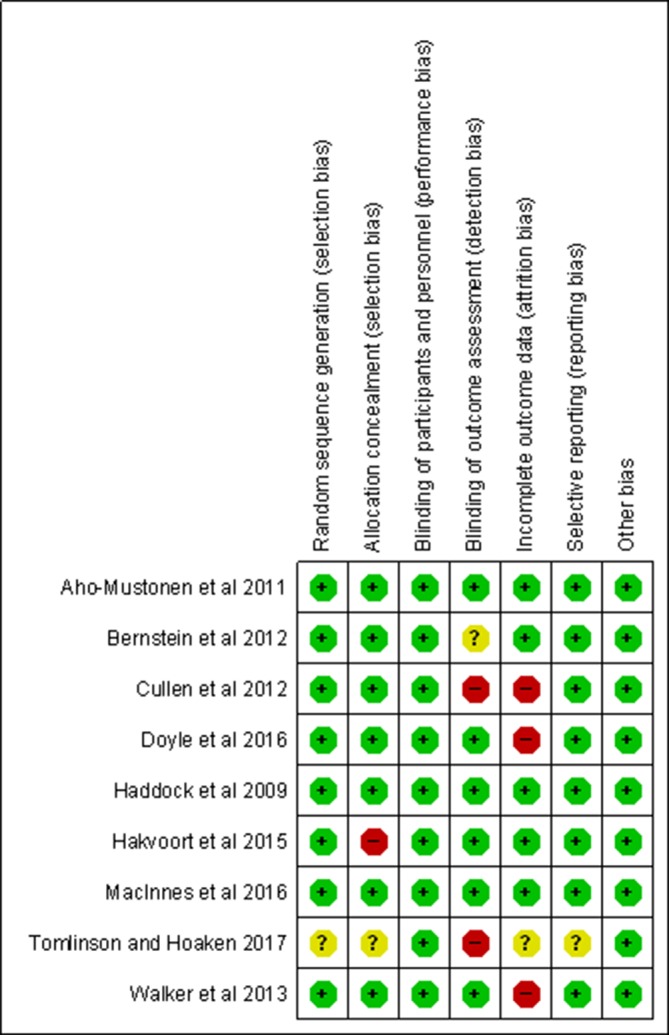
Two independent reviewers extracted data and assessed risk of bias.
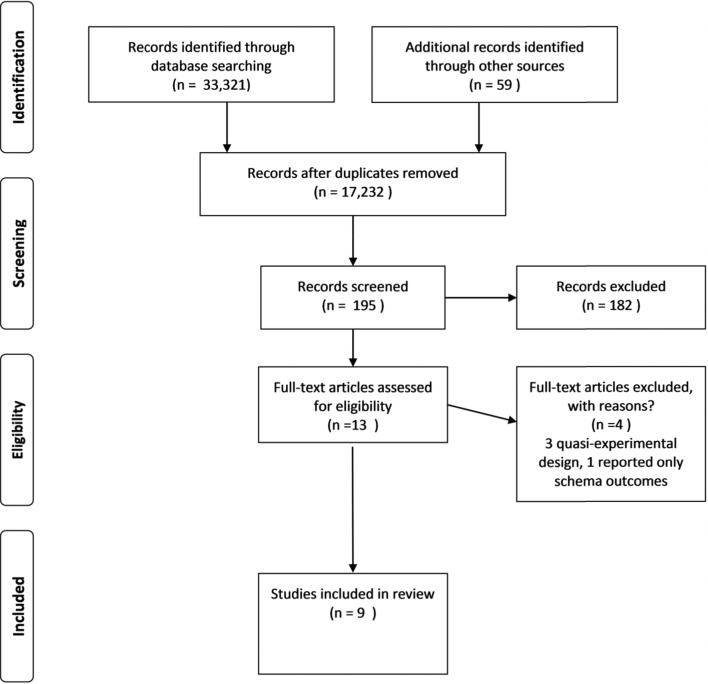
17 232 citations were identified with 195 full manuscripts examined in detail. Nine papers were included in the review. The heterogeneity of the identified studies meant that meta-analysis was inappropriate. The results were presented in table form together with a narrative synthesis. Only 7 out of 91 comparisons revealed statistically significant results with no consistent significant findings. The most frequently reported outcomes were violence/risk and symptoms. 61% of the violence/risk comparisons and 79% of the symptom comparisons reported improvements in the intervention groups compared with the control groups.
Current practice is based on limited evidence with no consistent significant findings. This review suggests psychoeducational and psychosocial interventions did not reduce violence/risk, but there is tentative support they may improve symptoms. More RCTs are required with: larger sample sizes, representative populations, standardised outcomes and control group interventions similar in treatment intensity to the intervention.
CRD42017067099.
考察为法医精神科住院患者提供的心理和心理社会干预措施的证据。
1990 年 1 月 1 日至 2018 年 5 月 31 日,在 CINAHL、MEDLINE、PsycINFO、ScienceDirect 和 Web of Science 数据库中搜索以英文发表的研究。
障碍、心理健康、生活质量、康复、暴力/风险、满意度、隔离、症状、治疗关系和病房环境。没有对随访时间长度的限制。
我们纳入了任何在法医住院环境中进行的心理或心理社会干预的随机对照试验(RCT)研究。如果使用 RCT 设计,我们也纳入了试点或可行性研究。我们将搜索标准限制为年龄在 18 岁以上的低、中、高安全单位的住院患者。我们专注于那些被认为适用于大多数居住在法医心理健康环境中的患者的干预措施。
两名独立的综述作者提取数据并评估了偏倚风险。
共确定了 17232 条引文,并详细检查了 195 篇全文。9 篇论文被纳入综述。由于确定的研究存在异质性,因此不适合进行荟萃分析。结果以表格形式呈现,并附有叙述性综合。只有 91 次比较中的 7 次显示出具有统计学意义的结果,没有一致的显著发现。报告最多的结果是暴力/风险和症状。与对照组相比,干预组中 61%的暴力/风险比较和 79%的症状比较显示出改善。
目前的实践基于有限的证据,没有一致的显著发现。本综述表明,心理教育和心理社会干预措施并没有降低暴力/风险,但有初步证据表明它们可能改善症状。需要进行更多的 RCT,样本量更大,代表性更强,结果标准化,对照组的干预措施在治疗强度上与干预措施相似。
PROSPERO 注册号:CRD42017067099。