Gawlitza Joshua, Sturm Timo, Spohrer Kai, Henzler Thomas, Akin Ibrahim, Schönberg Stefan, Borggrefe Martin, Haubenreisser Holger, Trinkmann Frederik
Institute of Clinical Radiology and Nuclear Medicine, University Medical Center Mannheim, Medical Faculty Mannheim, Heidelberg University, Theodor-Kutzer-Ufer 1-3, 68167 Mannheim, Germany.
Department of General Management and Information Systems, University of Mannheim, 68131 Mannheim, Germany.
Diagnostics (Basel). 2019 Mar 21;9(1):33. doi: 10.3390/diagnostics9010033.
Quantitative computed tomography (qCT) is an emergent technique for diagnostics and research in patients with chronic obstructive pulmonary disease (COPD). qCT parameters demonstrate a correlation with pulmonary function tests and symptoms. However, qCT only provides anatomical, not functional, information. We evaluated five distinct, partial-machine learning-based mathematical models to predict lung function parameters from qCT values in comparison with pulmonary function tests.
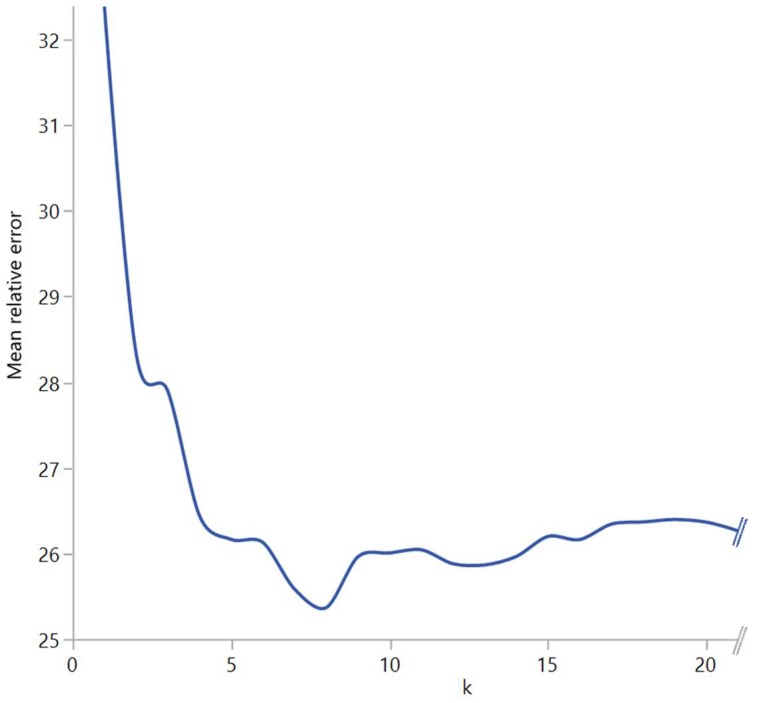
75 patients with diagnosed COPD underwent body plethysmography and a dose-optimized qCT examination on a third-generation, dual-source CT with inspiration and expiration. Delta values (inspiration-expiration) were calculated afterwards. Four parameters were quantified: mean lung density, lung volume low-attenuated volume, and full width at half maximum. Five models were evaluated for best prediction: average prediction, median prediction, -nearest neighbours (kNN), gradient boosting, and multilayer perceptron.
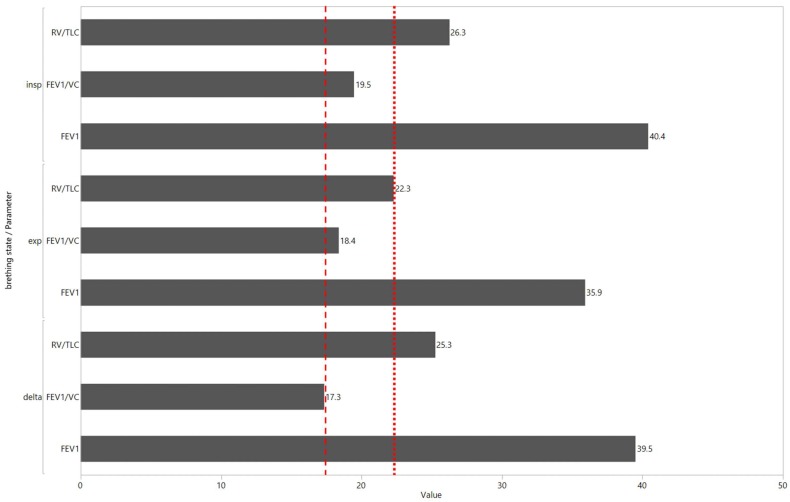
The lowest mean relative error (MRE) was calculated for the kNN model with 16%. Similar low MREs were found for polynomial regression as well as gradient boosting-based prediction. Other models led to higher MREs and thereby worse predictive performance. Beyond the sole MRE, distinct differences in prediction performance, dependent on the initial dataset (expiration, inspiration, delta), were found.
Different, partially machine learning-based models allow the prediction of lung function values from static qCT parameters within a reasonable margin of error. Therefore, qCT parameters may contain more information than we currently utilize and can potentially augment standard functional lung testing.
定量计算机断层扫描(qCT)是一种用于慢性阻塞性肺疾病(COPD)患者诊断和研究的新兴技术。qCT参数与肺功能测试及症状相关。然而,qCT仅提供解剖学信息,而非功能信息。我们评估了五种不同的、基于部分机器学习的数学模型,以根据qCT值预测肺功能参数,并与肺功能测试进行比较。
75例确诊为COPD的患者接受了体容积描记法检查,并在第三代双源CT上进行了吸气和呼气时的剂量优化qCT检查。随后计算差值(吸气 - 呼气)。对四个参数进行了量化:平均肺密度、肺低衰减体积和半高全宽。评估了五种模型的最佳预测效果:平均预测、中位数预测、k近邻(kNN)、梯度提升和多层感知器。
kNN模型的平均相对误差(MRE)最低,为16%。多项式回归以及基于梯度提升的预测也发现了类似的低MRE。其他模型导致更高的MRE,从而预测性能更差。除了单一的MRE外,还发现预测性能存在明显差异,这取决于初始数据集(呼气、吸气、差值)。
不同的、部分基于机器学习的模型能够在合理的误差范围内根据静态qCT参数预测肺功能值。因此,qCT参数可能包含比我们目前所利用的更多信息,并有可能增强标准的肺功能测试。