Department of Veterinary Preclinical Sciences, Faculty of Veterinary Medicine, Universiti Putra Malaysia, 43400, Serdang, Malaysia.
Agro-Biotechnology Institute (ABI), National Institutes of Biotechnology Malaysia (NIBM), c/o MARDI Headquarters, 43400, Serdang, Malaysia.
BMC Genet. 2019 Mar 25;20(1):37. doi: 10.1186/s12863-019-0741-0.
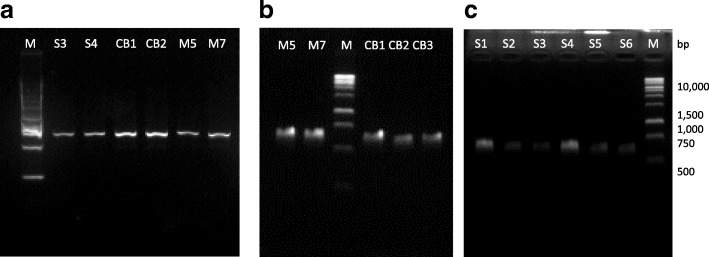
In Malaysia, the domestic water buffaloes (Bubalus bubalis) are classified into the swamp and the murrah buffaloes. Identification of these buffaloes is usually made via their phenotypic appearances. This study characterizes the subspecies of water buffaloes using karyotype, molecular and phylogenetic analyses. Blood of 105 buffaloes, phenotypically identified as swamp, murrah and crossbred buffaloes were cultured, terminated and harvested using conventional karyotype protocol to determine the number of chromosomes. Then, the D-loop of mitochondrial DNA of 10 swamp, 6 crossbred and 4 murrah buffaloes which were identified earlier by karyotyping were used to construct a phylogenetic tree was constructed.
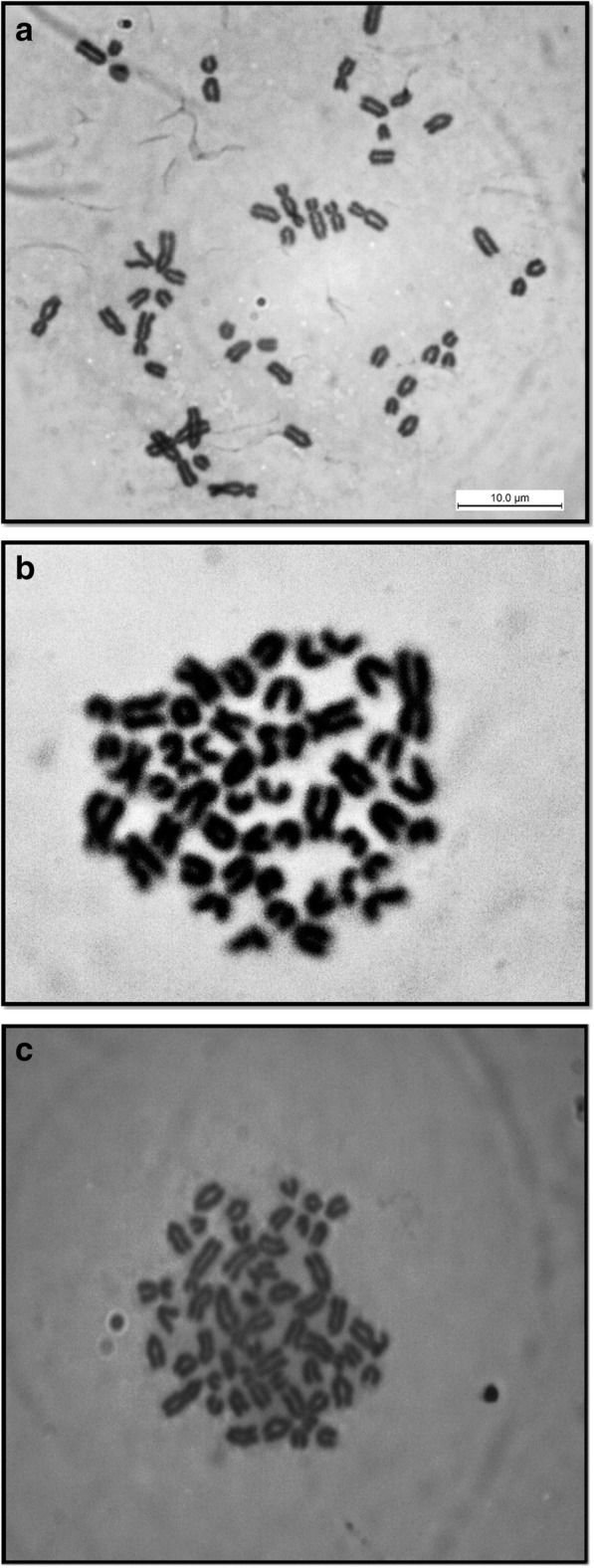
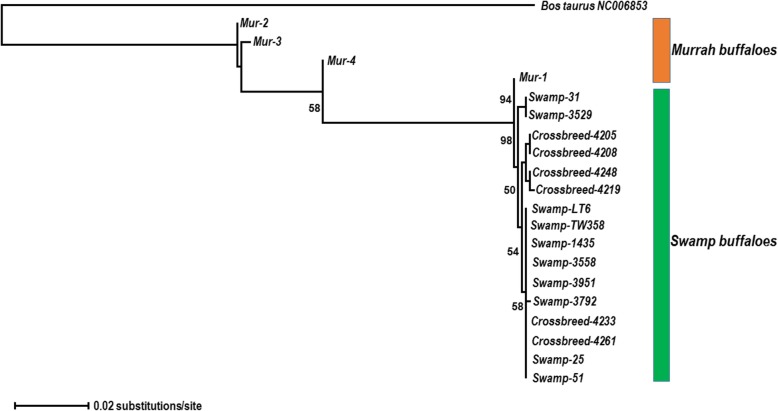
Karyotypic analysis confirmed that all 93 animals phenotypically identified as swamp buffaloes with 48 chromosomes, all 7 as crossbreds with 49 chromosomes, and all 5 as murrah buffaloes with 50 chromosomes. The D-loop of mitochondrial DNA analysis showed that 10 haplotypes were observed with haplotype diversity of 0.8000 ± 0.089. Sequence characterization revealed 72 variables sites in which 67 were parsimony informative sites with sequence diversity of 0.01906. The swamp and murrah buffaloes clearly formed 2 different clades in the phylogenetic tree, indicating clear maternal divergence from each other. The crossbreds were grouped within the swamp buffalo clade, indicating the dominant maternal swamp buffalo gene in the crossbreds.
Thus, the karyotyping could be used to differentiate the water buffaloes while genotypic analysis could be used to characterize the water buffaloes and their crossbreds.
在马来西亚,本地水牛(Bubalus bubalis)分为沼泽型和摩拉水牛。这些水牛的鉴定通常是通过它们的表型特征来进行的。本研究通过核型分析、分子和系统发育分析来描述水牛亚种的特征。从 105 头水牛(表型鉴定为沼泽型、摩拉水牛和杂交水牛)中采集血液,使用常规核型分析方案培养、终止和收获血液,以确定染色体数量。然后,对通过核型分析鉴定的 10 头沼泽型、6 头杂交型和 4 头摩拉水牛的线粒体 DNA 的 D 环进行测序,并构建系统发育树。
核型分析证实,所有 93 头表型鉴定为沼泽型的水牛均具有 48 条染色体,所有 7 头杂交型水牛均具有 49 条染色体,所有 5 头摩拉水牛均具有 50 条染色体。线粒体 DNA 的 D 环分析显示,共观察到 10 种单倍型,单倍型多样性为 0.8000 ± 0.089。序列特征分析显示,共发现 72 个变异位点,其中 67 个是简约信息位点,序列多样性为 0.01906。在系统发育树中,沼泽型和摩拉水牛形成了 2 个不同的分支,表明它们的母系遗传存在明显的分化。杂交水牛则聚集在沼泽水牛的分支中,表明杂交水牛的母系遗传以沼泽水牛为主导。
因此,核型分析可用于区分水牛,而基因分析可用于描述水牛及其杂交种。