• 文献检索
  • 文档翻译
  • 深度研究
  • 学术资讯
  • Suppr Zotero 插件Zotero 插件
  • 邀请有礼
  • 套餐&价格
  • 历史记录
应用&插件
Suppr Zotero 插件Zotero 插件浏览器插件Mac 客户端Windows 客户端微信小程序
定价
高级版会员购买积分包购买API积分包
服务
文献检索文档翻译深度研究API 文档MCP 服务
关于我们
关于 Suppr公司介绍联系我们用户协议隐私条款
关注我们

Suppr 超能文献

核心技术专利:CN118964589B侵权必究
粤ICP备2023148730 号-1Suppr @ 2026

文献检索

告别复杂PubMed语法,用中文像聊天一样搜索,搜遍4000万医学文献。AI智能推荐,让科研检索更轻松。

立即免费搜索

文件翻译

保留排版,准确专业,支持PDF/Word/PPT等文件格式,支持 12+语言互译。

免费翻译文档

深度研究

AI帮你快速写综述,25分钟生成高质量综述,智能提取关键信息,辅助科研写作。

立即免费体验

模拟白纹伊蚊(双翅目:蚊科)的季节性动态、种群稳定性和害虫控制。

Modelling seasonal dynamics, population stability, and pest control in Aedes japonicus japonicus (Diptera: Culicidae).

机构信息

Senckenberg Biodiversity and Climate Research Centre, Senckenberganlage 25, 60325, Frankfurt am Main, Germany.

Institute of Organismic and Molecular Evolution (iOME), Johannes Gutenberg University, Gresemundweg 2, 55128, Mainz, Germany.

出版信息

Parasit Vectors. 2019 Mar 25;12(1):142. doi: 10.1186/s13071-019-3366-2.

DOI:10.1186/s13071-019-3366-2
PMID:30909930
原文链接:https://pmc.ncbi.nlm.nih.gov/articles/PMC6434845/
Abstract

BACKGROUND

The invasive temperate mosquito Aedes japonicus japonicus is a potential vector for various infectious diseases and therefore a target of vector control measures. Even though established in Germany, it is unclear whether the species has already reached its full distribution potential. The possible range of the species, its annual population dynamics, the success of vector control measures and future expansions due to climate change still remain poorly understood. While numerous studies on occurrence have been conducted, they used mainly presence data from relatively few locations. In contrast, we used experimental life history data to model the dynamics of a continuous stage-structured population to infer potential seasonal densities and ask whether stable populations are likely to establish over a period of more than one year. In addition, we used climate change models to infer future ranges. Finally, we evaluated the effectiveness of various stage-specific vector control measures.

RESULTS

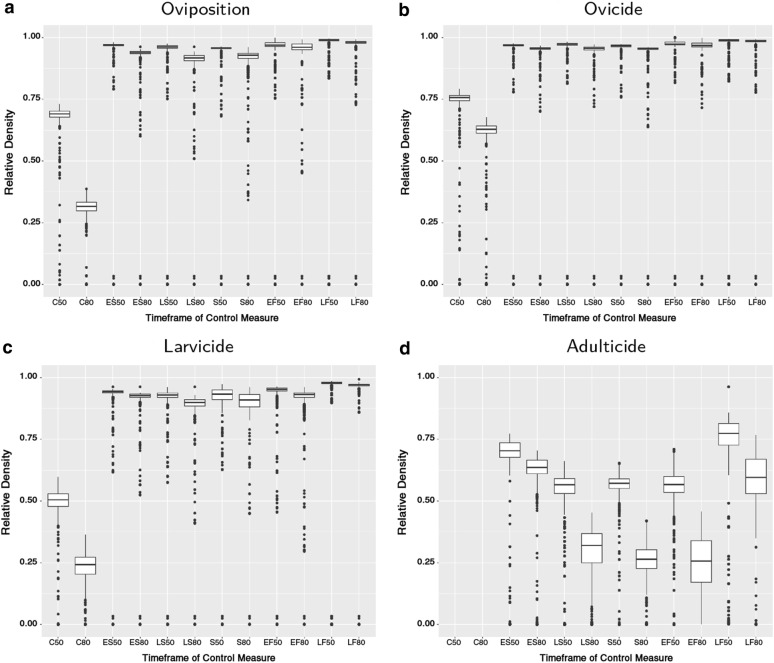
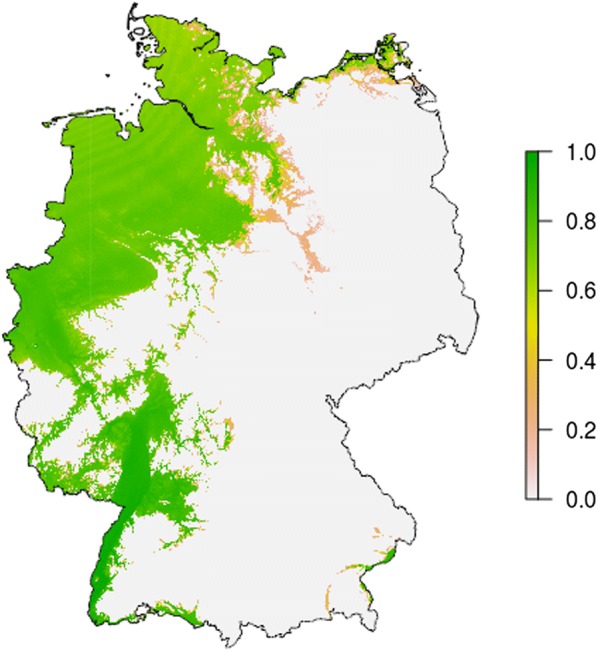
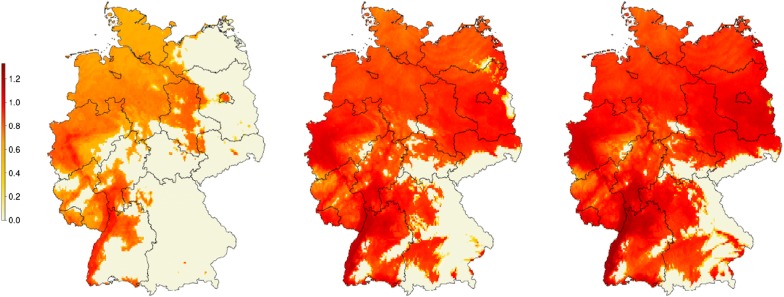
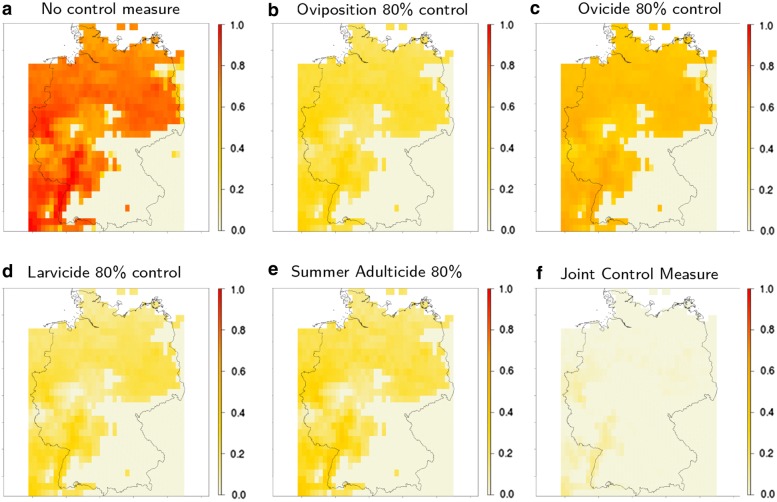
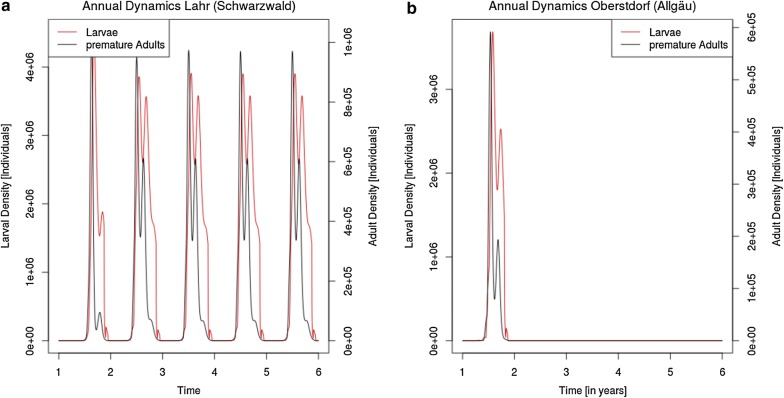
Aedes j. japonicus has already established stable populations in the southwest and west of Germany. Our models predict a spread of Ae. j. japonicus beyond the currently observed range, but likely not much further eastwards under current climatic conditions. Climate change models, however, will expand this range substantially and higher annual densities can be expected. Applying vector control measures to oviposition, survival of eggs, larvae or adults showed that application of adulticides for 30 days between late spring and early autumn, while ambient temperatures are above 9 °C, can reduce population density by 75%. Continuous application of larvicide showed similar results in population reduction. Most importantly, we showed that with the consequent application of a mixed strategy, it should be possible to significantly reduce or even extinguish existing populations with reasonable effort.

CONCLUSION

Our study provides valuable insights into the mechanisms concerning the establishment of stable populations in invasive species. In order to minimise the hazard to public health, we recommend vector control measures to be applied in 'high risk areas' which are predicted to allow establishment of stable populations to establish.

摘要

背景

入侵性温带蚊子白纹伊蚊是多种传染病的潜在媒介,因此也是病媒控制措施的目标。尽管它已经在德国建立,但尚不清楚该物种是否已经充分发挥了其分布潜力。该物种的可能范围、其年度种群动态、病媒控制措施的成功以及未来因气候变化而导致的扩张,仍然知之甚少。尽管已经进行了许多关于发生情况的研究,但这些研究主要使用了来自相对较少地点的存在数据。相比之下,我们使用实验生命史数据来模拟连续阶段结构种群的动态,以推断潜在的季节性密度,并询问在一年以上的时间内是否有可能建立稳定的种群。此外,我们还使用气候变化模型来推断未来的范围。最后,我们评估了各种特定阶段的病媒控制措施的有效性。

结果

白纹伊蚊已经在德国西南部和西部建立了稳定的种群。我们的模型预测,在当前气候条件下,白纹伊蚊的分布范围可能会进一步扩大,但不太可能向东扩展太多。然而,气候变化模型将大幅扩大这个范围,并预计每年的密度会更高。对白纹伊蚊的卵、幼虫或成虫进行特定阶段的病媒控制措施应用表明,在晚春至初秋期间,当环境温度高于 9°C 时,应用 30 天的成虫杀虫剂,可以将种群密度降低 75%。持续应用幼虫杀虫剂在种群减少方面也有类似的效果。最重要的是,我们表明,通过应用混合策略,有可能用合理的努力显著降低甚至消灭现有的种群。

结论

我们的研究为入侵物种中稳定种群建立的机制提供了有价值的见解。为了将对公众健康的危害降到最低,我们建议在预计可以建立稳定种群的“高风险地区”应用病媒控制措施。
https://cdn.ncbi.nlm.nih.gov/pmc/blobs/a380/6434845/ee0dafa5cb0d/13071_2019_3366_Fig5_HTML.jpg
https://cdn.ncbi.nlm.nih.gov/pmc/blobs/a380/6434845/29a2bcd7c123/13071_2019_3366_Fig1_HTML.jpg
https://cdn.ncbi.nlm.nih.gov/pmc/blobs/a380/6434845/f5c22a12a015/13071_2019_3366_Fig2_HTML.jpg
https://cdn.ncbi.nlm.nih.gov/pmc/blobs/a380/6434845/1aeaded28f20/13071_2019_3366_Fig3_HTML.jpg
https://cdn.ncbi.nlm.nih.gov/pmc/blobs/a380/6434845/ee2cc77fa7e3/13071_2019_3366_Fig4_HTML.jpg
https://cdn.ncbi.nlm.nih.gov/pmc/blobs/a380/6434845/ee0dafa5cb0d/13071_2019_3366_Fig5_HTML.jpg
https://cdn.ncbi.nlm.nih.gov/pmc/blobs/a380/6434845/29a2bcd7c123/13071_2019_3366_Fig1_HTML.jpg
https://cdn.ncbi.nlm.nih.gov/pmc/blobs/a380/6434845/f5c22a12a015/13071_2019_3366_Fig2_HTML.jpg
https://cdn.ncbi.nlm.nih.gov/pmc/blobs/a380/6434845/1aeaded28f20/13071_2019_3366_Fig3_HTML.jpg
https://cdn.ncbi.nlm.nih.gov/pmc/blobs/a380/6434845/ee2cc77fa7e3/13071_2019_3366_Fig4_HTML.jpg
https://cdn.ncbi.nlm.nih.gov/pmc/blobs/a380/6434845/ee0dafa5cb0d/13071_2019_3366_Fig5_HTML.jpg

相似文献

1
Modelling seasonal dynamics, population stability, and pest control in Aedes japonicus japonicus (Diptera: Culicidae).模拟白纹伊蚊(双翅目:蚊科)的季节性动态、种群稳定性和害虫控制。
Parasit Vectors. 2019 Mar 25;12(1):142. doi: 10.1186/s13071-019-3366-2.
2
Thermal experiments with the Asian bush mosquito (Aedes japonicus japonicus) (Diptera: Culicidae) and implications for its distribution in Germany.亚洲灌木蚊(Aedes japonicus japonicus)(双翅目:蚊科)的热实验及其对德国分布的影响。
Parasit Vectors. 2018 Feb 5;11(1):81. doi: 10.1186/s13071-018-2659-1.
3
What makes the Asian bush mosquito Aedes japonicus japonicus feel comfortable in Germany? A fuzzy modelling approach.是什么让亚洲灌木蚊(白纹伊蚊)在德国感到舒适?一种模糊建模方法。
Parasit Vectors. 2019 Mar 14;12(1):106. doi: 10.1186/s13071-019-3368-0.
4
Oviposition of Aedes japonicus japonicus (Diptera: Culicidae) and associated native species in relation to season, temperature and land use in western Germany.日本伊蚊(双翅目:蚊科)及其相关本地物种的产卵与季节、温度和德国西部土地利用的关系。
Parasit Vectors. 2020 Dec 17;13(1):623. doi: 10.1186/s13071-020-04461-z.
5
Can data from native mosquitoes support determining invasive species habitats? Modelling the climatic niche of Aedes japonicus japonicus (Diptera, Culicidae) in Germany.本土蚊子的数据能否支持确定入侵物种的栖息地?日本伊蚊在德国的气候生态位建模(双翅目,蚊科)。
Parasitol Res. 2020 Jan;119(1):31-42. doi: 10.1007/s00436-019-06513-5. Epub 2019 Nov 26.
6
Aedes albopictus and Aedes japonicus - two invasive mosquito species with different temperature niches in Europe.白纹伊蚊和日本伊蚊——欧洲两种具有不同温度生态位的入侵性蚊虫物种。
Parasit Vectors. 2016 Nov 4;9(1):573. doi: 10.1186/s13071-016-1853-2.
7
Occurrence and Spread of the Invasive Asian Bush Mosquito Aedes japonicus japonicus (Diptera: Culicidae) in West and North Germany since Detection in 2012 and 2013, Respectively.自2012年和2013年分别在德国西部和北部首次发现以来,入侵性亚洲丛林蚊种日本伊蚊(双翅目:蚊科)的发生与扩散情况
PLoS One. 2016 Dec 9;11(12):e0167948. doi: 10.1371/journal.pone.0167948. eCollection 2016.
8
The invasive Korean bush mosquito Aedes koreicus (Diptera: Culicidae) in Germany as of 2020.截至 2020 年,在德国的入侵性韩国灌木伊蚊(双翅目:蚊科)。
Parasit Vectors. 2021 Nov 12;14(1):575. doi: 10.1186/s13071-021-05077-7.
9
First record of the Asian bush mosquito, Aedes japonicus japonicus, in Italy: invasion from an established Austrian population.亚洲丛林蚊种日本伊蚊日本亚种在意大利的首次记录:源自奥地利一个已定居种群的入侵。
Parasit Vectors. 2016 May 16;9(1):284. doi: 10.1186/s13071-016-1566-6.
10
Predation on the invasive mosquito Aedes japonicus (Diptera: Culicidae) by native copepod species in Germany.德国本土桡足类物种对入侵蚊子日本伊蚊(双翅目:蚊科)的捕食行为
J Vector Ecol. 2019 Dec;44(2):241-247. doi: 10.1111/jvec.12355.

引用本文的文献

1
() , , and () (Diptera: Culicidae): Three Neglected Mosquitoes with Potential Global Health Risks.()、()和()(双翅目:蚊科):三种被忽视的具有潜在全球健康风险的蚊子。
Insects. 2024 Aug 8;15(8):600. doi: 10.3390/insects15080600.
2
Potential Global Distribution of the Invasive Mosquito under a Changing Climate.气候变化下入侵性蚊子的潜在全球分布
Trop Med Infect Dis. 2023 Oct 10;8(10):471. doi: 10.3390/tropicalmed8100471.
3
Trends in mosquito species distribution modeling: insights for vector surveillance and disease control.

本文引用的文献

1
The genomic footprint of climate adaptation in Chironomus riparius.丽蝇蛹库蚊的气候适应性的基因组足迹。
Mol Ecol. 2018 Mar;27(6):1439-1456. doi: 10.1111/mec.14543. Epub 2018 Mar 23.
2
Thermal experiments with the Asian bush mosquito (Aedes japonicus japonicus) (Diptera: Culicidae) and implications for its distribution in Germany.亚洲灌木蚊(Aedes japonicus japonicus)(双翅目:蚊科)的热实验及其对德国分布的影响。
Parasit Vectors. 2018 Feb 5;11(1):81. doi: 10.1186/s13071-018-2659-1.
3
Larval superiority of Culex pipiens to Aedes albopictus in a replacement series experiment: prospects for coexistence in Germany.
蚊子物种分布建模趋势:对病媒监测和疾病控制的启示。
Parasit Vectors. 2023 Aug 28;16(1):302. doi: 10.1186/s13071-023-05912-z.
4
dynamAedes: a unified modelling framework for invasive Aedes mosquitoes.dynamAedes:一种用于入侵性伊蚊的统一建模框架。
Parasit Vectors. 2022 Nov 8;15(1):414. doi: 10.1186/s13071-022-05414-4.
5
From a long-distance threat to the invasion front: a review of the invasive Aedes mosquito species in Belgium between 2007 and 2020.从远程威胁到入侵前线:2007 年至 2020 年期间比利时入侵性伊蚊种类综述。
Parasit Vectors. 2022 Jun 13;15(1):206. doi: 10.1186/s13071-022-05303-w.
6
Laboratory Evaluation of Flight Capacities of Aedes japonicus (Diptera: Culicidae) Using a Flight Mill Device.利用飞行磨设备对日本伊蚊(双翅目:蚊科)飞行能力的实验室评估。
J Insect Sci. 2021 Nov 1;21(6). doi: 10.1093/jisesa/ieab093.
7
Population genetic structure of the Asian bush mosquito, Aedes japonicus (Diptera, Culicidae), in Belgium suggests multiple introductions.比利时亚洲灌木蚊(双翅目,蚊科)的种群遗传结构表明存在多次引入。
Parasit Vectors. 2021 Mar 25;14(1):179. doi: 10.1186/s13071-021-04676-8.
8
Knowledge on exotic mosquitoes in Germany, and public acceptance and effectiveness of Bti and two self-prepared insecticides against Aedes japonicus japonicus.德国外来蚊虫知识及 Bti 和两种自制杀虫剂防治白纹伊蚊的公众接受度和效果。
Sci Rep. 2020 Nov 3;10(1):18901. doi: 10.1038/s41598-020-75780-5.
9
Can data from native mosquitoes support determining invasive species habitats? Modelling the climatic niche of Aedes japonicus japonicus (Diptera, Culicidae) in Germany.本土蚊子的数据能否支持确定入侵物种的栖息地?日本伊蚊在德国的气候生态位建模(双翅目,蚊科)。
Parasitol Res. 2020 Jan;119(1):31-42. doi: 10.1007/s00436-019-06513-5. Epub 2019 Nov 26.
10
First report of the influence of temperature on the bionomics and population dynamics of Aedes koreicus, a new invasive alien species in Europe.首次报告温度对在欧洲新入侵的外来物种白纹伊蚊的生态学和种群动态的影响。
Parasit Vectors. 2019 Nov 6;12(1):524. doi: 10.1186/s13071-019-3772-5.
在替代系列实验中,库蚊幼虫比白纹伊蚊幼虫更占优势:德国共存的前景。
Parasit Vectors. 2018 Feb 2;11(1):80. doi: 10.1186/s13071-018-2665-3.
4
Mosquito-Borne Diseases: Advances in Modelling Climate-Change Impacts.蚊媒疾病:气候变化影响建模的进展。
Trends Parasitol. 2018 Mar;34(3):227-245. doi: 10.1016/j.pt.2017.11.006. Epub 2017 Dec 8.
5
Climatologies at high resolution for the earth's land surface areas.高分辨率地球陆地区域气候概况。
Sci Data. 2017 Sep 5;4:170122. doi: 10.1038/sdata.2017.122.
6
Occurrence and Spread of the Invasive Asian Bush Mosquito Aedes japonicus japonicus (Diptera: Culicidae) in West and North Germany since Detection in 2012 and 2013, Respectively.自2012年和2013年分别在德国西部和北部首次发现以来,入侵性亚洲丛林蚊种日本伊蚊(双翅目:蚊科)的发生与扩散情况
PLoS One. 2016 Dec 9;11(12):e0167948. doi: 10.1371/journal.pone.0167948. eCollection 2016.
7
Aedes albopictus and Aedes japonicus - two invasive mosquito species with different temperature niches in Europe.白纹伊蚊和日本伊蚊——欧洲两种具有不同温度生态位的入侵性蚊虫物种。
Parasit Vectors. 2016 Nov 4;9(1):573. doi: 10.1186/s13071-016-1853-2.
8
Newly discovered population of Aedes japonicus japonicus (Diptera: Culicidae) in Upper Bavaria, Germany, and Salzburg, Austria, is closely related to the Austrian/Slovenian bush mosquito population.在德国上巴伐利亚州和奥地利萨尔茨堡新发现的日本伊蚊(双翅目:蚊科)种群与奥地利/斯洛文尼亚丛林蚊种群密切相关。
Parasit Vectors. 2016 Mar 21;9:163. doi: 10.1186/s13071-016-1447-z.
9
Support for the evolutionary speed hypothesis from intraspecific population genetic data in the non-biting midge Chironomus riparius.来自非吸血摇蚊河岸摇蚊种内群体遗传数据对进化速度假说的支持。
Proc Biol Sci. 2016 Feb 24;283(1825):20152413. doi: 10.1098/rspb.2015.2413.
10
Standardized Laboratory Feeding of Larval Aedes japonicus japonicus (Diptera: Culicidae).日本伊蚊幼虫的标准化实验室饲养(双翅目:蚊科)
J Insect Sci. 2015 Oct 9;15(1). doi: 10.1093/jisesa/iev126. Print 2015.