Cunze Sarah, Koch Lisa K, Kochmann Judith, Klimpel Sven
Institute of Ecology, Evolution and Diversity, Goethe-University, D-60438 Frankfurt/ M., Germany.
Senckenberg Biodiversity and Climate Research Centre, Senckenberg Gesellschaft für Naturforschung, D-60438 Frankfurt/ M., Germany.
Parasit Vectors. 2016 Nov 4;9(1):573. doi: 10.1186/s13071-016-1853-2.
Aedes albopictus and Ae. japonicus are two of the most widespread invasive mosquito species that have recently become established in western Europe. Both species are associated with the transmission of a number of serious diseases and are projected to continue their spread in Europe.
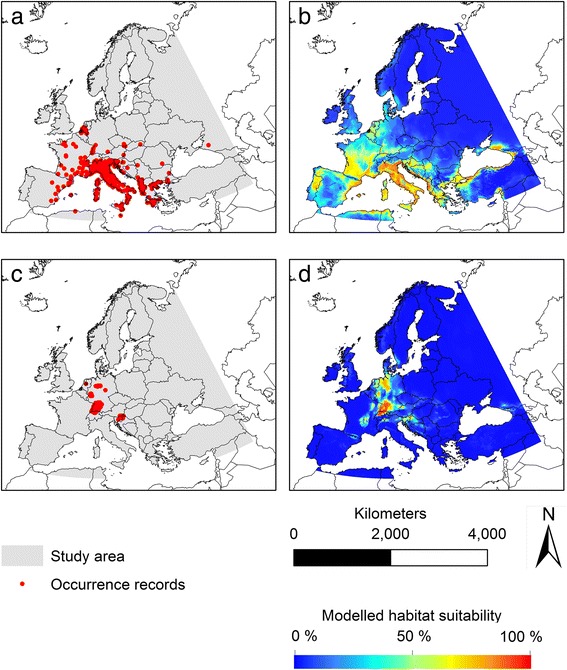
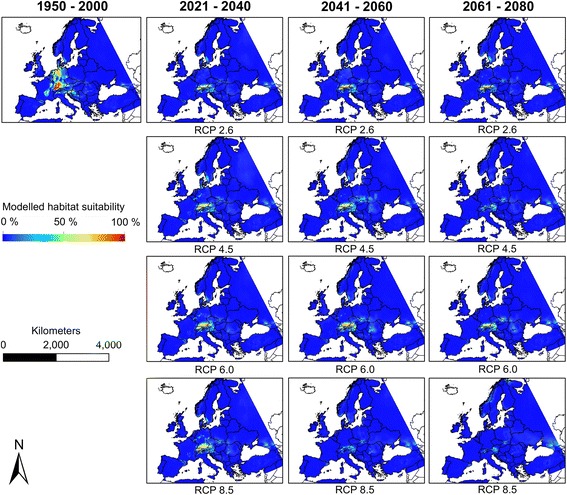
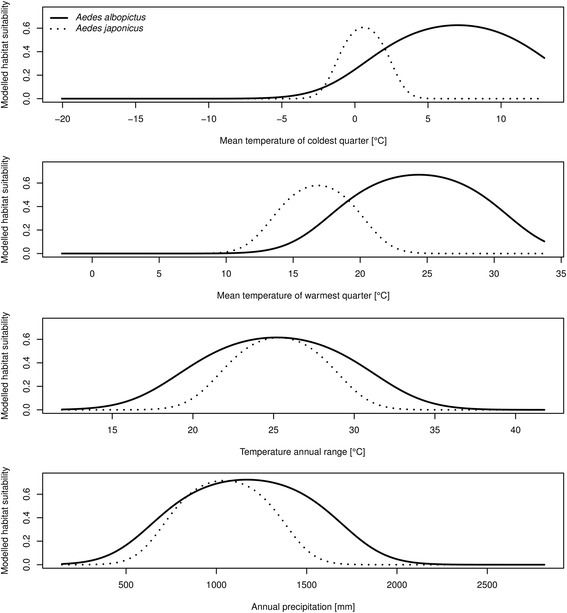
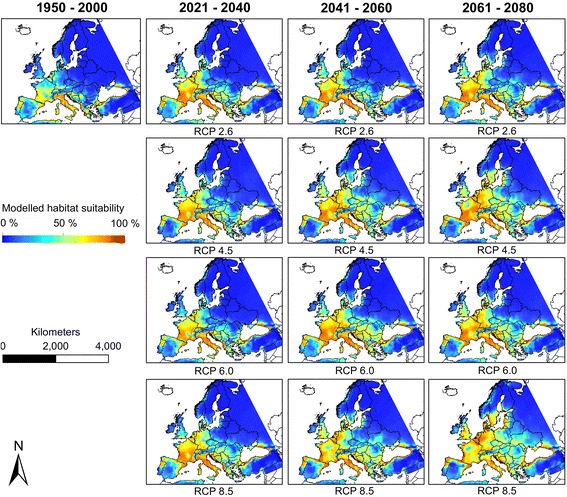
In the present study, we modelled the habitat suitability for both species under current and future climatic conditions by means of an Ensemble forecasting approach. We additionally compared the modelled MAXENT niches of Ae. albopictus and Ae. japonicus regarding temperature and precipitation requirements.
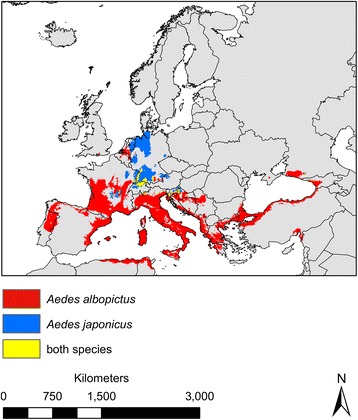
Both species were modelled to find suitable habitat conditions in distinct areas within Europe: Ae. albopictus within the Mediterranean regions in southern Europe, Ae. japonicus within the more temperate regions of central Europe. Only in few regions, suitable habitat conditions were projected to overlap for both species. Whereas Ae. albopictus is projected to be generally promoted by climate change in Europe, the area modelled to be climatically suitable for Ae. japonicus is projected to decrease under climate change. This projection of range reduction under climate change relies on the assumption that Ae. japonicus is not able to adapt to warmer climatic conditions. The modelled MAXENT temperature niches of Ae. japonicus were found to be narrower with an optimum at lower temperatures compared to the niches of Ae. albopictus.
Species distribution models identifying areas with high habitat suitability can help improving monitoring programmes for invasive species currently in place. However, as mosquito species are known to be able to adapt to new environmental conditions within the invasion range quickly, niche evolution of invasive mosquito species should be closely followed upon in future studies.
白纹伊蚊和日本伊蚊是西欧最近新出现的两种分布最广泛的入侵蚊种。这两个物种都与多种严重疾病的传播有关,预计它们将继续在欧洲扩散。
在本研究中,我们采用集合预测方法对这两个物种在当前和未来气候条件下的栖息地适宜性进行了建模。我们还比较了白纹伊蚊和日本伊蚊在温度和降水需求方面的最大熵生态位模型。
对这两个物种的建模结果显示,它们在欧洲的不同区域找到了适宜的栖息地条件:白纹伊蚊分布在南欧的地中海地区,日本伊蚊分布在中欧较温和的地区。只有在少数地区,预计这两个物种的适宜栖息地条件会重叠。虽然预计气候变化总体上会促进白纹伊蚊在欧洲的分布,但预计气候变化下,建模显示气候适宜日本伊蚊生存的区域将会减少。这种气候变化下分布范围缩小的预测是基于日本伊蚊无法适应更温暖气候条件这一假设。与白纹伊蚊的生态位相比,发现日本伊蚊的最大熵温度生态位更窄,且在较低温度下有一个最佳值。
识别高栖息地适宜性区域的物种分布模型有助于改进目前针对入侵物种的监测计划。然而,由于已知蚊虫能够在入侵范围内迅速适应新的环境条件,未来的研究应密切关注入侵蚊虫物种的生态位演变。