Hematology Research Group, Instituto de Investigación Sanitaria La Fe, Valencia.
Grupo de Investigación en Biomedicina Molecular, Celular y Genómica, Instituto de Investigación Sanitaria La Fe, Valencia.
Haematologica. 2019 May;104(5):881-893. doi: 10.3324/haematol.2018.211359. Epub 2019 Mar 28.
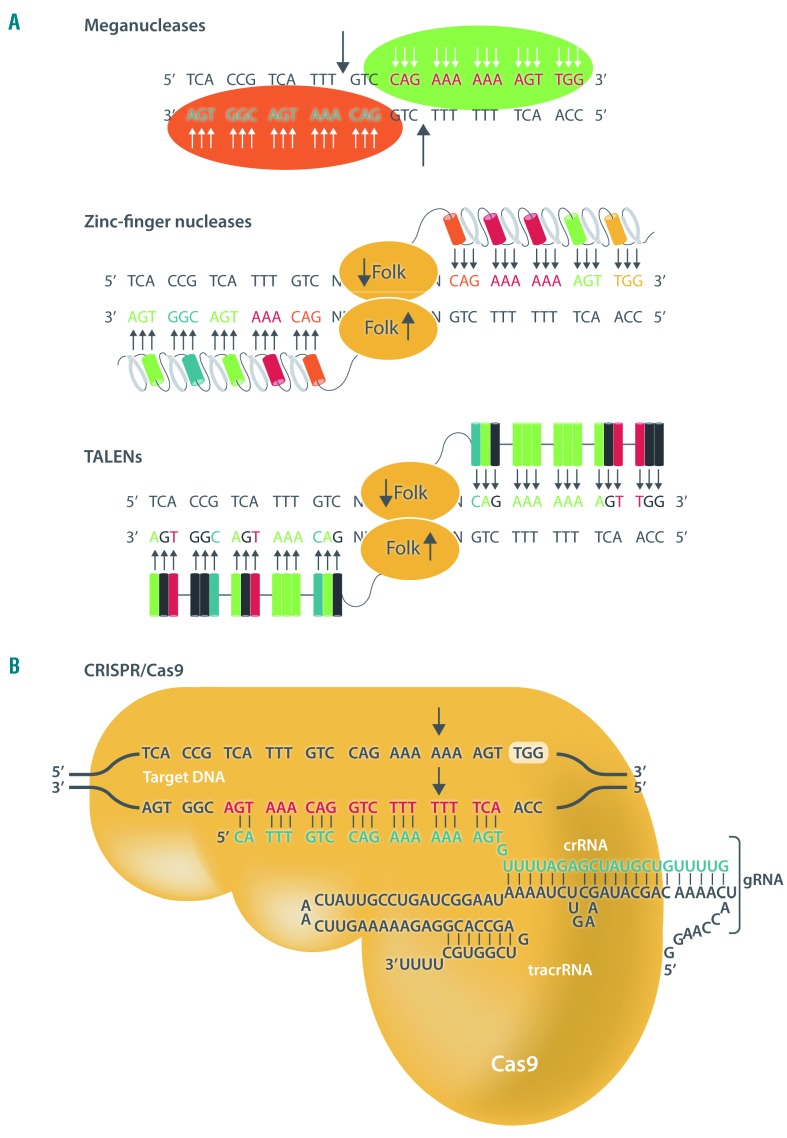
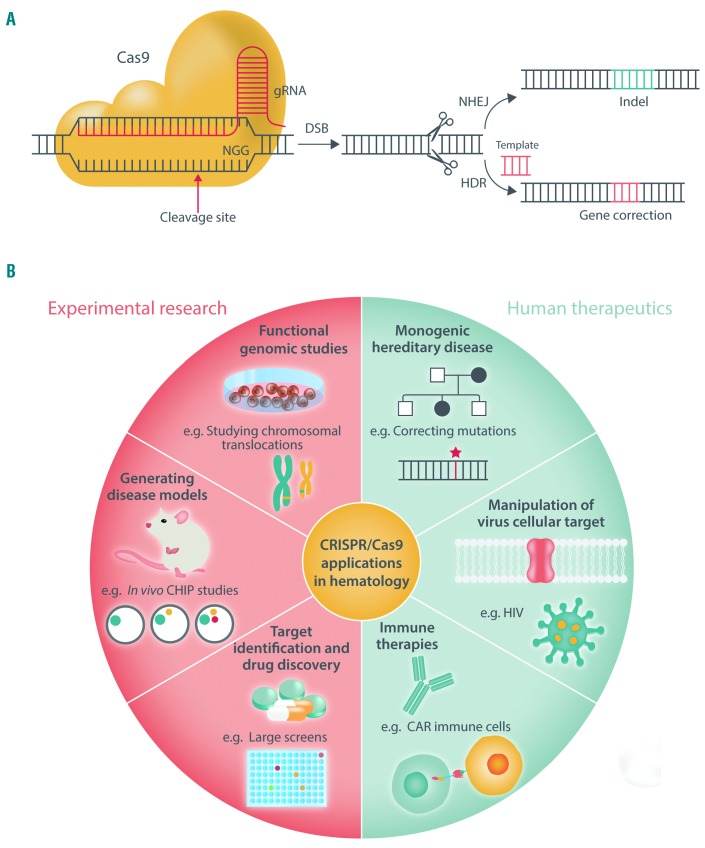
Advances in genome engineering in the last decade, particularly in the development of programmable nucleases, have made it possible to edit the genomes of most cell types precisely and efficiently. Chief among these advances, the clustered regularly interspaced short palindromic repeats (CRISPR)/Cas9 system is a novel, versatile and easy-to-use tool to edit genomes irrespective of their complexity, with multiple and broad applications in biomedicine. In this review, we focus on the use of CRISPR/Cas9 genome editing in the context of hematologic diseases and appraise the major achievements and challenges in this rapidly moving field to gain a clearer perspective on the potential of this technology to move from the laboratory to the clinic. Accordingly, we discuss data from studies editing hematopoietic cells to understand and model blood diseases, and to develop novel therapies for hematologic malignancies. We provide an overview of the applications of gene editing in experimental, preclinical and clinical hematology including interrogation of gene function, target identification and drug discovery and chimeric antigen receptor T-cell engineering. We also highlight current limitations of CRISPR/Cas9 and the possible strategies to overcome them. Finally, we consider what advances in CRISPR/Cas9 are needed to move the hematology field forward.
在过去十年中,基因组工程取得了进展,特别是可编程核酸酶的发展,使得精确和高效地编辑大多数细胞类型的基因组成为可能。在这些进展中,最为突出的是成簇规律间隔短回文重复序列(CRISPR)/Cas9 系统,这是一种新颖、多功能且易于使用的工具,可用于编辑基因组,无论其复杂程度如何,在生物医学中有多种广泛的应用。在这篇综述中,我们重点介绍了 CRISPR/Cas9 基因组编辑在血液疾病中的应用,并评估了这一快速发展领域中的主要成就和挑战,以更清楚地了解该技术从实验室走向临床的潜力。因此,我们讨论了编辑造血细胞以了解和模拟血液疾病以及开发血液恶性肿瘤新疗法的研究数据。我们概述了基因编辑在实验、临床前和临床血液学中的应用,包括基因功能的研究、靶点的确定以及药物发现和嵌合抗原受体 T 细胞工程。我们还强调了 CRISPR/Cas9 的当前局限性以及克服这些局限性的可能策略。最后,我们考虑了需要在 CRISPR/Cas9 方面取得哪些进展才能推动血液学领域的发展。