Department of Pediatrics, Hillel Yaffe Medical Center, Hadera, Israel.
Department of Epidemiology and Preventive Medicine, School of Public Health, Sackler Faculty of Medicine, Tel Aviv University, Tel Aviv, Israel.
PLoS One. 2019 Apr 1;14(4):e0214197. doi: 10.1371/journal.pone.0214197. eCollection 2019.
Ethnic disparities have been shown in respiratory syncytial virus (RSV) bronchiolitis. However, it is unclear whether such differences are related to access to care. We compared demographic and clinical characteristics of Arab and Jewish children hospitalized for RSV bronchiolitis in Israel, a country with universal health insurance.
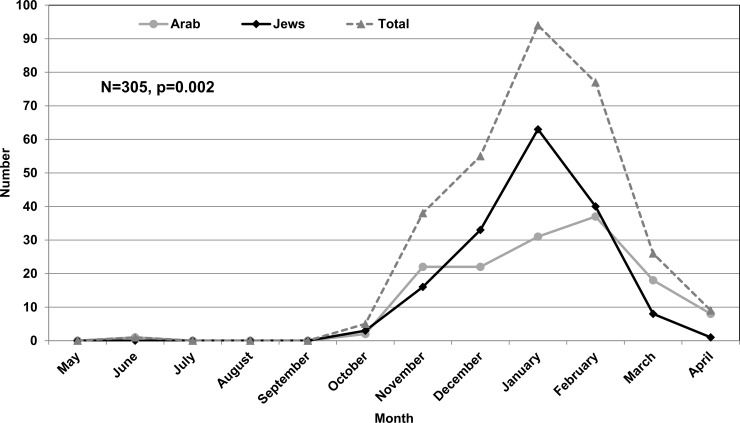
We reviewed the medical records of all children (n = 309) aged less than 24 months who were hospitalized with RSV between 2008 and 2011 in one medical center in Israel. Demographic, clinical, laboratory and radiological data were collected. The RSV antigen was identified using immunochromatography.
The annual incidence of RSV hospitalization was 5.4/1000 and 6.8/1000 among Arab and Jewish children, respectively. Arab patients were significantly younger and had significantly younger parents; most lived in low socioeconomic status towns (93.7% vs. 13.3%; p<0.001) and had more siblings (median 2 vs. 1; p = 0.01) compared to Jewish patients. Disease severity did not differ between the two ethnic groups (p = 0.3). The main predictors of severe illness were having pneumonia (adjusted odds ratio [OR] 3.86; 95% confidence intervals [CI] 1.87-7.97) and history of respiratory diseases (adjusted OR 3.89; 95% CI 1.22-12.38).
The incidence of hospitalizations for RSV bronchiolitis tended to be higher among Jewish than Arab children, possibly due to differences in health care utilization patterns. Differences between the Jewish and Arab patients in demographic factors likely mirror differences between the groups in the general population. Pneumonia, and not ethnicity, affected the severity of RSV bronchiolitis.
呼吸道合胞病毒(RSV)细支气管炎存在种族差异。然而,尚不清楚这些差异是否与获得医疗保健有关。我们比较了在以色列住院的患有 RSV 细支气管炎的阿拉伯裔和犹太裔儿童的人口统计学和临床特征,以色列是一个拥有全民健康保险的国家。
我们回顾了 2008 年至 2011 年期间在以色列一家医疗中心因 RSV 住院的所有年龄小于 24 个月的儿童(n=309)的病历。收集了人口统计学、临床、实验室和影像学数据。使用免疫层析法鉴定 RSV 抗原。
RSV 住院的年发病率分别为阿拉伯裔儿童 5.4/1000 和犹太裔儿童 6.8/1000。阿拉伯裔患者明显更年轻,父母也明显更年轻;他们大多居住在社会经济地位较低的城镇(93.7%对 13.3%;p<0.001),兄弟姐妹也更多(中位数 2 个对 1 个;p=0.01)。与犹太裔患者相比,两组患者的疾病严重程度无差异(p=0.3)。严重疾病的主要预测因素是患有肺炎(校正比值比[OR]3.86;95%置信区间[CI]1.87-7.97)和有呼吸系统疾病史(校正 OR 3.89;95% CI 1.22-12.38)。
与阿拉伯裔儿童相比,犹太裔儿童因 RSV 细支气管炎住院的发生率更高,这可能是由于卫生保健利用模式的差异。犹太裔和阿拉伯裔患者在人口统计学因素上的差异可能反映了两组人群在一般人群中的差异。肺炎而不是种族影响 RSV 细支气管炎的严重程度。