Copenhagen Diabetes Research Center (CPH-DIRECT), Department of Paediatrics, Herlev Hospital, University of Copenhagen, Herlev Ringvej 75, 2730 Herlev, Denmark.
Centre for Fetal Programming, Department of Epidemiology Research, Statens Serum Institut, 2300 Copenhagen S, Denmark.
Nutrients. 2019 Mar 29;11(4):734. doi: 10.3390/nu11040734.
Iron overload has been associated with diabetes. Studies on iron exposure during pregnancy and in early life and risk of childhood type 1 diabetes (T1D) are sparse. We investigated whether iron supplementation during pregnancy and early in life were associated with risk of childhood T1D.
In a case-cohort design, we identified up to 257 children with T1D (prevalence 0.37%) from the Danish National Birth Cohort through linkage with the Danish Childhood Diabetes Register. The primary exposure was maternal pure iron supplementation (yes/no) during pregnancy as reported in interview two at 30 weeks of gestation ( = 68,497 with iron supplement data). We estimated hazard ratios (HRs) using weighted Cox regression adjusting for multiple confounders. We also examined if offspring supplementation during the first 18 months of life was associated with later risk of T1D.
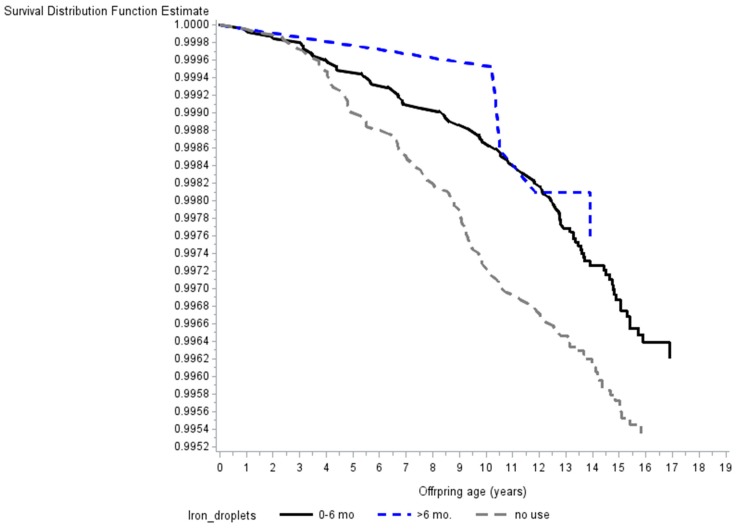
Maternal iron supplementation was not associated with later risk of T1D in the offspring HR 1.05 (95% CI: 0.76⁻1.45). Offspring intake of iron droplets during the first 18 months of life was inversely associated with risk of T1D HR 0.74 (95% CI: 0.55⁻1.00) (p = 0.03).
Our large-scale prospective study demonstrated no harmful effects of iron supplementation during pregnancy and in early life in regard to later risk of childhood T1D in the offspring.
铁过载与糖尿病有关。关于怀孕期间和生命早期暴露于铁与儿童 1 型糖尿病(T1D)风险的研究较少。我们研究了怀孕期间和生命早期补充铁是否与儿童 T1D 的风险相关。
在病例-队列设计中,我们通过与丹麦儿童糖尿病登记处的链接,从丹麦全国出生队列中确定了多达 257 名 T1D 儿童(患病率为 0.37%)。主要暴露是孕妇在妊娠 30 周时的两次访谈中报告的纯铁补充(是/否)(= 68497 例有铁补充数据)。我们使用加权 Cox 回归调整了多种混杂因素后,估计了危险比(HR)。我们还检查了儿童在生命的头 18 个月内补充铁是否与以后患 T1D 的风险有关。
母亲的铁补充与后代以后患 T1D 的风险无关(HR 1.05,95%CI:0.76-1.45)。儿童在生命的头 18 个月内摄入铁滴与 T1D 的风险呈负相关(HR 0.74,95%CI:0.55-1.00)(p=0.03)。
我们的大规模前瞻性研究表明,怀孕期间和生命早期补充铁对后代以后患儿童 T1D 的风险没有不良影响。