Universidad de Castilla-La Mancha, Centro de Estudios Socio-Sanitarios, 16071 Cuenca, Spain.
Universidad de Castilla-La Mancha, Facultad de Enfermería, 16071 Cuenca, Spain.
Nutrients. 2019 Mar 29;11(4):741. doi: 10.3390/nu11040741.
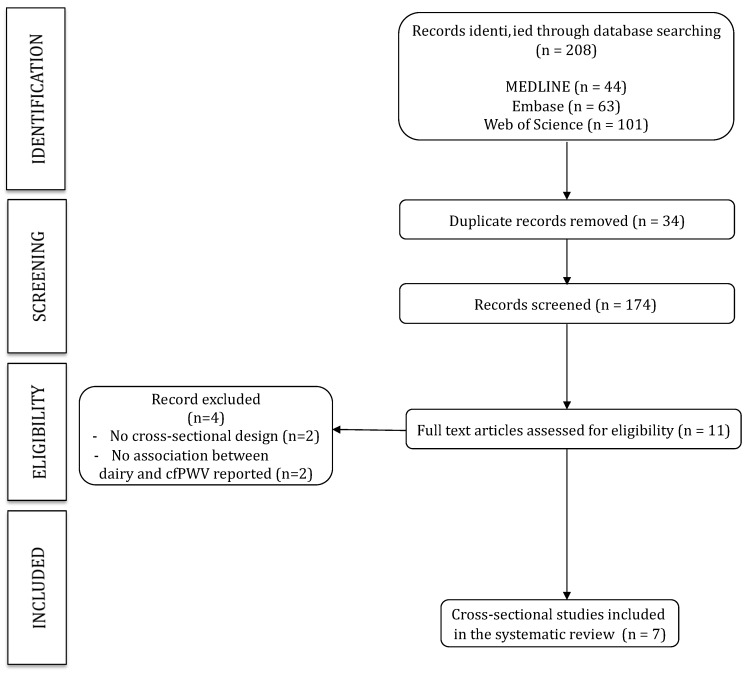
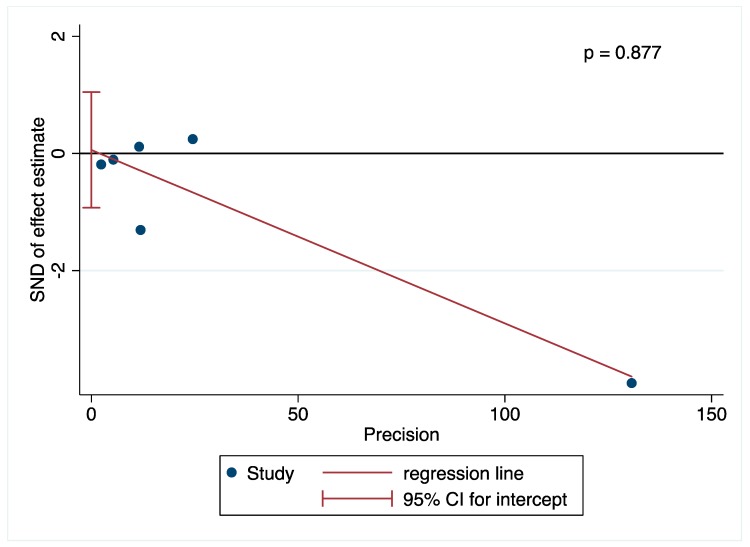
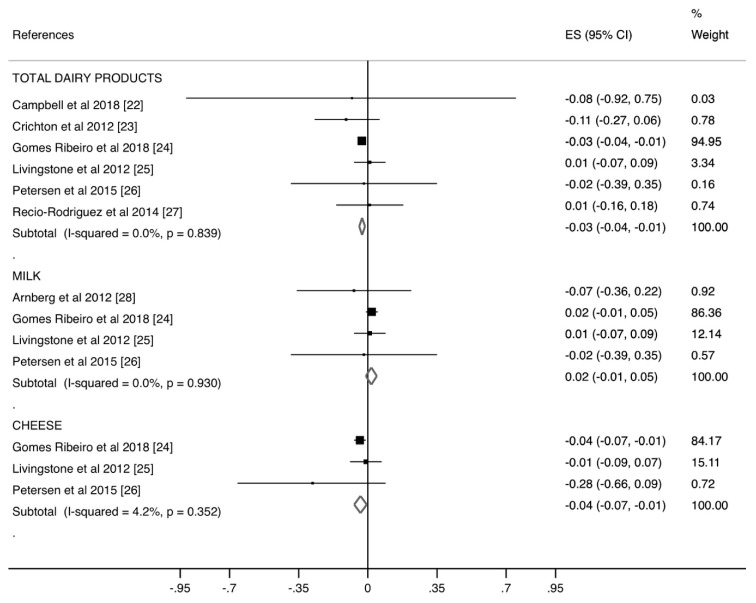
The aim of this review was to determine the relationship between dairy product consumption and arterial stiffness, measured by pulse wave velocity (PWV). We systematically searched the Medline, Embase and Web of Science databases until 30 January 2019 for cross-sectional data from studies addressing the association between dairy product consumption and PWV. This study was registered with PROSPERO (CRD42018110528). Both the inverse-variance fixed effects method and the DerSimonian and Laird method were used to compute pooled estimates of effect size (ES) and the respective 95% confidence intervals (CIs). Seven studies were included in the meta-analysis, with a total of 16,443 patients. Total dairy product (ES = -0.03; 95% CI [-0.04, -0.01]) and cheese (ES = -0.04; 95% CI [-0.07, -0.01]) consumption were weak, but significantly associated with lower PWV levels. Conversely, milk intake showed no significant association with PWV (ES = 0.02; 95% CI [-0.01, 0.05]). Heterogeneity in the ES was not important for the three groups of dairy products assessed. This systematic review and meta-analysis of seven studies found no detrimental effects of dairy product consumption on arterial stiffness measured by PWV. Due to the scarcity of studies, further investigations are warranted to clarify the role of dairy products on arterial stiffness.
本综述的目的是确定乳制品消费与脉搏波速度(PWV)测量的动脉僵硬之间的关系。我们系统地检索了 Medline、Embase 和 Web of Science 数据库,以获取截至 2019 年 1 月 30 日的研究报告,这些研究报告探讨了乳制品消费与 PWV 之间的关联。本研究已在 PROSPERO(CRD42018110528)中注册。我们使用逆方差固定效应法和 DerSimonian 和 Laird 法来计算效应大小(ES)和各自的 95%置信区间(CI)的汇总估计值。共有 7 项研究纳入荟萃分析,总计 16443 名患者。总的乳制品(ES = -0.03;95%CI [-0.04,-0.01])和奶酪(ES = -0.04;95%CI [-0.07,-0.01])消费虽然较弱,但与较低的 PWV 水平显著相关。相反,牛奶摄入与 PWV 无显著相关性(ES = 0.02;95%CI [-0.01,0.05])。评估的三组乳制品的 ES 异质性并不重要。对 7 项研究的系统回顾和荟萃分析发现,乳制品消费对 PWV 测量的动脉僵硬没有不良影响。由于研究数量有限,需要进一步研究来阐明乳制品对动脉僵硬的作用。