Ma Zhi, Bumunang Emmanuel W, Stanford Kim, Bie Xiaomei, Niu Yan D, McAllister Tim A
Nanjing Agricultural University, Nanjing 210095, China.
Agriculture and Agri-Food Canada, Lethbridge, AB T1J 4B1, Canada.
Microorganisms. 2019 Mar 31;7(4):95. doi: 10.3390/microorganisms7040095.
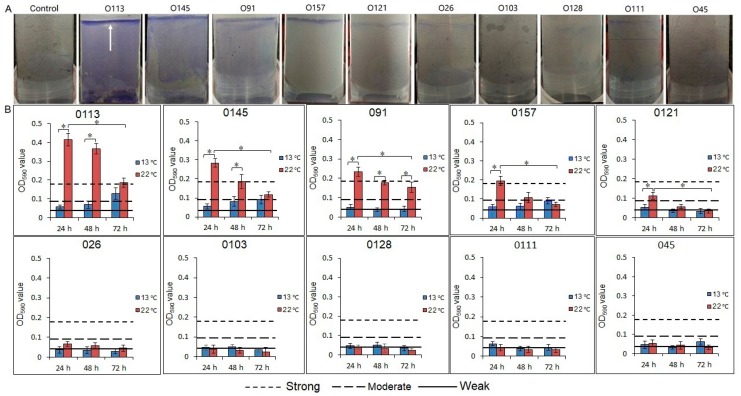
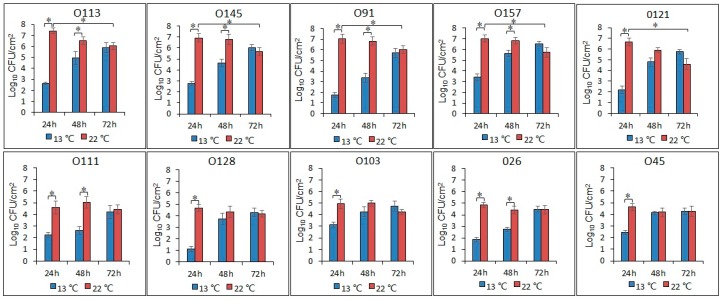
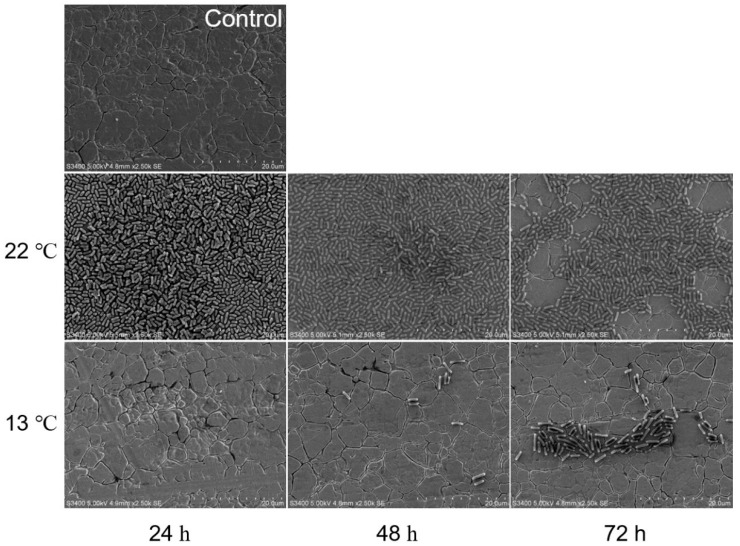
Forming biofilm is a strategy utilized by Shiga toxin-producing Escherichia coli (STEC) to survive and persist in food processing environments. We investigated the biofilm-forming potential of STEC strains from 10 clinically important serogroups on stainless steel at 22 °C or 13 °C after 24, 48, and 72 h of incubation. Results from crystal violet staining, plate counts, and scanning electron microscopy (SEM) identified a single isolate from each of the O113, O145, O91, O157, and O121 serogroups that was capable of forming strong or moderate biofilms on stainless steel at 22 °C. However, the biofilm-forming strength of these five strains was reduced when incubation time progressed. Moreover, we found that these strains formed a dense pellicle at the air-liquid interface on stainless steel, which suggests that oxygen was conducive to biofilm formation. At 13 °C, biofilm formation by these strains decreased (P < 0.05), but gradually increased over time. Overall, STEC biofilm formation was most prominent at 22 °C up to 24 h. The findings in this study identify the environmental conditions that may promote STEC biofilm formation in food processing facilities and suggest that the ability of specific strains to form biofilms contributes to their persistence within these environments.
形成生物膜是产志贺毒素大肠杆菌(STEC)在食品加工环境中生存和持续存在所采用的一种策略。我们研究了来自10个临床重要血清群的STEC菌株在22°C或13°C下于不锈钢表面培养24、48和72小时后形成生物膜的潜力。结晶紫染色、平板计数和扫描电子显微镜(SEM)结果表明,从O113、O145、O91、O157和O121血清群中各分离出一株能够在22°C下于不锈钢表面形成强或中度生物膜的菌株。然而,随着培养时间的延长,这五株菌株的生物膜形成强度降低。此外,我们发现这些菌株在不锈钢表面的气液界面形成了致密的菌膜,这表明氧气有利于生物膜的形成。在13°C时,这些菌株的生物膜形成减少(P<0.05),但随时间逐渐增加。总体而言,STEC生物膜形成在22°C下24小时内最为显著。本研究结果确定了可能促进食品加工设施中STEC生物膜形成的环境条件,并表明特定菌株形成生物膜的能力有助于它们在这些环境中的持续存在。