Xu Jian, Chen Fuqin, Liu Taiyuan, Wang Ting, Zhang Junran, Yuan Huijuan, Wang Meiyun
Department of Medical Information Engineering, School of Electrical Engineering and Information, Sichuan University, Chengdu, China.
School of Information Engineering, Hubei University for Nationalities, Enshi, China.
Front Neurosci. 2019 Mar 19;13:239. doi: 10.3389/fnins.2019.00239. eCollection 2019.
Previous diabetes mellitus studies of cognitive impairments in the early stages have focused on changes in brain structure and function, and more recently the focus has shifted to the relationships between encephalic regions and diversification of network topology. However, studies examining network topology in diabetic brain function are still limited.
The study included 102 subjects; 55 type 2 diabetes mellitus (T2DM) patients plus 47 healthy controls. All subjects were examined by resting-state functional magnetic resonance imaging (rs-fMRI) scan. According to Automated Anatomical Labeling, the brain was divided into 90 anatomical regions, and every region corresponds to a brain network analysis node. The whole brain functional network was constructed by thresholding the correlation matrices of the 90 brain regions, and the topological properties of the network were computed based on graph theory. Then, the topological properties of the network were compared between different groups by using a non-parametric test. Finally, the associations between differences in topological properties and the clinical indicators were analyzed.
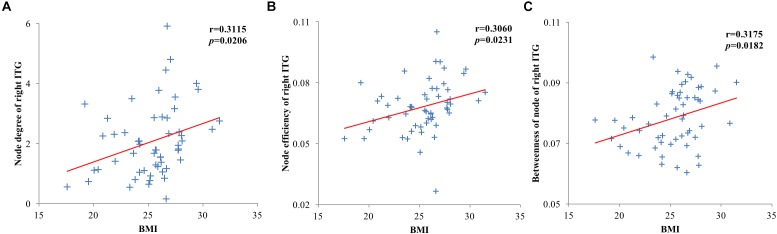
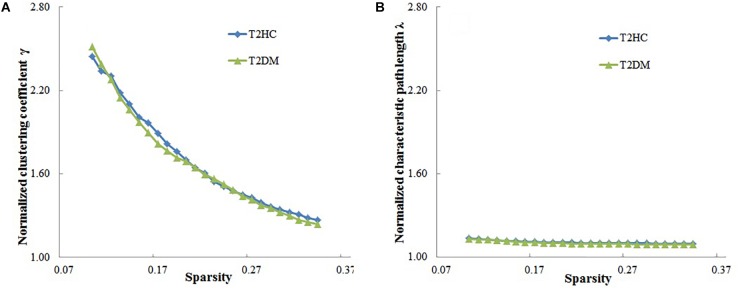
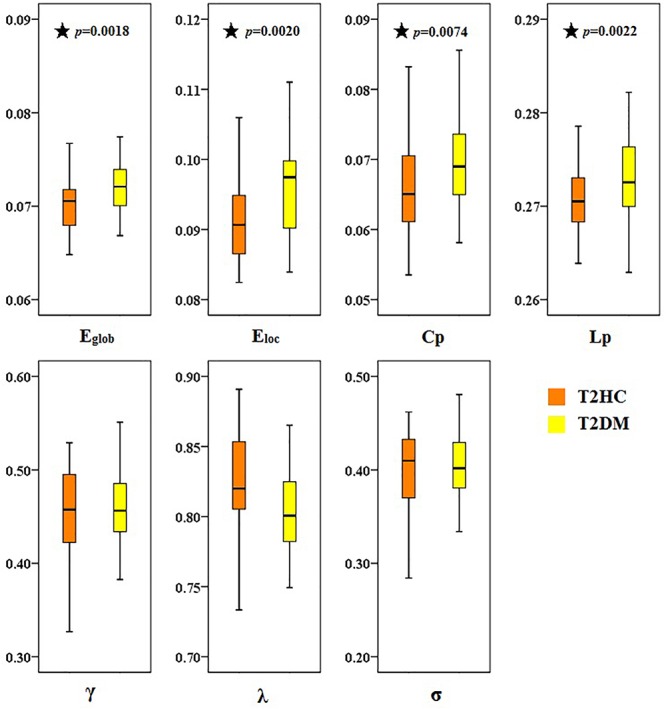
The brain functional networks of both T2DM patients and healthy controls were found to possess small-world characteristics, i.e., normalized clustering coefficient (γ) > 1, and normalized characteristic path length (λ) close to 1. No significant differences were found in the small-world characteristics (σ). Second, the T2DM patient group displayed significant differences in node properties in certain brain regions. Correlative analytic results showed that the node degree of the right inferior temporal gyrus (ITG) and the node efficiencies of the right ITG and superior temporal gyrus of T2DM patients were positively correlated with body mass index.
The brain network of T2DM patients has the same small-world characteristics as normal people, but the normalized clustering coefficient is higher and the normalized characteristic path length is lower than that of the normal control group, indicating that the brain function network of the T2DM patients has changed. The changes of node properties were mostly concentrated in frontal lobe, temporal lobe and posterior cingulate gyrus. The abnormal changes in these indices in T2DM patients might be explained as a compensatory behavior to reduce cognitive impairments, which is achieved by mobilizing additional neural resources, such as the excessive activation of the network and the efficient networking of multiple brain regions.
以往关于糖尿病早期认知障碍的研究主要集中在脑结构和功能的变化上,最近研究重点已转向脑区之间的关系以及网络拓扑的多样性。然而,对糖尿病脑功能中网络拓扑的研究仍然有限。
该研究纳入102名受试者;55例2型糖尿病(T2DM)患者和47名健康对照者。所有受试者均接受静息态功能磁共振成像(rs-fMRI)扫描。根据自动解剖标记,将大脑分为90个解剖区域,每个区域对应一个脑网络分析节点。通过对90个脑区的相关矩阵进行阈值处理构建全脑功能网络,并基于图论计算网络的拓扑特性。然后,使用非参数检验比较不同组之间网络的拓扑特性。最后,分析拓扑特性差异与临床指标之间的关联。
发现T2DM患者和健康对照者的脑功能网络均具有小世界特征,即标准化聚类系数(γ)>1,标准化特征路径长度(λ)接近1。小世界特征(σ)无显著差异。其次,T2DM患者组在某些脑区的节点特性存在显著差异。相关分析结果显示,T2DM患者右侧颞下回(ITG)的节点度以及右侧ITG和颞上回的节点效率与体重指数呈正相关。
T2DM患者的脑网络与正常人具有相同的小世界特征,但标准化聚类系数高于正常对照组,标准化特征路径长度低于正常对照组,表明T2DM患者的脑功能网络发生了变化。节点特性的变化主要集中在额叶、颞叶和后扣带回。T2DM患者这些指标的异常变化可能被解释为一种减少认知障碍的代偿行为,这是通过调动额外的神经资源实现的,如网络的过度激活和多个脑区的高效联网。