Buckingham Sarah Ann, Williams Andrew James, Morrissey Karyn, Price Lisa, Harrison John
European Centre for Environment and Human Health, Knowledge Spa, Royal Cornwall Hospitals NHS Trust, University of Exeter Medical School, Truro, UK.
Sport and Health Sciences, College of Life and Environmental Sciences, University of Exeter, Exeter, UK.
Digit Health. 2019 Mar 27;5:2055207619839883. doi: 10.1177/2055207619839883. eCollection 2019 Jan-Dec.
This systematic review aimed to assess the effectiveness, feasibility and acceptability of mobile health (mHealth) technology (including wearable activity monitors and smartphone applications) for promoting physical activity (PA) and reducing sedentary behaviour (SB) in workplace settings.
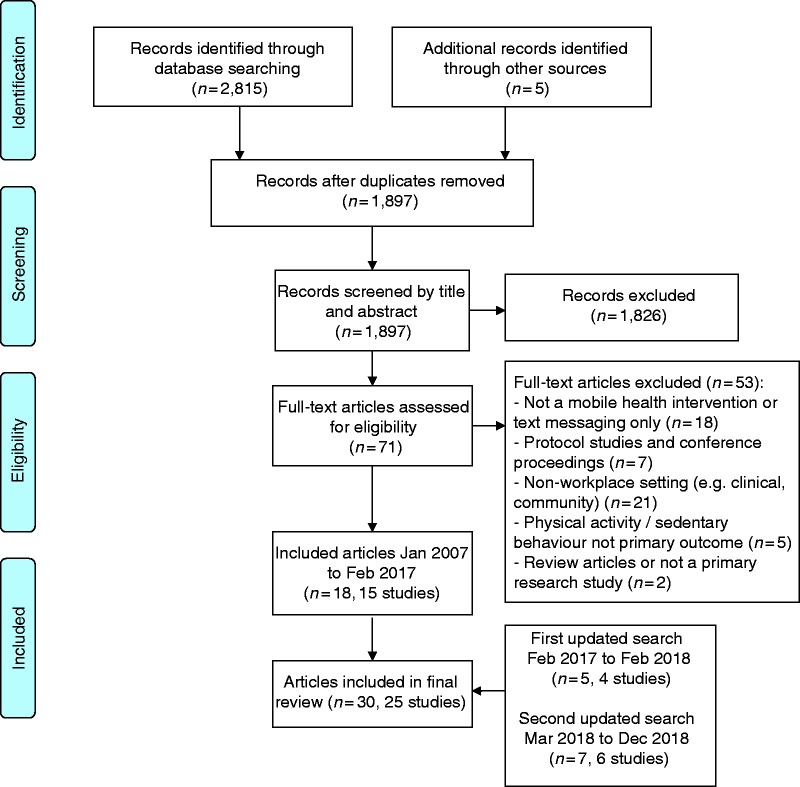
Systematic searches were conducted in seven electronic databases (MEDLINE, SPORTDiscus, Scopus, EMBASE, PsycINFO, Web of Science and the Cochrane library). Studies were included if mHealth was a major intervention component, PA/SB was a primary outcome, and participants were recruited and/or the intervention was delivered in the workplace. Study quality was assessed using the Effective Public Health Practice Project (EPHPP) tool. Interventions were coded for behaviour change techniques (BCTs) using the Coventry, Aberdeen and London - Refined (CALO-RE) taxonomy.
Twenty-five experimental and quasi-experimental studies were included. Studies were highly heterogeneous and only one was rated as 'strong' methodological quality. Common BCTs included self-monitoring, feedback, goal-setting and social comparison. A total of 14/25 (56%) studies reported a significant increase in PA, and 4/10 (40%) reported a significant reduction in sedentary time; 11/16 (69%) studies reported a significant impact on secondary outcomes including reductions in weight, systolic blood pressure and total cholesterol. While overall acceptability was high, a large decline in technology use and engagement was observed over time.
While methodological quality was generally weak, there is reasonable evidence for mHealth in a workplace context as a feasible, acceptable and effective tool to promote PA. The impact in the longer term and on SB is less clear. Higher quality, mixed methods studies are needed to explore the reasons for decline in engagement with time and the longer-term potential of mHealth in workplace interventions. The review protocol was registered with PROSPERO: CRD42017058856.
本系统评价旨在评估移动健康(mHealth)技术(包括可穿戴活动监测器和智能手机应用程序)在工作场所环境中促进身体活动(PA)和减少久坐行为(SB)的有效性、可行性和可接受性。
在七个电子数据库(MEDLINE、SPORTDiscus、Scopus、EMBASE、PsycINFO、科学引文索引和考科蓝图书馆)中进行系统检索。如果mHealth是主要干预组成部分,PA/SB是主要结局,且参与者是在工作场所招募和/或实施干预,则纳入研究。使用有效公共卫生实践项目(EPHPP)工具评估研究质量。使用考文垂、阿伯丁和伦敦改进版(CALO-RE)分类法对干预措施的行为改变技术(BCTs)进行编码。
纳入了25项实验性和准实验性研究。研究具有高度异质性,只有一项被评为“强”方法学质量。常见的BCTs包括自我监测、反馈、目标设定和社会比较。共有14/25(56%)的研究报告PA显著增加,4/10(40%)的研究报告久坐时间显著减少;11/16(69%)的研究报告对次要结局有显著影响,包括体重、收缩压和总胆固醇的降低。虽然总体可接受性较高,但随着时间的推移,观察到技术使用和参与度大幅下降。
虽然方法学质量总体较弱,但有合理证据表明,在工作场所环境中,mHealth作为促进PA的可行、可接受和有效工具。其对长期和SB的影响尚不清楚。需要更高质量的混合方法研究来探讨随着时间推移参与度下降的原因以及mHealth在工作场所干预中的长期潜力。该综述方案已在国际前瞻性系统评价注册库(PROSPERO)注册:CRD42017058856。