Program in Neuroscience, Vanderbilt University, Nashville, Tennessee.
Department of Cell and Developmental Biology, Vanderbilt University School of Medicine, Nashville, Tennessee 37240.
Genetics. 2019 Jun;212(2):387-395. doi: 10.1534/genetics.119.302063. Epub 2019 Apr 5.
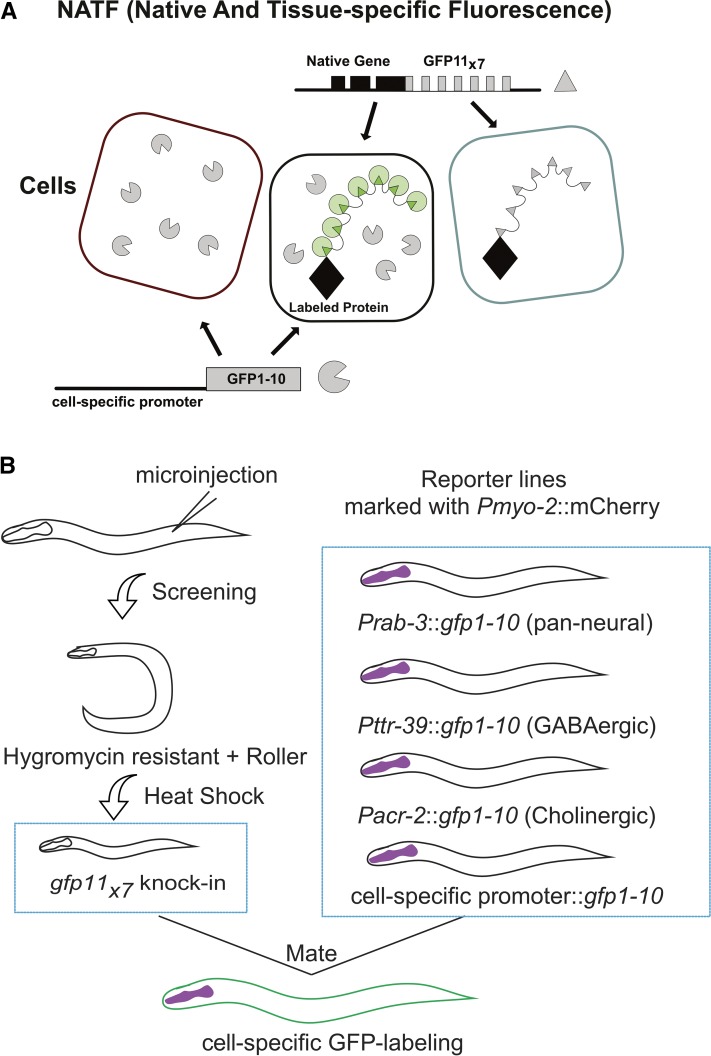
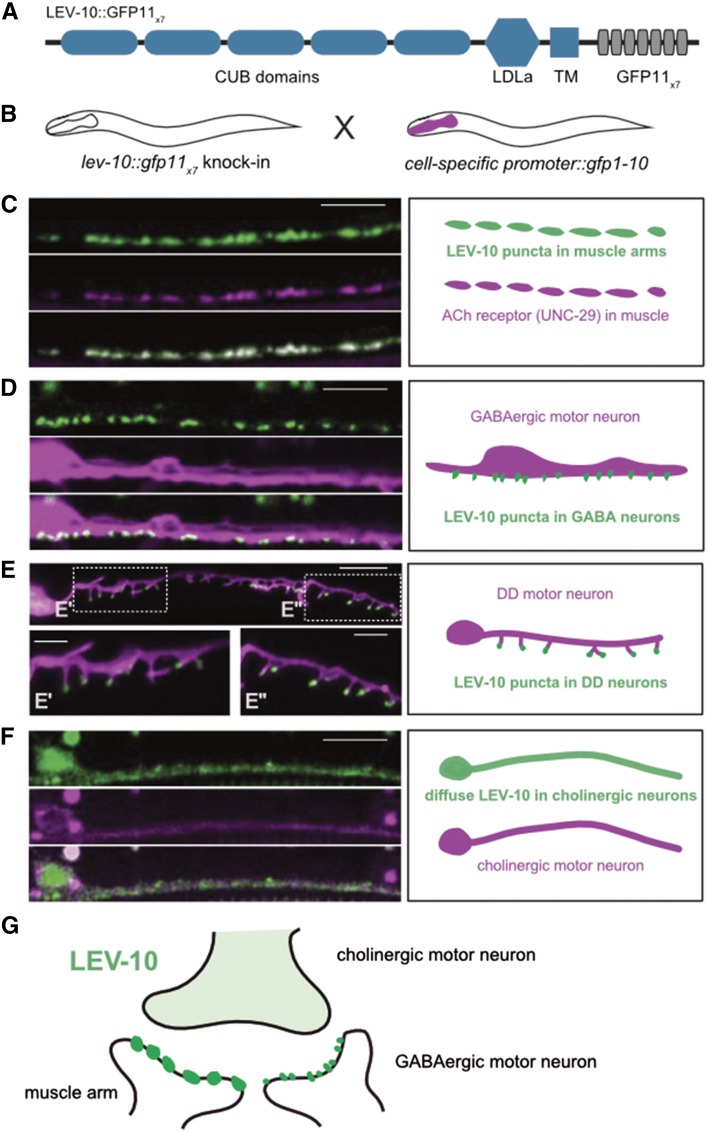
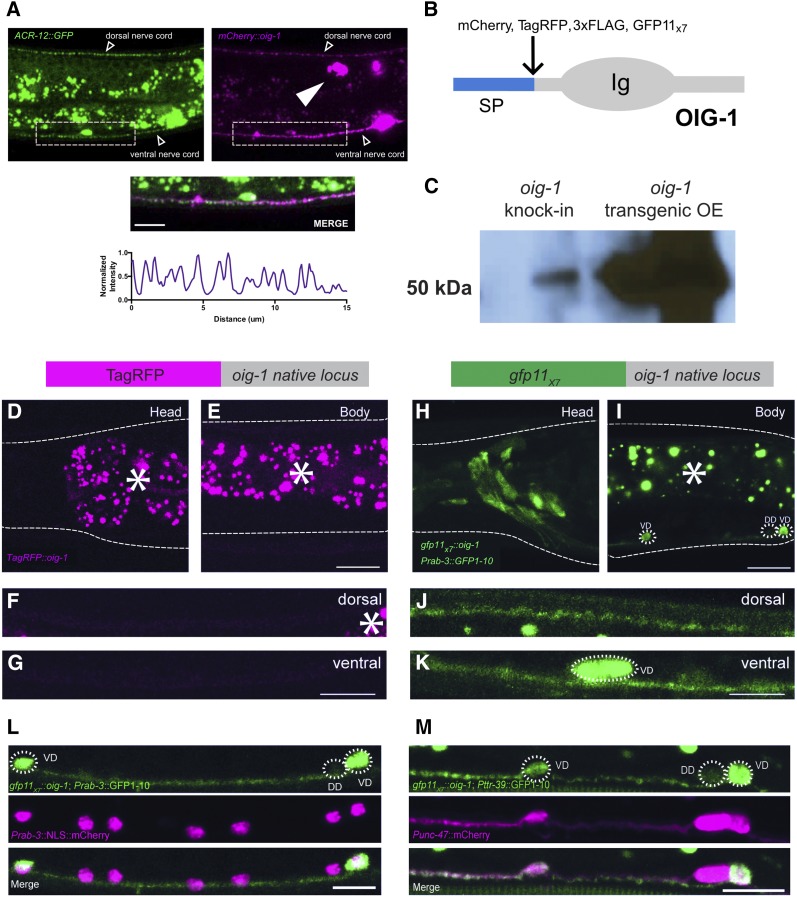
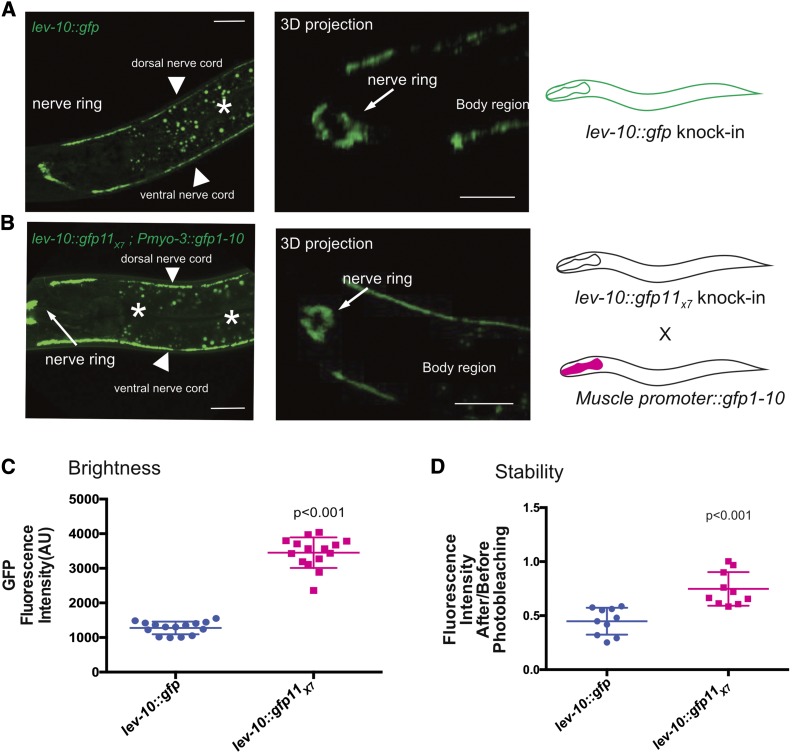
GFP labeling by genome editing can reveal the authentic location of a native protein, but is frequently hampered by weak GFP signals and broad expression across a range of tissues that may obscure cell-specific localization. To overcome these problems, we engineered a Native And Tissue-specific Fluorescence (NATF) strategy that combines genome editing and split-GFP to yield bright, cell-specific protein labeling. We use clustered regularly interspaced short palindromic repeats CRISPR/Cas9 to insert a tandem array of seven copies of the GFP11 β-strand ( ) at the genomic locus of each target protein. The resultant knock-in strain is then crossed with separate reporter lines that express the complementing split-GFP fragment () in specific cell types, thus affording tissue-specific labeling of the target protein at its native level. We show that NATF reveals the otherwise undetectable intracellular location of the immunoglobulin protein OIG-1 and demarcates the receptor auxiliary protein LEV-10 at cell-specific synaptic domains in the nervous system.
通过基因组编辑进行 GFP 标记可以揭示天然蛋白质的真实位置,但 GFP 信号较弱且在广泛的组织中广泛表达,这可能会掩盖细胞特异性定位。为了克服这些问题,我们设计了一种 Native And Tissue-specific Fluorescence(NATF)策略,该策略结合了基因组编辑和分裂 GFP,以产生明亮的、细胞特异性的蛋白质标记。我们使用成簇的规律间隔的短回文重复 CRISPR/Cas9 将 GFP11 β-链的串联数组()插入每个靶蛋白的基因组位置。然后,将产生的 敲入菌株与分别表达在特定细胞类型中互补分裂 GFP 片段()的报告基因系杂交,从而以天然水平对靶蛋白进行组织特异性标记。我们表明,NATF 揭示了免疫球蛋白蛋白 OIG-1 的原本不可检测的细胞内位置,并在 神经系统中的特定突触域标记了受体辅助蛋白 LEV-10。