The Novo Nordisk Foundation Center for Biosustainability, Technical University of Denmark, Kongens Lyngby, Denmark.
Yeast. 2019 May;36(5):237-247. doi: 10.1002/yea.3390.
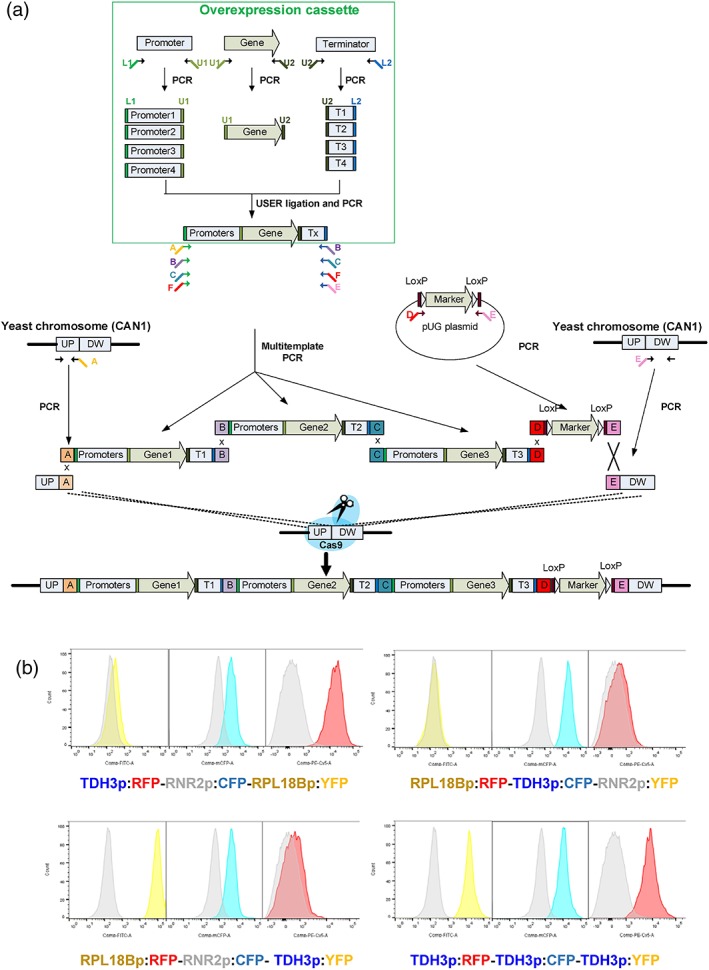
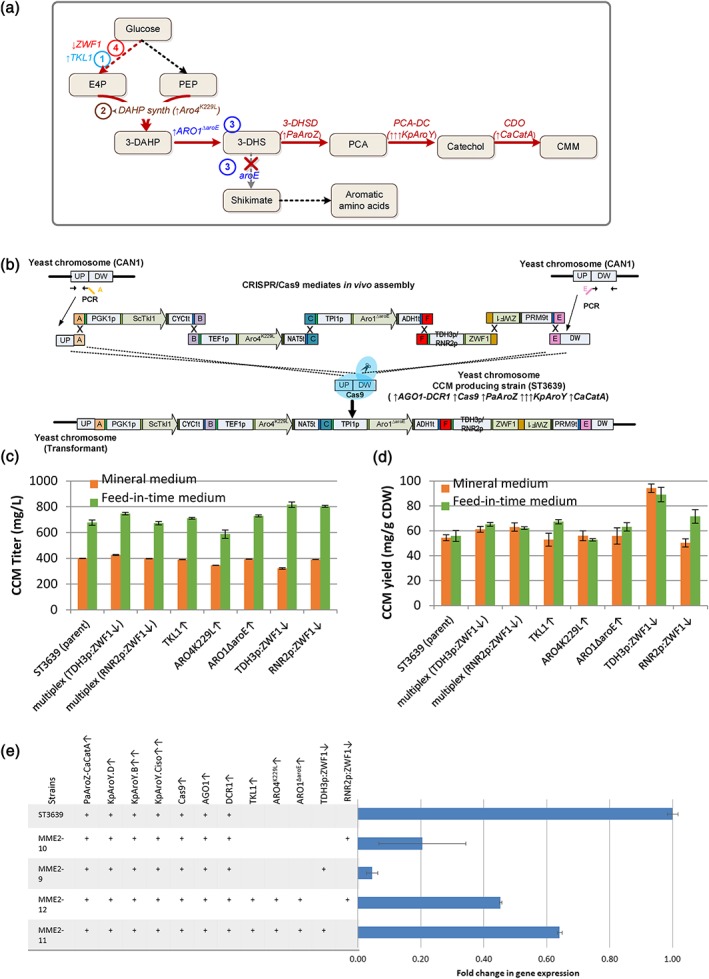
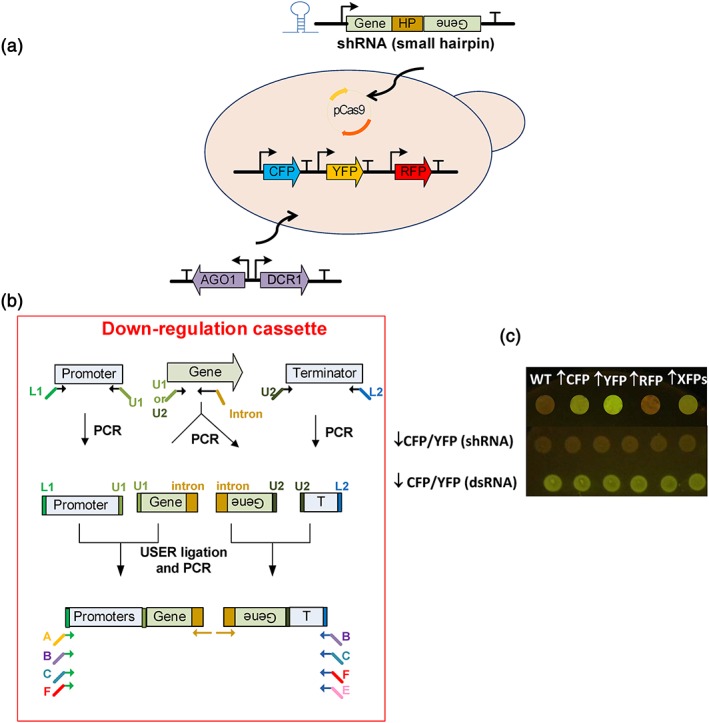
The yeast Saccharomyces cerevisiae is widely used in industrial biotechnology for the production of fuels, chemicals, food ingredients, food and beverages, and pharmaceuticals. To obtain high-performing strains for such bioprocesses, it is often necessary to test tens or even hundreds of metabolic engineering targets, preferably in combinations, to account for synergistic and antagonistic effects. Here, we present a method that allows simultaneous perturbation of multiple selected genetic targets by combining the advantage of CRISPR/Cas9, in vivo recombination, USER assembly and RNA interference. CRISPR/Cas9 introduces a double-strand break in a specific genomic region, where multiexpression constructs combined with the knockdown constructs are simultaneously integrated by homologous recombination. We show the applicability of the method by improving cis,cis-muconic acid production in S. cerevisiae through simultaneous manipulation of several metabolic engineering targets. The method can accelerate metabolic engineering efforts for the construction of future cell factories.
酿酒酵母(Saccharomyces cerevisiae)被广泛应用于工业生物技术,用于生产燃料、化学品、食品成分、食品和饮料以及药品。为了获得此类生物工艺的高性能菌株,通常需要测试数十甚至数百种代谢工程目标,最好是组合测试,以考虑协同和拮抗作用。在这里,我们提出了一种方法,通过结合 CRISPR/Cas9、体内重组、USER 组装和 RNA 干扰的优势,同时对多个选定的遗传靶标进行扰动。CRISPR/Cas9 在特定基因组区域引入双链断裂,其中多表达构建体与敲低构建体同时通过同源重组进行整合。我们通过同时操纵多个代谢工程目标来提高酿酒酵母中顺,顺-粘康酸的产量,展示了该方法的适用性。该方法可以加速代谢工程工作,用于构建未来的细胞工厂。