Tripathi Pushpendra Kumar, Gorain Bapi, Choudhury Hira, Srivastava Ayushi, Kesharwani Prashant
Department of Pharmaceutics, Rameshwaram Institute of Technology and Management, Sitapur Road, Lucknow, Uttar Pradesh, India.
School of Pharmacy, Faculty of Health and Medical Science, Taylor's University, Subang Jaya, 47500, Selengor, Malaysia.
Heliyon. 2019 Mar 20;5(3):e01343. doi: 10.1016/j.heliyon.2019.e01343. eCollection 2019 Mar.
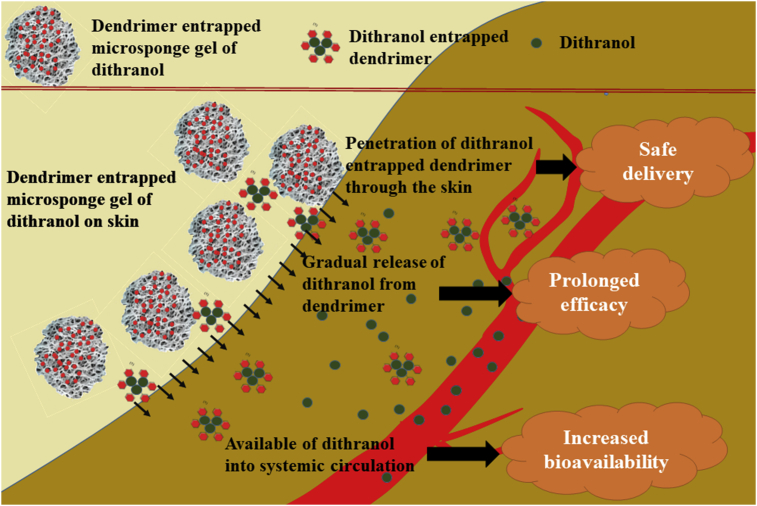
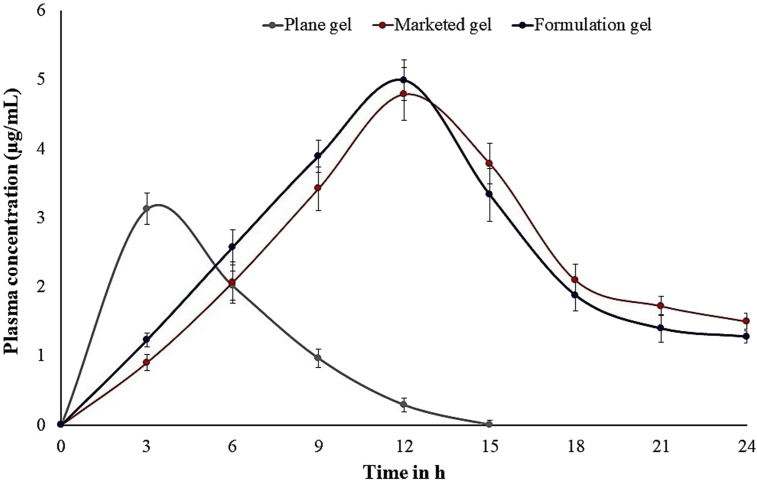
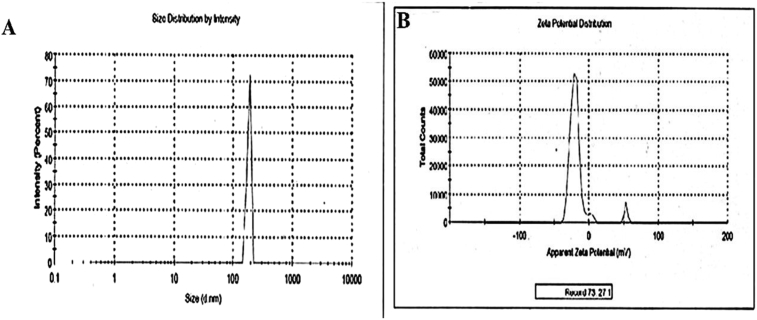
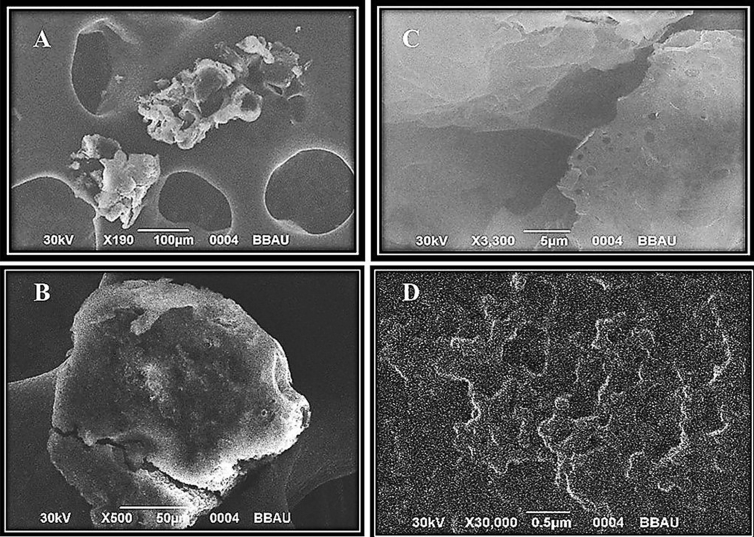
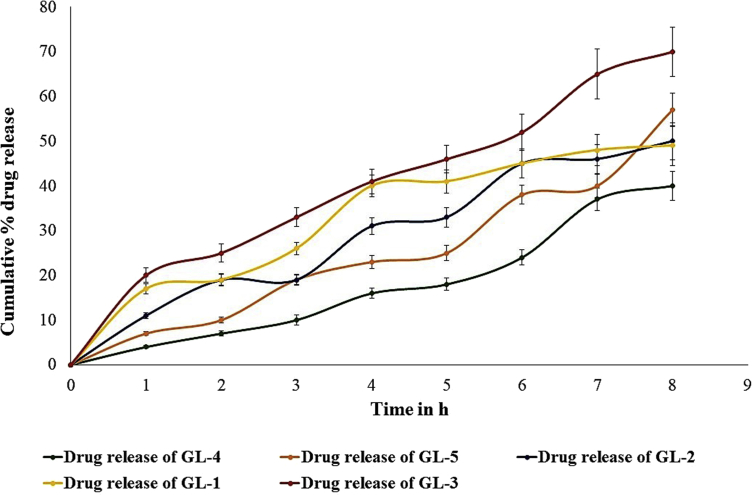
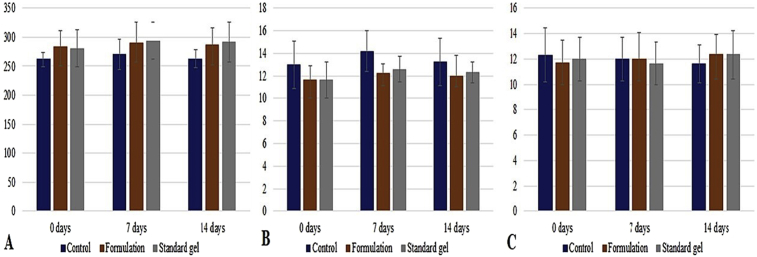
Dithranol is one of the important topical agents for the treatment of psoriasis, a chronic inflammatory skin disease with aberrant differentiation of keratinocytes. However, its application is troublesome and inconvenient because of its associated side effects, including staining, burning sensation, irritation, and necrotizing effect on the diseased cells as well as on the normal cells. The purpose of the current investigation was to explore the potential of poly(amido) amine (PAMAM) dendrimers in the topical delivery of dithranol through a novel microsponge based gel. Generation-4 (G4) dendrimers were incorporated into the microsponge based gel formulation by quasi-emulsion solvent diffusion method with varying concentration of polymers, and evaluated for the morphology of the formulation, encapsulation efficiency and skin irritation potential. Percentage yield of the formulation was found to be 66.28%, whereas encapsulation efficiency was ranged between 71.33% to 49.21%, and an average particle size was ranged between 28 ± 1.12 μm to 130 ± 1.01 μm. Surface morphology of developed microsponge was confirmed by scanning electron microscopy, revealed micro-porous nature. The optimized microsponge formulation was found to be stable and recorded non-irritant during cutaneous application of the experimental animals. Further, the pharmacokinetic outcomes of study were showed prolong penetration of the drug through the skin, equivalent to the marketed formulation of dithranol. Therefore, it could be conferred that the microsponge formulation of the PAMAM entrapped dithranol can produce prolonged efficacy without producing toxicities to the skin, and thus can effectively be projected in the treatment of diseases like psoriasis.
地蒽酚是治疗银屑病的重要外用药物之一,银屑病是一种角质形成细胞分化异常的慢性炎症性皮肤病。然而,由于其相关的副作用,包括染色、烧灼感、刺激以及对病变细胞和正常细胞的坏死作用,其应用麻烦且不便。本研究的目的是通过一种新型的基于微海绵的凝胶来探索聚(酰胺)胺(PAMAM)树枝状大分子在局部递送地蒽酚方面的潜力。通过准乳液溶剂扩散法将第4代(G4)树枝状大分子掺入基于微海绵的凝胶制剂中,聚合物浓度不同,并对制剂的形态、包封效率和皮肤刺激潜力进行评估。发现制剂的百分产率为66.28%,而包封效率在71.33%至49.21%之间,平均粒径在28±1.12μm至130±1.01μm之间。通过扫描电子显微镜确认了所制备微海绵的表面形态,显示出微孔性质。优化后的微海绵制剂在实验动物皮肤应用期间被发现是稳定的且无刺激性。此外,研究的药代动力学结果表明药物通过皮肤的渗透时间延长,与市售的地蒽酚制剂相当。因此,可以认为包载地蒽酚的PAMAM微海绵制剂可以产生延长的疗效而不对皮肤产生毒性,从而可以有效地用于治疗银屑病等疾病。