1 Shanghai Municipality Key Laboratory of Veterinary Biotechnology, School of Agriculture and Biology, Shanghai Jiao Tong University , Shanghai , People's Republic of China.
3 Department of Biochemistry, Zhongshan School of Medicine, Sun Yat-sen University , GuangZhou , People's Republic of China.
Open Biol. 2019 Jan 31;9(1):180238. doi: 10.1098/rsob.180238.
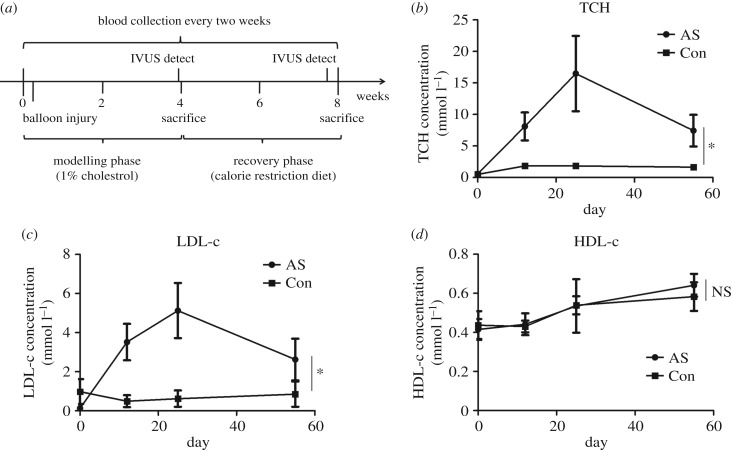
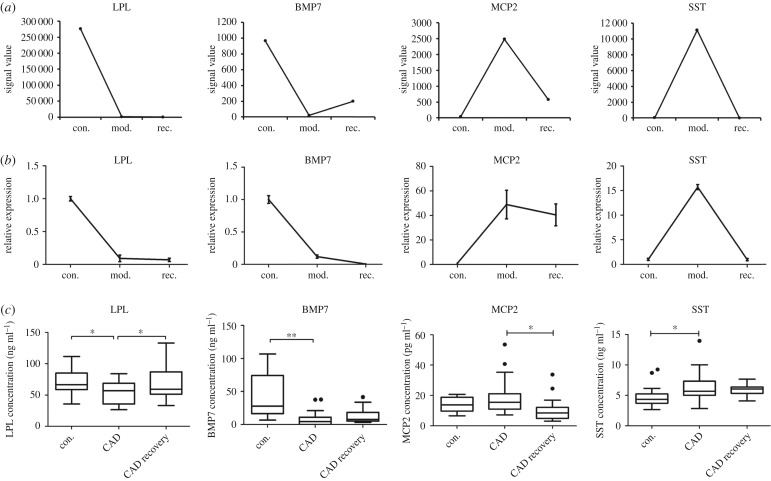
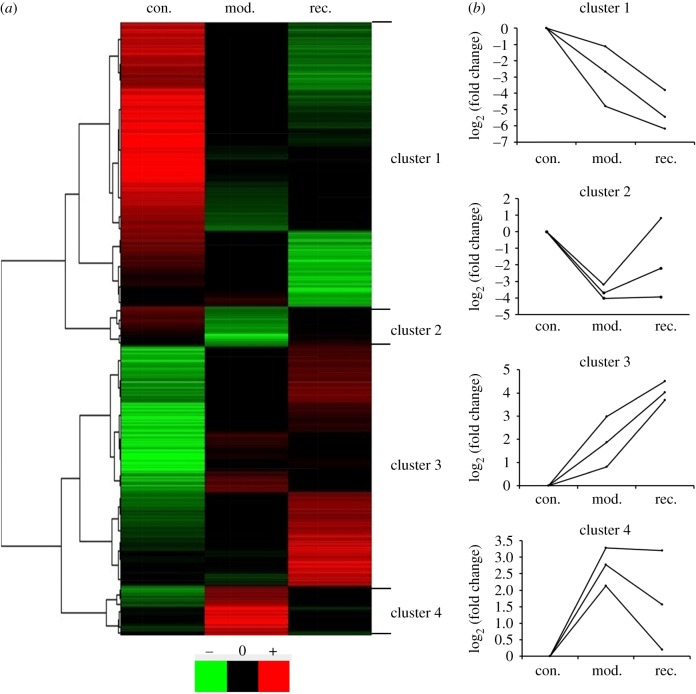
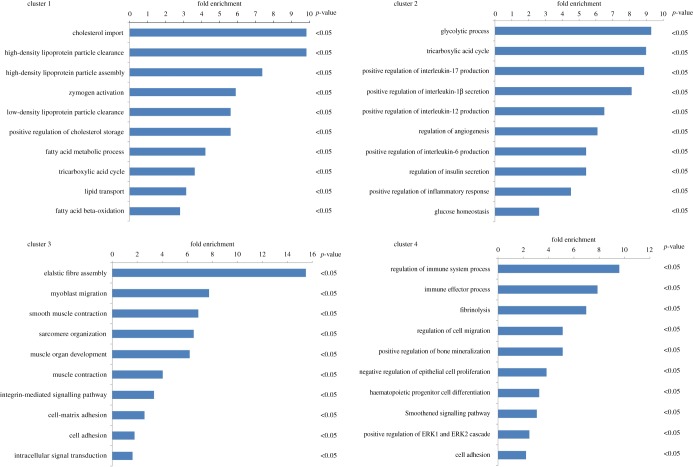
Atherosclerosis is the pathological basis of coronary artery disease (CAD) and causes high mortality. Thus, early detection is thought to be crucial in reducing the risk of CAD. Uncovering the mechanisms of the progression and regression of atherosclerosis will provide insights into discovering novel biomarkers to identify subjects at risk for CAD and improve prevention. We established atherosclerosis progression and regression in a rabbit model. Then, we extracted mRNA of the abdominal aorta from control, model and recovery groups to perform gene chip analysis. Candidate biomarkers were screened by large-scale gene analysis and validated in patients with CAD or with CAD recovery by ELISA. The differentially expressed genes in the progression and regression of atherosclerosis were mainly enriched in four clusters. Genes associated with inflammation and extracellular matrix were returned to normal or close-to-normal levels much earlier than genes associated with metabolism and sarcoplasmic proliferation, and they were maintained downregulated or upregulated after feeding a normal diet. We then selected four candidate biomarkers and found that lipoprotein lipase (LPL), bone morphogenetic protein 7 and somatostatin concentrations could indicate CAD diagnosis. In addition, LPL and macrophage cationic peptide 2 can be indicators of the prognosis of CAD. Molecular changes during the progression and regression of atherosclerosis in rabbits were revealed, and candidate regulators were identified. The identified factors could be used as novel biomarkers and targets for improving the diagnosis and prognosis of human CAD in the future.
动脉粥样硬化是冠心病(CAD)的病理基础,死亡率高。因此,早期发现被认为是降低 CAD 风险的关键。揭示动脉粥样硬化进展和消退的机制将有助于发现识别 CAD 风险人群的新型生物标志物,并改善预防措施。我们在兔模型中建立了动脉粥样硬化的进展和消退。然后,我们从对照组、模型组和恢复组的腹主动脉中提取 mRNA,进行基因芯片分析。通过大规模基因分析筛选候选生物标志物,并通过 ELISA 在 CAD 患者或 CAD 恢复患者中进行验证。动脉粥样硬化进展和消退过程中差异表达的基因主要富集在四个簇中。与代谢和肌浆增殖相关的基因比与炎症和细胞外基质相关的基因更早恢复到正常或接近正常水平,并且在正常饮食喂养后仍保持下调或上调。我们随后选择了四个候选生物标志物,发现脂蛋白脂肪酶(LPL)、骨形态发生蛋白 7 和生长抑素的浓度可以指示 CAD 的诊断。此外,LPL 和巨噬细胞阳离子肽 2 可以作为 CAD 预后的指标。揭示了兔动脉粥样硬化进展和消退过程中的分子变化,并鉴定了候选调节剂。鉴定出的因子可作为新型生物标志物和靶点,用于改善未来人类 CAD 的诊断和预后。