Patil Bheemshetty S, Kanthe Pallavi S, Reddy Chandramouli R, Das Kusal K
Department of Anatomy, Shri B.M. Patil Medical College, Hospital and Research Centre, BLDE (Deemed to be University), Vijayapur-586103, Karnataka, India.
Laboratory of Vascular Physiology and Medicine, Department of Physiology, Shri B. M. Patil Medical College, Hospital and Research Centre, BLDE (Deemed to be University), Vijayapur- 586103, Karnataka, India.
Cardiovasc Hematol Agents Med Chem. 2019;17(1):52-63. doi: 10.2174/1871525717666190409120018.
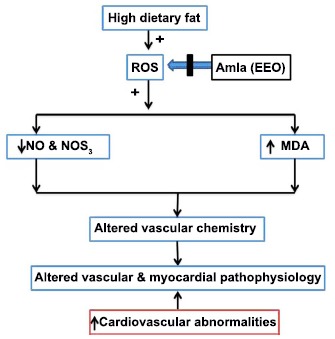
Dietary high fat possibly causes oxidative stress. Also, it alters the pathophysiology of metabolically active myocardial tissues and vascular architecture. contains a potential antioxidant that counteracts oxidative stress and possibly maintains vascular integrity.
To assess the effect of ethanolic extract of Emblica officinalis (EEO) on High Fat Diet (HFD) induced changes in vascular chemistry and histopathology of the cardiovascular system in male albino rats.
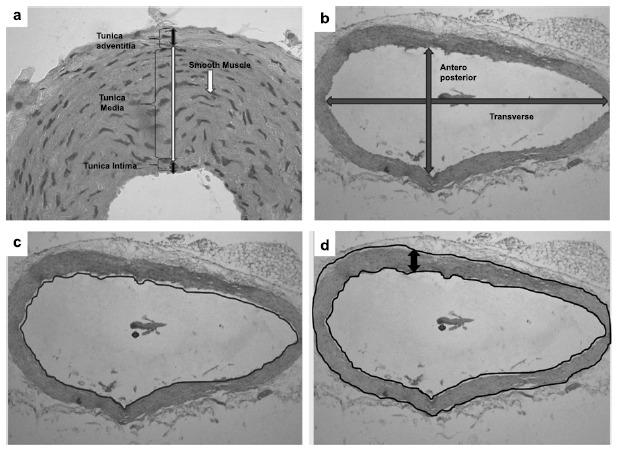
Ethanolic extract of (EEO) was prepared and phytochemical analysis was done. Rats were divided into four groups, having six rats in each group as follows: group 1- Control (20% fat); group 2 (20% fat+ EEO 100 mg/kg/b w); group 3 (30% fat) and group 4 (30% fat + EEO 100 mg/kg/b w). Dietary and EEO supplementation was continued for 21 days. Gravimetric and oxidative stress markers like MDA, NO, antioxidants like Vitamin C and E, and molecular marker (NOS) were evaluated. Histopathological analysis was done on the myocardium and elastic artery along with measurement of coronary arterial wall thickness and lumen diameter. One way ANOVA was done for analysis of data.
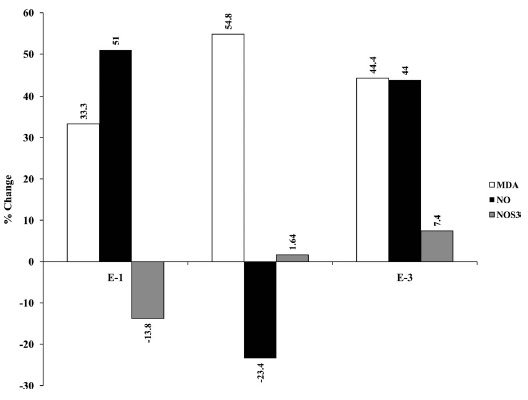
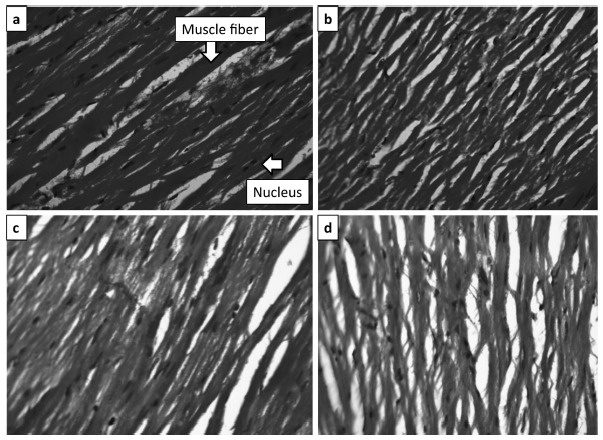
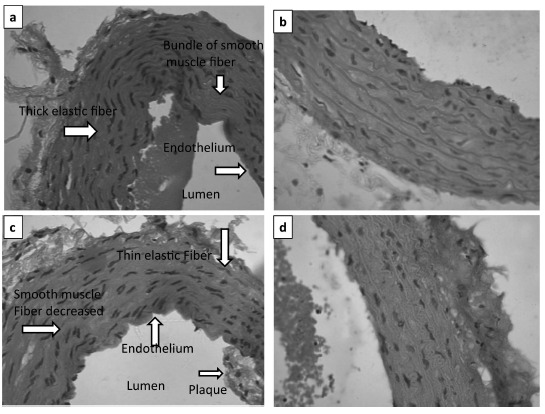
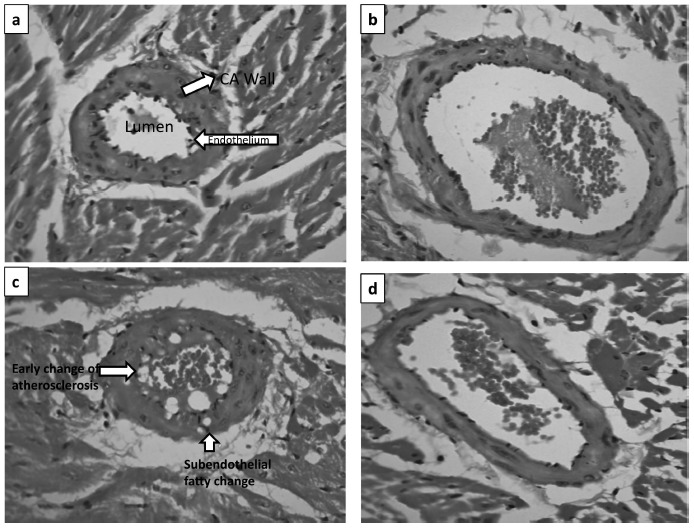
High fat diet showed a significant increase in MDA, decrease of NO with unaltered NOS protein in rats fed with high fat diet, which indicate possible alteration of vascular pathophysiology. Supplementation of EEO showed an ameliorating effect on high fat diet induced oxidative stress. These results were further corroborated with findings of a histopathological study on the myocardium, elastic artery and coronary arterial architecture.
Ethanolic extract of (EEO) indicates its cardioprotective efficacy against rats fed with high fat diet.
饮食中的高脂肪可能会导致氧化应激。此外,它还会改变代谢活跃的心肌组织的病理生理学和血管结构。[某种物质]含有一种潜在的抗氧化剂,可抵消氧化应激并可能维持血管完整性。
评估余甘子乙醇提取物(EEO)对高脂饮食(HFD)诱导的雄性白化大鼠心血管系统血管化学变化和组织病理学变化的影响。
制备余甘子乙醇提取物(EEO)并进行植物化学分析。将大鼠分为四组,每组六只,分组如下:第1组为对照组(20%脂肪);第2组(20%脂肪 + EEO 100毫克/千克/体重);第3组(30%脂肪)和第4组(30%脂肪 + EEO 100毫克/千克/体重)。持续21天给予饮食和EEO补充剂。评估重量法和氧化应激标志物如丙二醛(MDA)、一氧化氮(NO)、抗氧化剂如维生素C和E以及分子标志物(一氧化氮合酶,NOS)。对心肌和弹性动脉进行组织病理学分析,并测量冠状动脉壁厚度和管腔直径。采用单因素方差分析进行数据分析。
高脂饮食组大鼠的丙二醛显著增加,一氧化氮减少,一氧化氮合酶蛋白未改变,这表明血管病理生理学可能发生改变。补充EEO对高脂饮食诱导的氧化应激具有改善作用。心肌、弹性动脉和冠状动脉结构的组织病理学研究结果进一步证实了这些结果。
余甘子乙醇提取物(EEO)表明其对高脂饮食喂养的大鼠具有心脏保护作用。