Grobman M E, Hutcheson K D, Lever T E, Mann F A, Reinero C R
Department of Veterinary Medicine and Surgery, University of Missouri College of Veterinary Medicine, Columbia, Missouri.
Department of Veterinary Medicine and Surgery, University of Missouri Columbia College of Veterinary Medicine Ringgold Standard Institution, Columbia, Missouri.
J Vet Intern Med. 2019 May;33(3):1423-1433. doi: 10.1111/jvim.15476. Epub 2019 Apr 9.
Megaesophagus (ME) carries a poor long-term prognosis in dogs. In people, lower esophageal sphincter (LES) achalasia is a rare cause of ME that may respond to targeted intervention. Dogs with lower esophageal sphincter achalasia-like syndrome (LES-AS) have been described recently, warranting investigation of analogous targeted treatment.
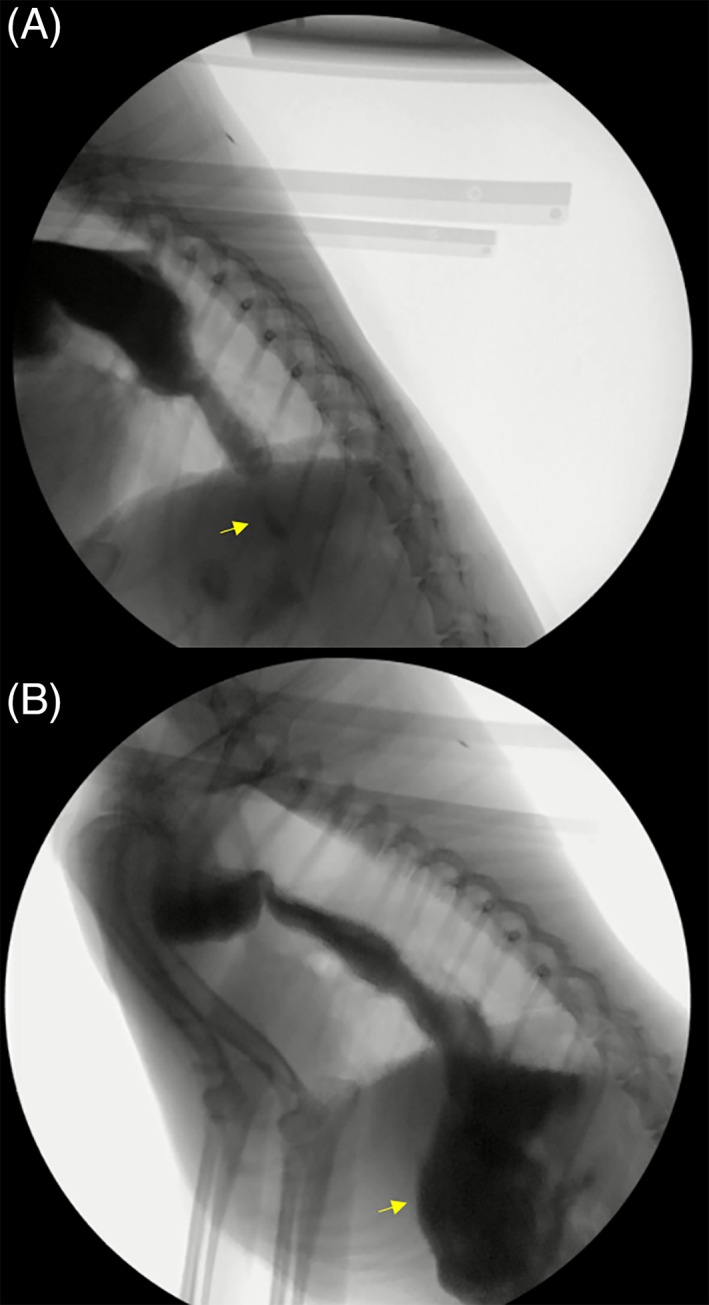
HYPOTHESIS/OBJECTIVES: Evaluate response of dogs with LES-AS to LES mechanical dilation and botulinum toxin A (BTA) injections, with or without surgical myotomy and fundoplication. We hypothesized that clinical and videofluoroscopic swallow study (VFSS) features of LES-AS would improve after treatment targeting functional LES obstruction.
Fourteen client-owned dogs with LES-AS diagnosed by VFSS.
Retrospective study. Dogs diagnosed with LES-AS underwent treatment between April 2015 and December 2017. Outcome measures included client perception of clinical severity, body weight (BW), body condition score (BCS), regurgitation frequency, and VFSS parameters (ME, esophageal motility, gastric filling). Dogs with positive responses were considered candidates for LES myotomy with fundoplication.
By a median IQR of 21 (IQR, 14-25) days after mechanical dilation and BTA, clients reported clinical improvement in 100% of dogs, BW increased 20.4% (IQR, 12.7%-25%), pre- and post-treatment BCS was 3 (IQR, 3-4) and 5 (IQR, 4-5), respectively, and frequency of regurgitation decreased by 80% (IQR, 50%-85%). Duration of effect was 40 (IQR, 17-53) days. Despite clinical improvement, ME and abnormal esophageal motility persisted in 14 dogs. Six dogs subsequently underwent myotomy and fundoplication and maintained improvement observed after mechanical dilation and BTA.
Dogs with LES-AS experienced significant, temporary, clinical improvement after mechanical dilation and BTA. Preliminary results suggest myotomy with fundoplication provide lasting clinical benefit despite persistence of ME.
巨食管症(ME)在犬类中的长期预后较差。在人类中,食管下括约肌(LES)失弛缓症是ME的一种罕见病因,可能对靶向干预有反应。最近已描述了患有食管下括约肌失弛缓症样综合征(LES-AS)的犬类,因此有必要对类似的靶向治疗进行研究。
假设/目标:评估患有LES-AS的犬类对LES机械扩张和注射肉毒杆菌毒素A(BTA)的反应,无论是否进行手术肌切开术和胃底折叠术。我们假设,针对功能性LES梗阻进行治疗后,LES-AS的临床和视频荧光吞咽造影研究(VFSS)特征会得到改善。
14只通过VFSS诊断为LES-AS的客户拥有的犬类。
回顾性研究。2015年4月至2017年12月期间,对诊断为LES-AS的犬类进行治疗。结果指标包括客户对临床严重程度的感知、体重(BW)、身体状况评分(BCS)、反流频率以及VFSS参数(ME、食管动力、胃充盈)。反应阳性的犬类被视为LES肌切开术加胃底折叠术的候选对象。
在机械扩张和注射BTA后的中位IQR为21(IQR,14 - 25)天,所有犬类的客户均报告临床症状改善,BW增加20.4%(IQR,12.7% - 25%),治疗前和治疗后的BCS分别为3(IQR,3 - 4)和5(IQR,4 - 5),反流频率降低80%(IQR,50% - 85%)。效果持续时间为40(IQR,17 - 53)天。尽管临床症状有所改善,但14只犬仍存在ME和异常食管动力。随后,6只犬接受了肌切开术和胃底折叠术,并维持了机械扩张和注射BTA后观察到的改善。
患有LES-AS的犬类在机械扩张和注射BTA后经历了显著的、暂时的临床改善。初步结果表明,尽管存在ME,肌切开术加胃底折叠术仍能提供持久的临床益处。