Costa Sebastiano, Kuss Daria J
Dipartimento di Psicologia, Università degli Studi della Campania Luigi Vanvitelli, Caserta, Italy.
Department of Psychology, Nottingham Trent University, Nottingham, United Kingdom.
Front Psychol. 2019 Mar 27;10:578. doi: 10.3389/fpsyg.2019.00578. eCollection 2019.
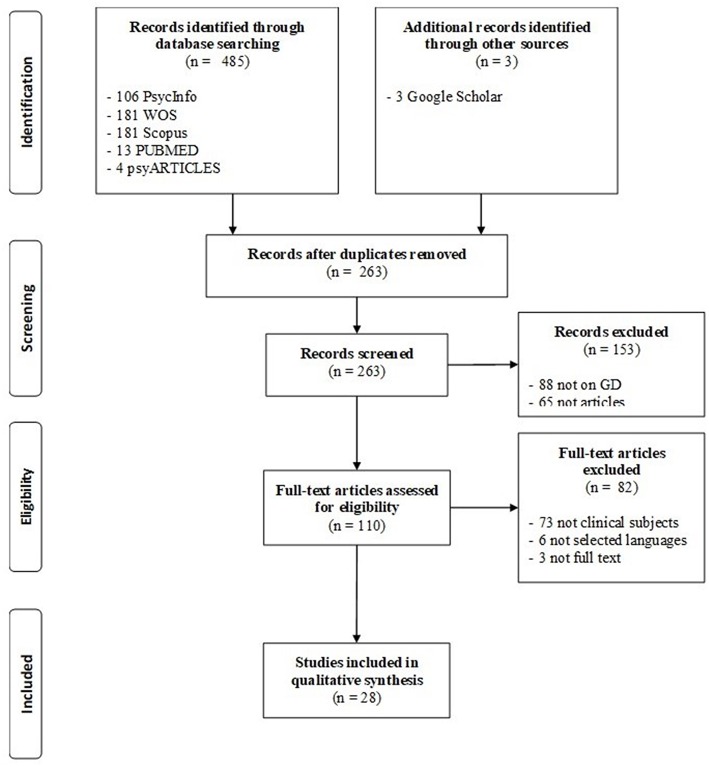
Despite the growth in the number of studies on Gaming Disorders (GD), assessing the characteristics of clinical subjects is still limited. Driven by the need to overcome this limitation, a broad systematic review is essential to cover the studies that have already assessed the clinical characteristics of individuals diagnosed with GD. The aim of this systematic review is to provide a broad cross-cultural picture of the current diagnostic procedures and interventions used for GDs in clinical practice. A total of 28 studies met the inclusion criteria, and data were synthesized in these categories: (1) the cultural background of the country where the research took place; (2) the instruments used to measure GD; (3) the diagnostic criteria for GD; (4) the diagnostic procedures used; and (5) the treatment protocol applied. Results of this systematic review suggest that in GD clinical practice, there is a great deal of heterogeneity in the choice of instruments, the diagnostic and intervention processes for GD. This systematic review indicates that a validation process of standard procedures in clinical populations with GD is necessary to create clear shared guidelines for practitioners.
尽管关于游戏障碍(GD)的研究数量有所增加,但对临床受试者特征的评估仍然有限。出于克服这一局限性的需要,进行广泛的系统评价对于涵盖已评估被诊断为GD的个体临床特征的研究至关重要。本系统评价的目的是全面呈现临床实践中用于GD的当前诊断程序和干预措施的跨文化情况。共有28项研究符合纳入标准,并在以下类别中进行了数据综合:(1)开展研究的国家的文化背景;(2)用于测量GD的工具;(3)GD的诊断标准;(4)使用的诊断程序;以及(5)应用的治疗方案。本系统评价的结果表明,在GD临床实践中,在工具选择、GD的诊断和干预过程方面存在很大异质性。本系统评价表明,有必要对患有GD的临床人群的标准程序进行验证,以便为从业者制定明确的共享指南。